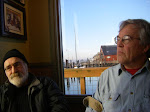
I just mailed Frog Hospital, No. 190, titled "Making Corrections. I am sitting in a coffee shop in San Antonio called Mad Hatters, in the artsy area called Southtown, lots of gay people here.
Things are getting better for me. I have the cowboys to write about, then I do garden work in the Courthouse Square. It's a volunteer project, but I keep track of my hours. Evenings I have my press pass to the minor league baseball game -- the San Antonio Missions in the Texas League -- it's totally cool.
Or, I can go to Southtown -- no cowboys here. Or maybe the gay cowboys come here, but I haven't seen them.
Anyway, I got choices. Except for the weather. It's hot. It will be hot until October. I have been adjusting to the heat, but I see the natives walking around like they don't even notice it -- I am a long way from that. I wonder if they sweat as much as I do. Maybe if you ignore it, it will go away -- the heat, I mean.
Monday, May 29, 2006


Saturday, May 27, 2006
"God Must Hate Me," Oil Can Boyd
Pete Rose & Capital Punishment
This is not a serious baseball story.
It’s not about Pete Rose, and
it’s not about capital punishment.
although for the first few paragraphs
it might seem so.
BOSTON, MASS., 1992. I always hated Pete Rose, right from the beginning back in the early seventies. I used to watch the World Series, and when they showed him on third base I would start screaming and gnashing my teeth. He didn’t care a damn about anybody except to play his game and win. Baseball isn’t supposed to be like that. Football is for hard-ass people -- but baseball players should have enough sense to get in out of the rain. Not Pete Rose, he would have played with Vince Lombardi in Green Bay when it was twenty below zero. I always hated him.
So when he got caught for gambling I wasn’t surprised -- he’s a very compulsive man. Something serious had to be done about it -- he has banned from baseball for life. That didn’t make me feel any better because I still can’t stand him. Maybe they wanted to make an example out of him, but Pete Rose is truly one of a kind, or maybe two of a kind if you count Ty Cobb.
Banned for life -- and if baseball is your life than this amounts to a death sentence, which means the man has absolutely no incentive to change his behavior. What could he get out of it if he changed? He would still be a non-person.
Following this line of thought a little further, we can begin to understand why the Red Sox have waited so long to win the World Series. The curse of the Bambino -- you know about that -- it’s because they traded Babe Ruth to the Yankees in 1921. The curse is real, but Babe didn’t put it on the Red Sox, if you think about it. Why would a pleasure-loving man like the Babe put a curse on somebody? The curse was self-imposed. The morbid Calvinistic temperament in New England fosters a belief in punishment. First they did something awful and stupid when they sold the greatest player the game ever had. Then, to compound the injury, the cursed themselves -- the Red Sox would forever come close, but never win the big one. Eternal Damnation. Cotton Mather would have approved.
Of course I’m new around here. For the past twenty years I’ve been out on the West Coast where people have no sense of history -- they can hardly remember what happened yesterday. And the idea of a missing out on a good time because of some unfortunate mistake is considered absurd.
This curse thing is definitely East Coast, and I’m wondering if it will ever end? It would help if the baseball rulers would cut Pete Rose some slack be reinstating him in baseball on condition that he mend his ways -- that would motivate him. “Banned for life” to Pete Rose and “cursed forever” to the Red Sox -- they go together. I know this sounds kind of pie in the sky. I’m not suggesting anything really fantastic like the Red Sox should start running and stealing bases or build a bigger stadium out in the suburbs -- just some straightforward new age thinking. The team that cursed themselves can let go of that burden. Forgiveness begins at home, it is a sublime human attribute.
Attitudes change, although in New England you always need a crowbar and jackhammer to get anything to move, because people here are so set in their ways. The Red Sox can win the World Series if they want to -- if they only let go and start to have fun. Next Year.
I really think this is true, and that my reasoning is as sound as anybody’s, but let me tell you about the game we saw.
It was July 30, an overcast day and so not too hot, when this gang of underemployed lawyers, real estate developers and civil servants came up from New York on the shuttle to watch the Red Sox play the Texas Rangers. They were out for a good time. Some of the guys made phone calls between innings but that was just for effect and out of habit --
“Anything going on at the office?”
“No, nothing going on here.”
“Fine, well, I’ll get back to you later.”
I know Jim Gardella really well. Jim and his cadre of cronies got ousted in a political coup last year when Mayor Dinkins took over the city government. He still occupies his office at Brooklyn City Hall, be he fills his melancholy days doing crossword puzzles and waiting for the phone to ring. It never does. He eats lunch in empty restaurants. “Where did everybody go?” he says to the maitre’d, who smiles back at him politely.
But at least he has time for baseball. Jim told me that the group was coming up to Boston for the game, and he mailed me a ticket so I could meet him at the Park. We had seats in the centerfield bleachers. It was an afternoon game on a Tuesday, and the house was packed --children, idlers, the unemployed, and the usual riffraff.
The Red Sox were a disaster in July, they were in fourth place, nine games behind Toronto. I was very pessimistic.
I hated Jack Clark. He had 89 strikeouts so far this year. The pitcher threw the ball -- I looked, Jack Clark looked -- only I couldn’t swing because I didn’t have a bat. But I thought, reasonably enough, that since Jack Clark did have a bat, his job required more than mere observation. The bum! I wanted to take his gold chain and choke him.
I sat next to Jim at the game and he introduced me to his friends. Shelley, the lawyer, had arranged to buy the tickets, so everybody was giving him a hard time about being in the bleachers. They said, “Next year let’s make it a rule that we get seats in the same city that they’re playing the game in.”
But the women in the group liked the bleacher seats because it gave them a view of nine sets of powerful athletic buns. On a serious note, the bleacher seat are good because it’s like being on the field, being a part of the defense. It gives a wide view of the whole field, not the details, but the sweep of the play. And it gives the pleasure of being a common man, no better or worse than his fellows. Privilege is exhilarating, but the humbler seats can be more relaxing.
Ed Burke came in during the third inning. He said the seats were lousy but so were the Red Sox and they weren’t worth more than $6 to see anyway. Ed’s a funny guy -- he was wearing a white cap, and he had a gum massager sticking out of his shirt pocket. Ed’s a State Senator; he’s been representing Framingham for twenty years. Then he did his political thing, updating his file by asking Jim and me about our families, children, schools, wives, etc. He left a few innings later. Jim asked me how come Ed doesn’t have any clout? How come he couldn’t get us better seats?
The Red Sox won the game 11 to 6. They sent 14 batters to the plate in the third inning and scored 10 runs. Six of those runs were from the hot bat of Carlos Quintana, my favorite player. He got a grand slam for four runs, and a double for two. That’s my man. Carlos is a different kind of guy than Jack Clark. The proper psychology with a guy like Clark is to heap abuse on him when he’s playing badly. He likes the attention and it gets him mad. Eventually he will take out his aggression on the ball and hit it over the fence, which happened the very next day.
But the “Q” is a gentler soul, a man who responds better to approval and kindness. He had been playing badly because he had been treated badly by Joe Morgan, the Red Sox manager. Carlos’ feelings were hurt. He had been playing first base well and hitting over .300 when Mo Vaughan got called up from Pawtucket. Mo was the new hero that everybody was excited about. They made T-shirts about him, they splashed him all over the sports page. He was black and would be a credit to his race in Boston. (They hadn’t advanced much further than this in the Old Towne.)
Morgan put Vaughan on first base and sent Quintana to right field. Quintana immediately went into a hitting slump and made careless errors in the field. It was Morgan’s mistake, not mine. My policy of abuse towards Clark and affection towards Quintana would pay off in the following two games, as the Red Sox came out of their torpor and began to play like a team.
The next day the Red Sox faced the Athletics and did what they hadn’t been able to do for six weeks -- come from behind and win. I’ll quote Nick Cafardo, a sportswriter for the Boston Globe.
“Maligned as a free-agent bust throughout his tempestuous first season in Boston, Jack Clark gave Red Sox fans a glimpse of why the teams acquired him. Actually three glimpses.
“Three monumental glimpses.
“Clark drove in six runs as he cracked three homers, including a net shot off Steve Chitren in the bottom of the 14th inning that lifted the Red Sox to a palpitating 11-10 victory over the Oakland A’s...”
It was a wonderful game, the lead kept changing hands. It was a slugger’s feast, vintage Red Sox style. I watched it on TV.
Before, when they had been playing badly, it wasn’t just that they were losing, but that they would give up in the third inning and lose two to nothing.
So the team turned it around and gave us a season. They are still “in it”, and today, Labor Day, the Red Sox are five games in back of the Blue Jays. I feel satisfied.
“God Must Hate Me”
Before leaving the game and joining the New York gang for dinner, we need to talk about Oil Can Boyd. He was pitching for the Rangers. You know a lot of these guys up from New York are Mets fans -- may they all burn in hell, may their toast get soggy every morning. Mets fans are the worst people in the world. You remember 1986 as well as I do, when Oil Can was pitching for the Red Sox and they lost the Series to the Mets. You remember where you were that day like you remember Kennedy’s assassination.
The Can is one of the games truly existential players, a man with a mind as well as a heart, a human being of tragic proportions. He’s the “Natural”, the one they wrote the book about.
Michael Madden, another Globe reporter, wrote about Boyd’s loss to the Sox on the day we were there in the bleachers:
Other men might have lied and said it was just another day. Just another game. Other men might have tried to put the best face, the phony face, on a bad situation gone worse. But not the Can, because the Can knows how to speak only from his heart:
“For me to be traded to the Rangers, and for me to pitch my first two games against the Boston Red Sox means that God must hate me.
“It’s the worst game I ever pitched in my life. And for a lot of reasons. First of all, I never wanted to pitch in Fenway Park again.....I’ve never walked the bases full before, and I’ve never given up a grand slam homer, and it all happened in one day, shit, it all happened in one inning. I just look at it and say it was meant to be.
“I don’t have anything to cherish about Boston. You talk about the ‘86 World Series, but I don’t care about any of that. That year a lot of things happened to me that probably will go to the grave with me, and still don’t let me get no peace of mind. So I don’t have anything to feel good about at all and especially today. Today just poured gas on it. Just made the flame bigger.”
We stayed until the end of the game because it was nice in the Park. Many of the New Yorkers had never seen Fenway Park before. It was a treat for them, and they could even make charitable comments about it.
We piled into three taxis and headed for Anthony’s Pier Four Restaurant. There was a lot of hoo-hooing in our car about going to Anthony’s. Shelley said, “They fill that place with old ladies on tour buses, why don’t we go to a real restaurant?” Shelley lived in Boston once, on Beacon Street -- he showed us the apartment when we drove by. He made some cryptic remarks about Boston being a cold town, a mean town. He didn’t say what kind of trouble he had, but I bet it was some kind of bad luck with a woman.
Anthony Athanas owns Pier Four and the surrounding 36 acres of very valuable waterfront property. He’s Albanian. He’s an old man and very well connected. He had just sold the property surrounding the restaurant to the federal government for a fabulous profit. The feds will build a courthouse on the land. The guys in our group would have killed to get in on this deal, but they don’t really know anybody. I could tell that, because they were with me. It’s like Grouch Marx’s rule about clubs, the ones he wouldn’t join if they were willing to accept him as a member. Power brokers don’t have dinner with me unless they’re on the skids.
Still we were a merry crew. They gave us a table for twelve outside on the deck, and we made a lot of noise. Now I was bluffing just like the rest of these guys do on a real estate deal. I had twenty dollars in my pocket and an overdrawn checking account. Naturally I flourished a ten spot and paid for the cab ride when we got there. That didn’t leave me with money for dinner, but I was hoping for the Greater Fool -- that one of these guys was so desperate to put on a show and he would pick up the tab -- and I could get off with pretending I wanted to pay.
I hedged my bets -- I ordered way down the menu, choosing the striped bass special for $9.95. Jim Gardella ordered it too, mainly because he’s a cheapskate. The others guys were going for the gold -- three pound lobsters, steamer clams for appetizers, nice wine from the list and Grand Marnier after dinner. The wine was good. Jim -- the other Jim, the one who looks like the Great Gatsby -- ordered the wine. He wore his blazer and tie all through the meal and never unbuttoned his collar. Then he had this sophisticated conversation with the wine steward, and, for God’s sakes, the rest of the table took him seriously. They say New Yorkers are street smart, but they fell for this game.
Jim -- the real Jim -- was making a complete fool of himself over Amy, the 30-year-old beauty who was making her first trip with this group. He kept hitting on her and wanted to sit next to her at dinner. She asked me if I would please sit between Jim and her, which I did. Jim was being no worse than usual. You have to remember that his friends go with him to out of town ball games because they know they won’t be seen.
The bill came to $600 including tip, to be divided up 12 ways. I guess my bluff didn’t work because nobody wanted to make a $600 impression and pick up the tab. I was forced to ask Jim for a loan of fifty to pay my share, and I wrote him a hot check to cover it.
Boy, it was a lot of fun. Now the sun was going down, and some of us walked to the railing and looked at the water and the boats going by. Jim and I talked quietly for a little bit. Jim’s a good guy, and I really like him. These New Yorkers have a sense of humor and style. Boston is a good town, but it can get a little too serious here without some outside help.
This is not a serious baseball story.
It’s not about Pete Rose, and
it’s not about capital punishment.
although for the first few paragraphs
it might seem so.
BOSTON, MASS., 1992. I always hated Pete Rose, right from the beginning back in the early seventies. I used to watch the World Series, and when they showed him on third base I would start screaming and gnashing my teeth. He didn’t care a damn about anybody except to play his game and win. Baseball isn’t supposed to be like that. Football is for hard-ass people -- but baseball players should have enough sense to get in out of the rain. Not Pete Rose, he would have played with Vince Lombardi in Green Bay when it was twenty below zero. I always hated him.
So when he got caught for gambling I wasn’t surprised -- he’s a very compulsive man. Something serious had to be done about it -- he has banned from baseball for life. That didn’t make me feel any better because I still can’t stand him. Maybe they wanted to make an example out of him, but Pete Rose is truly one of a kind, or maybe two of a kind if you count Ty Cobb.
Banned for life -- and if baseball is your life than this amounts to a death sentence, which means the man has absolutely no incentive to change his behavior. What could he get out of it if he changed? He would still be a non-person.
Following this line of thought a little further, we can begin to understand why the Red Sox have waited so long to win the World Series. The curse of the Bambino -- you know about that -- it’s because they traded Babe Ruth to the Yankees in 1921. The curse is real, but Babe didn’t put it on the Red Sox, if you think about it. Why would a pleasure-loving man like the Babe put a curse on somebody? The curse was self-imposed. The morbid Calvinistic temperament in New England fosters a belief in punishment. First they did something awful and stupid when they sold the greatest player the game ever had. Then, to compound the injury, the cursed themselves -- the Red Sox would forever come close, but never win the big one. Eternal Damnation. Cotton Mather would have approved.
Of course I’m new around here. For the past twenty years I’ve been out on the West Coast where people have no sense of history -- they can hardly remember what happened yesterday. And the idea of a missing out on a good time because of some unfortunate mistake is considered absurd.
This curse thing is definitely East Coast, and I’m wondering if it will ever end? It would help if the baseball rulers would cut Pete Rose some slack be reinstating him in baseball on condition that he mend his ways -- that would motivate him. “Banned for life” to Pete Rose and “cursed forever” to the Red Sox -- they go together. I know this sounds kind of pie in the sky. I’m not suggesting anything really fantastic like the Red Sox should start running and stealing bases or build a bigger stadium out in the suburbs -- just some straightforward new age thinking. The team that cursed themselves can let go of that burden. Forgiveness begins at home, it is a sublime human attribute.
Attitudes change, although in New England you always need a crowbar and jackhammer to get anything to move, because people here are so set in their ways. The Red Sox can win the World Series if they want to -- if they only let go and start to have fun. Next Year.
I really think this is true, and that my reasoning is as sound as anybody’s, but let me tell you about the game we saw.
It was July 30, an overcast day and so not too hot, when this gang of underemployed lawyers, real estate developers and civil servants came up from New York on the shuttle to watch the Red Sox play the Texas Rangers. They were out for a good time. Some of the guys made phone calls between innings but that was just for effect and out of habit --
“Anything going on at the office?”
“No, nothing going on here.”
“Fine, well, I’ll get back to you later.”
I know Jim Gardella really well. Jim and his cadre of cronies got ousted in a political coup last year when Mayor Dinkins took over the city government. He still occupies his office at Brooklyn City Hall, be he fills his melancholy days doing crossword puzzles and waiting for the phone to ring. It never does. He eats lunch in empty restaurants. “Where did everybody go?” he says to the maitre’d, who smiles back at him politely.
But at least he has time for baseball. Jim told me that the group was coming up to Boston for the game, and he mailed me a ticket so I could meet him at the Park. We had seats in the centerfield bleachers. It was an afternoon game on a Tuesday, and the house was packed --children, idlers, the unemployed, and the usual riffraff.
The Red Sox were a disaster in July, they were in fourth place, nine games behind Toronto. I was very pessimistic.
I hated Jack Clark. He had 89 strikeouts so far this year. The pitcher threw the ball -- I looked, Jack Clark looked -- only I couldn’t swing because I didn’t have a bat. But I thought, reasonably enough, that since Jack Clark did have a bat, his job required more than mere observation. The bum! I wanted to take his gold chain and choke him.
I sat next to Jim at the game and he introduced me to his friends. Shelley, the lawyer, had arranged to buy the tickets, so everybody was giving him a hard time about being in the bleachers. They said, “Next year let’s make it a rule that we get seats in the same city that they’re playing the game in.”
But the women in the group liked the bleacher seats because it gave them a view of nine sets of powerful athletic buns. On a serious note, the bleacher seat are good because it’s like being on the field, being a part of the defense. It gives a wide view of the whole field, not the details, but the sweep of the play. And it gives the pleasure of being a common man, no better or worse than his fellows. Privilege is exhilarating, but the humbler seats can be more relaxing.
Ed Burke came in during the third inning. He said the seats were lousy but so were the Red Sox and they weren’t worth more than $6 to see anyway. Ed’s a funny guy -- he was wearing a white cap, and he had a gum massager sticking out of his shirt pocket. Ed’s a State Senator; he’s been representing Framingham for twenty years. Then he did his political thing, updating his file by asking Jim and me about our families, children, schools, wives, etc. He left a few innings later. Jim asked me how come Ed doesn’t have any clout? How come he couldn’t get us better seats?
The Red Sox won the game 11 to 6. They sent 14 batters to the plate in the third inning and scored 10 runs. Six of those runs were from the hot bat of Carlos Quintana, my favorite player. He got a grand slam for four runs, and a double for two. That’s my man. Carlos is a different kind of guy than Jack Clark. The proper psychology with a guy like Clark is to heap abuse on him when he’s playing badly. He likes the attention and it gets him mad. Eventually he will take out his aggression on the ball and hit it over the fence, which happened the very next day.
But the “Q” is a gentler soul, a man who responds better to approval and kindness. He had been playing badly because he had been treated badly by Joe Morgan, the Red Sox manager. Carlos’ feelings were hurt. He had been playing first base well and hitting over .300 when Mo Vaughan got called up from Pawtucket. Mo was the new hero that everybody was excited about. They made T-shirts about him, they splashed him all over the sports page. He was black and would be a credit to his race in Boston. (They hadn’t advanced much further than this in the Old Towne.)
Morgan put Vaughan on first base and sent Quintana to right field. Quintana immediately went into a hitting slump and made careless errors in the field. It was Morgan’s mistake, not mine. My policy of abuse towards Clark and affection towards Quintana would pay off in the following two games, as the Red Sox came out of their torpor and began to play like a team.
The next day the Red Sox faced the Athletics and did what they hadn’t been able to do for six weeks -- come from behind and win. I’ll quote Nick Cafardo, a sportswriter for the Boston Globe.
“Maligned as a free-agent bust throughout his tempestuous first season in Boston, Jack Clark gave Red Sox fans a glimpse of why the teams acquired him. Actually three glimpses.
“Three monumental glimpses.
“Clark drove in six runs as he cracked three homers, including a net shot off Steve Chitren in the bottom of the 14th inning that lifted the Red Sox to a palpitating 11-10 victory over the Oakland A’s...”
It was a wonderful game, the lead kept changing hands. It was a slugger’s feast, vintage Red Sox style. I watched it on TV.
Before, when they had been playing badly, it wasn’t just that they were losing, but that they would give up in the third inning and lose two to nothing.
So the team turned it around and gave us a season. They are still “in it”, and today, Labor Day, the Red Sox are five games in back of the Blue Jays. I feel satisfied.
“God Must Hate Me”
Before leaving the game and joining the New York gang for dinner, we need to talk about Oil Can Boyd. He was pitching for the Rangers. You know a lot of these guys up from New York are Mets fans -- may they all burn in hell, may their toast get soggy every morning. Mets fans are the worst people in the world. You remember 1986 as well as I do, when Oil Can was pitching for the Red Sox and they lost the Series to the Mets. You remember where you were that day like you remember Kennedy’s assassination.
The Can is one of the games truly existential players, a man with a mind as well as a heart, a human being of tragic proportions. He’s the “Natural”, the one they wrote the book about.
Michael Madden, another Globe reporter, wrote about Boyd’s loss to the Sox on the day we were there in the bleachers:
Other men might have lied and said it was just another day. Just another game. Other men might have tried to put the best face, the phony face, on a bad situation gone worse. But not the Can, because the Can knows how to speak only from his heart:
“For me to be traded to the Rangers, and for me to pitch my first two games against the Boston Red Sox means that God must hate me.
“It’s the worst game I ever pitched in my life. And for a lot of reasons. First of all, I never wanted to pitch in Fenway Park again.....I’ve never walked the bases full before, and I’ve never given up a grand slam homer, and it all happened in one day, shit, it all happened in one inning. I just look at it and say it was meant to be.
“I don’t have anything to cherish about Boston. You talk about the ‘86 World Series, but I don’t care about any of that. That year a lot of things happened to me that probably will go to the grave with me, and still don’t let me get no peace of mind. So I don’t have anything to feel good about at all and especially today. Today just poured gas on it. Just made the flame bigger.”
We stayed until the end of the game because it was nice in the Park. Many of the New Yorkers had never seen Fenway Park before. It was a treat for them, and they could even make charitable comments about it.
We piled into three taxis and headed for Anthony’s Pier Four Restaurant. There was a lot of hoo-hooing in our car about going to Anthony’s. Shelley said, “They fill that place with old ladies on tour buses, why don’t we go to a real restaurant?” Shelley lived in Boston once, on Beacon Street -- he showed us the apartment when we drove by. He made some cryptic remarks about Boston being a cold town, a mean town. He didn’t say what kind of trouble he had, but I bet it was some kind of bad luck with a woman.
Anthony Athanas owns Pier Four and the surrounding 36 acres of very valuable waterfront property. He’s Albanian. He’s an old man and very well connected. He had just sold the property surrounding the restaurant to the federal government for a fabulous profit. The feds will build a courthouse on the land. The guys in our group would have killed to get in on this deal, but they don’t really know anybody. I could tell that, because they were with me. It’s like Grouch Marx’s rule about clubs, the ones he wouldn’t join if they were willing to accept him as a member. Power brokers don’t have dinner with me unless they’re on the skids.
Still we were a merry crew. They gave us a table for twelve outside on the deck, and we made a lot of noise. Now I was bluffing just like the rest of these guys do on a real estate deal. I had twenty dollars in my pocket and an overdrawn checking account. Naturally I flourished a ten spot and paid for the cab ride when we got there. That didn’t leave me with money for dinner, but I was hoping for the Greater Fool -- that one of these guys was so desperate to put on a show and he would pick up the tab -- and I could get off with pretending I wanted to pay.
I hedged my bets -- I ordered way down the menu, choosing the striped bass special for $9.95. Jim Gardella ordered it too, mainly because he’s a cheapskate. The others guys were going for the gold -- three pound lobsters, steamer clams for appetizers, nice wine from the list and Grand Marnier after dinner. The wine was good. Jim -- the other Jim, the one who looks like the Great Gatsby -- ordered the wine. He wore his blazer and tie all through the meal and never unbuttoned his collar. Then he had this sophisticated conversation with the wine steward, and, for God’s sakes, the rest of the table took him seriously. They say New Yorkers are street smart, but they fell for this game.
Jim -- the real Jim -- was making a complete fool of himself over Amy, the 30-year-old beauty who was making her first trip with this group. He kept hitting on her and wanted to sit next to her at dinner. She asked me if I would please sit between Jim and her, which I did. Jim was being no worse than usual. You have to remember that his friends go with him to out of town ball games because they know they won’t be seen.
The bill came to $600 including tip, to be divided up 12 ways. I guess my bluff didn’t work because nobody wanted to make a $600 impression and pick up the tab. I was forced to ask Jim for a loan of fifty to pay my share, and I wrote him a hot check to cover it.
Boy, it was a lot of fun. Now the sun was going down, and some of us walked to the railing and looked at the water and the boats going by. Jim and I talked quietly for a little bit. Jim’s a good guy, and I really like him. These New Yorkers have a sense of humor and style. Boston is a good town, but it can get a little too serious here without some outside help.
Limited Access
I have a ton of things to write about -- but my Internet access has been limited lately and I have not been able to post. Please be patient. I will get back here as soon as I can.
Saturday, May 06, 2006
Beer
I got off the couch and drove down to the Longbranch for a beer. The Longbranch is safe on Saturday night -- nobody goes there. It was quiet there, but not quiet enough. I got a Budweiser for $2.50. It tasted really good. I drank it quickly and came back here. I took a warm bath. I continued reading Saul Bellow's book about his trip to Jerusalem in 1976. It's 10:30. I found more beer in the refrigerator, a Japanese brew called Kirin Ichiban. It has a good, bitter taste -- and thirst-quenching as well. I sweated a lot today working in the garden.
The Couch
I can lie on the couch. I can't do anything else. The daughter has encouraged me to step out on the town -- impossible. I could watch a DVD, but I would have to go get one -- impossible. I can't be around people, even nice people -- too stressful.
I was thinking of going back to landscaping, but now I'm thinking of doing farm work instead. Maybe I could work for Alan Messman at his dairy farm -- long hours and quiet. I could probably do that. I wouldn't have to talk to people. I would talk to people when I wanted to, but only when I wanted to.
I could spend time with the cows. They are easy to get along with, although there is lots of work to take care of them. If I did that for a few months, I would probably be all right.
I was thinking of going back to landscaping, but now I'm thinking of doing farm work instead. Maybe I could work for Alan Messman at his dairy farm -- long hours and quiet. I could probably do that. I wouldn't have to talk to people. I would talk to people when I wanted to, but only when I wanted to.
I could spend time with the cows. They are easy to get along with, although there is lots of work to take care of them. If I did that for a few months, I would probably be all right.
Got the fever
Power tools can give you the fever -- get you pumped up, and you end up working harder, faster, and longer than you should. I just finished weedeating the front yard. It took me one hour. I stopped to rest. I was going to go right ahead and do the back yard, but then I remembered the fever. And I remembered that I had not eaten dinner. So I put the tools away and sat on a chair for a while to see how good it looks -- The fact is that it doesn't look much better. The yard is really rough, and I just made it a little less rough -- it's just going to take a while.
Clementine's
I'm sitting on the red couch at Clementine's coffee shop. The place is full. Looking around, I'm the only one here over 30 years old. It's a little noisy.
I'm reading a non-fiction book by Saul Bellow, "To Jerusalem and Back," which he wrote in 1976. Thirty years ago. And none of these kids were born, and there were no laptops or cell phones either.
But Israel was in great danger, and still is. Nothing has gotten better in the Middle East
I'm reading a non-fiction book by Saul Bellow, "To Jerusalem and Back," which he wrote in 1976. Thirty years ago. And none of these kids were born, and there were no laptops or cell phones either.
But Israel was in great danger, and still is. Nothing has gotten better in the Middle East
Poison Ivy
I went to Austin today to help the daughter in the garden. I put on long sleeves, pants, and double gloves. I pulled up a garbage bag full of poison ivy. I didn't get too much of the roots, but I made a dent in it. It was hot work. My shirt was soaked with sweat.
When I finished, I took off all my clothes and put them in the washer. Then I took a shower and scrubbed all over with soap. The best way to handle poison ivy is to be totally paranoid about it. I've gotten it before, and it's hell. You see the glistening leaves, and they call out to you in a very wicked way, "Touch me, feel me, stroke me."
However, by doing the toughest job, I pleased the daughter and then lazed on the couch for a while.
In one hour, when it's cooler, I will go back out with the weedeater and give the yard a trim. Then, first thing Sunday morning, when it's cool, I will rake it all up -- that's quiet work, and I will have the pleasure of seeing something get done.
Removing the poison ivy focused my mind quite wonderfully -- total focus, total paranoia. This was good, because I was in such a funk, such a you-can't-win and my-life-is-over mood. I am such a moody bastard. In fact, now I'm sitting here again, sinkng back into misery.
It's so good that I have work to do. The garden has saved my life a thousand times.
I am at the absolute end of my rope at the newspaper. It has been this way for over a month. The only thing keeping my there now is a need to maintain my esteem in the eyes of my children. Both of them would wish that I "make something of myself."
Well -- it's what I have expected of them. I was never totally demanding with them, only slightly demanding. And fairly direct, not coy. I told them, more than once, "do something to make me proud, give me something to brag about to my friends," and they accompished things, like graduating from college.
Now the shoe is on the other foot. I am short of being an embarrassment to them, but they have don't have much to say either. I don't know. I want to ask my daughter to please just let me be myself, and that I can't live up to her expectations.
Aimless hippy drifter -- that's what they have on me. It never ends, from one generation to the next.
When I finished, I took off all my clothes and put them in the washer. Then I took a shower and scrubbed all over with soap. The best way to handle poison ivy is to be totally paranoid about it. I've gotten it before, and it's hell. You see the glistening leaves, and they call out to you in a very wicked way, "Touch me, feel me, stroke me."
However, by doing the toughest job, I pleased the daughter and then lazed on the couch for a while.
In one hour, when it's cooler, I will go back out with the weedeater and give the yard a trim. Then, first thing Sunday morning, when it's cool, I will rake it all up -- that's quiet work, and I will have the pleasure of seeing something get done.
Removing the poison ivy focused my mind quite wonderfully -- total focus, total paranoia. This was good, because I was in such a funk, such a you-can't-win and my-life-is-over mood. I am such a moody bastard. In fact, now I'm sitting here again, sinkng back into misery.
It's so good that I have work to do. The garden has saved my life a thousand times.
I am at the absolute end of my rope at the newspaper. It has been this way for over a month. The only thing keeping my there now is a need to maintain my esteem in the eyes of my children. Both of them would wish that I "make something of myself."
Well -- it's what I have expected of them. I was never totally demanding with them, only slightly demanding. And fairly direct, not coy. I told them, more than once, "do something to make me proud, give me something to brag about to my friends," and they accompished things, like graduating from college.
Now the shoe is on the other foot. I am short of being an embarrassment to them, but they have don't have much to say either. I don't know. I want to ask my daughter to please just let me be myself, and that I can't live up to her expectations.
Aimless hippy drifter -- that's what they have on me. It never ends, from one generation to the next.
Friday, May 05, 2006
Friday in San Antonio
I took the day off from the newspaper. I drove into San Antonio. I'm at a coffee shop, sitting in a wingback chair next to a large window. I'm going to Whole Foods to buy brown rice and quinoa. I will probably go to Borders to look at magazines. I don't know too much about San Antonio -- there is a lot of cultural variety here, but I'm not plugged in to anything. I don't have a plan, but to drive, wandering aimlessly around town and see what I see.
CAR NAPS. I like to park my car in the shade, tilt back the seat, and take a car nap. I do it all the time.
I had a great phone chat with an old friend in LaConner last night. We talked for one hour. The topic: anxiety. She has a lot of experience with anxiety, but it's a new thing for me. Any way, we shared experiences, analyzed our respective situations, and shared coping strategies.
My old standard emotional states were: anger and depression. I did that for years. First depression, then anger, then depression again -- the old reliables.
It's curious to me why I hardly get angry at all anymore, but instead I have developed anxiety. They are both completely fear-based emotions. It could be that I'm too old to waste the energy to be angry, so instead of responding to fear by a vigorous display of anger, I simply quiver and quake.
This is a good development, going from anger to anxiety -- it's more direct.
So, what am I afraid of?
CAR NAPS. I like to park my car in the shade, tilt back the seat, and take a car nap. I do it all the time.
I had a great phone chat with an old friend in LaConner last night. We talked for one hour. The topic: anxiety. She has a lot of experience with anxiety, but it's a new thing for me. Any way, we shared experiences, analyzed our respective situations, and shared coping strategies.
My old standard emotional states were: anger and depression. I did that for years. First depression, then anger, then depression again -- the old reliables.
It's curious to me why I hardly get angry at all anymore, but instead I have developed anxiety. They are both completely fear-based emotions. It could be that I'm too old to waste the energy to be angry, so instead of responding to fear by a vigorous display of anger, I simply quiver and quake.
This is a good development, going from anger to anxiety -- it's more direct.
So, what am I afraid of?
Sunday, April 30, 2006
Save the Old Birds
CASCABEL, Ariz. — The Oasis Sanctuary is far from the largest retirement community in the Arizona desert, but it is certainly the noisiest.
BY Rick Scibelli Jr. for The New York Times
Along with the morning sun each day, there climbs a riotous opera of screeches, shrieks and squawks along with the occasional wolf whistle, "What's up?" and "I love you."
Tucked in a remote river valley, separated from Tucson by an enormous mountain range, the sanctuary is a "life care facility" for some 450 parrots, cockatoos, macaws and other tropical birds.
With life spans that for some species can be 80 years or longer, many of the birds have outlived their human caretakers. Others reached the end of their productivity as commercial breeders. Most were deemed too ornery or skittish for adoption as pets and faced euthanasia.
"Nobody wants these older birds," said Sybil Erden, who founded the sanctuary in 1998, noting that a parrot can take months or years to recover from losing a companion. "People call and say, 'We've had a bird for two months, and it just doesn't like us.' "
Ms. Erden's goal is definitely not to socialize birds for another try with people. "We're helping them learn to have bird friends," she said. "Some of them have a hard time understanding that they are birds."
Still, the enduring imprint of owners past, of decades spent in someone's living room or kitchen, was abundantly audible on a walk through the sanctuary grounds.
Billy, a yellow-naped Amazon, delivered the extended monologue that staff members call a "one-sided phone conversation."
"Hello," he said as a visitor approached and then continued with considered pauses between phrases: "Uh huh" ... "Yeah" ... "O.K." ... "Then what happened?"
Ms. Erden, a onetime artist who has parrots tattooed across her back, opened the sanctuary in Phoenix but moved to this larger isolated location along the San Pedro River six years ago. It occupies an old pecan orchard, miles up a bumpy dirt road, through a rocky landscape of prickly pear cactus and thorny mesquites.
Wild javelinas wander onto the property in daylight, ignored by the resident menagerie of roosters, geese, goats, sheep and cows, each animal with a back story that bears out Ms. Erden's admitted soft spot for forlorn creatures.
Sharing one aviary are some racing pigeons that had faced doom because they could no longer find their way home. The cherry-headed conure named Mingus and two other refugees from the feral flock made famous by the 2003 documentary "The Wild Parrots of Telegraph Hill" are also here. Physically handicapped, the three needed a new home after the squatter who tended them in San Francisco was forced from his house.
Two well-trained dogs protect the birds from coyotes and bobcats.
The larger birds are usually paired in rows of large veranda-covered cages. Some, mainly smaller species, inhabit two larger aviaries where they flock and fly, getting closer to their natural state. Ms. Erden hopes to build 10 more aviaries.
Many parrots are monogamous, bonding for life with another bird or, in homes, with a human. A top priority is helping them find a new companion. Self-chosen, companions are not necessarily of the same sex or species.
Milo, a green-wing macaw measuring three feet from head to tail, arrived nearly six years ago after being rescued from an unstable person's fetid basement. Ms. Erden had already been looking to set up Rah Rah, a military macaw nearly as big, so she tried placing them by themselves in a large cage.
"The first thing Milo did was to say 'Hello' in a loud voice," she recalled. "Rah Rah literally fell off his perch."
Two days later, Ms. Erden said, the birds were perched side by side, and Milo actually had a wing over Rah Rah's shoulder. Neither is friendly toward humans. But Rah Rah, who had never uttered English words, started saying the occasional "Hello" and "How are you?" Of course, talking with Milo's accent.
Jasmine, a double-yellow-headed Amazon now around 10 years old, was given up by an owner who became infirm after a series of strokes. Here she bonded with Tabasco, same species, age unknown, and now the two preen and feed each other.
But beware to intruders. When Ms. Erden stopped to talk with Jasmine, Tabasco started biting Jasmine out of jealousy, a behavior these parrots exhibit in the wild to keep their mates from flirting with rivals.
Their mimicking skills are sometimes so acute that it is hard not to impute humanlike reasoning. As Ms. Erden neared Stinkerbelle, a small green and grey Quaker parrot, the bird cried out, "No, no, no!" pecked Ms. Erden's finger and mockingly screamed, "Ha, ha, ha, ha!"
The last thing the sanctuary wants is to produce offspring. Sometimes the birds are seen having sex. But without appropriate nesting sites, they seldom lay eggs, and when they do, ceramic eggs are substituted until the parents lose interest.
Even as she works to expand and improve the sanctuary, whose $250,000-a-year operating budget is financed by donations, Ms. Erden worries about a potential flood of unwanted parrots as pet-owning baby boomers become infirm.
"We're getting more calls from people in their 60's and 70's who need to give up their birds," she said. "We don't see an end to the problem."
BY Rick Scibelli Jr. for The New York Times
Along with the morning sun each day, there climbs a riotous opera of screeches, shrieks and squawks along with the occasional wolf whistle, "What's up?" and "I love you."
Tucked in a remote river valley, separated from Tucson by an enormous mountain range, the sanctuary is a "life care facility" for some 450 parrots, cockatoos, macaws and other tropical birds.
With life spans that for some species can be 80 years or longer, many of the birds have outlived their human caretakers. Others reached the end of their productivity as commercial breeders. Most were deemed too ornery or skittish for adoption as pets and faced euthanasia.
"Nobody wants these older birds," said Sybil Erden, who founded the sanctuary in 1998, noting that a parrot can take months or years to recover from losing a companion. "People call and say, 'We've had a bird for two months, and it just doesn't like us.' "
Ms. Erden's goal is definitely not to socialize birds for another try with people. "We're helping them learn to have bird friends," she said. "Some of them have a hard time understanding that they are birds."
Still, the enduring imprint of owners past, of decades spent in someone's living room or kitchen, was abundantly audible on a walk through the sanctuary grounds.
Billy, a yellow-naped Amazon, delivered the extended monologue that staff members call a "one-sided phone conversation."
"Hello," he said as a visitor approached and then continued with considered pauses between phrases: "Uh huh" ... "Yeah" ... "O.K." ... "Then what happened?"
Ms. Erden, a onetime artist who has parrots tattooed across her back, opened the sanctuary in Phoenix but moved to this larger isolated location along the San Pedro River six years ago. It occupies an old pecan orchard, miles up a bumpy dirt road, through a rocky landscape of prickly pear cactus and thorny mesquites.
Wild javelinas wander onto the property in daylight, ignored by the resident menagerie of roosters, geese, goats, sheep and cows, each animal with a back story that bears out Ms. Erden's admitted soft spot for forlorn creatures.
Sharing one aviary are some racing pigeons that had faced doom because they could no longer find their way home. The cherry-headed conure named Mingus and two other refugees from the feral flock made famous by the 2003 documentary "The Wild Parrots of Telegraph Hill" are also here. Physically handicapped, the three needed a new home after the squatter who tended them in San Francisco was forced from his house.
Two well-trained dogs protect the birds from coyotes and bobcats.
The larger birds are usually paired in rows of large veranda-covered cages. Some, mainly smaller species, inhabit two larger aviaries where they flock and fly, getting closer to their natural state. Ms. Erden hopes to build 10 more aviaries.
Many parrots are monogamous, bonding for life with another bird or, in homes, with a human. A top priority is helping them find a new companion. Self-chosen, companions are not necessarily of the same sex or species.
Milo, a green-wing macaw measuring three feet from head to tail, arrived nearly six years ago after being rescued from an unstable person's fetid basement. Ms. Erden had already been looking to set up Rah Rah, a military macaw nearly as big, so she tried placing them by themselves in a large cage.
"The first thing Milo did was to say 'Hello' in a loud voice," she recalled. "Rah Rah literally fell off his perch."
Two days later, Ms. Erden said, the birds were perched side by side, and Milo actually had a wing over Rah Rah's shoulder. Neither is friendly toward humans. But Rah Rah, who had never uttered English words, started saying the occasional "Hello" and "How are you?" Of course, talking with Milo's accent.
Jasmine, a double-yellow-headed Amazon now around 10 years old, was given up by an owner who became infirm after a series of strokes. Here she bonded with Tabasco, same species, age unknown, and now the two preen and feed each other.
But beware to intruders. When Ms. Erden stopped to talk with Jasmine, Tabasco started biting Jasmine out of jealousy, a behavior these parrots exhibit in the wild to keep their mates from flirting with rivals.
Their mimicking skills are sometimes so acute that it is hard not to impute humanlike reasoning. As Ms. Erden neared Stinkerbelle, a small green and grey Quaker parrot, the bird cried out, "No, no, no!" pecked Ms. Erden's finger and mockingly screamed, "Ha, ha, ha, ha!"
The last thing the sanctuary wants is to produce offspring. Sometimes the birds are seen having sex. But without appropriate nesting sites, they seldom lay eggs, and when they do, ceramic eggs are substituted until the parents lose interest.
Even as she works to expand and improve the sanctuary, whose $250,000-a-year operating budget is financed by donations, Ms. Erden worries about a potential flood of unwanted parrots as pet-owning baby boomers become infirm.
"We're getting more calls from people in their 60's and 70's who need to give up their birds," she said. "We don't see an end to the problem."
Best Column on Immigration
By Ruben Navarette
As members of Congress wrap up their spring break, many Americans want immigration reform that is both tough and compassionate.
Beef up enforcement, they tell pollsters, but also grant legal status to at least some of the 11 million to 12 million illegal immigrants already here.
Lawmakers appear ready to deliver along those lines. No surprise there. Whenever Washington turns its attention to immigration reform, say every 20 years or so, we always hear words like “tough” and “compassionate.”
But what we need is an immigration policy that is nuanced and honest.
Nuance has been in short supply in this debate ever since Benjamin Franklin lit into German immigrants around the time of the American Revolution.
Today, you can support increasing the number of Border Patrol agents without supporting amateur hour in the form of the Minutemen. You can support fences along portions of the border without going along with building a 2,000-mile-long wall. You can support converting unauthorized presence in the United States from a civil violation to a criminal offense – an idea that was recently squashed by House Speaker Dennis Hastert and Senate Majority Leader Bill Frist – without saying it should be a felony rather than a misdemeanor. And you can be alarmed over the cost of providing education and health care to the U.S-born children of illegal immigrants without concluding that the solution is to deprive those children of U.S. citizenship.
On the other side of the great divide, you can sympathize with the plight of illegal immigrants without convincing yourself that they haven't really committed a serious infraction by coming to the United States without the proper documents. You can admire the fact that demonstrators would protest for a cause they believe in and still feel uneasy about the waving of Mexican flags. You can support increased border security and fairer immigration laws without being branded a racist or a xenophobe. And you can oppose the concept of a foreign guest worker program not because it harms the country, or the economic well-being of the native-born, but because it's harmful to the foreign workers themselves.
Honesty has also been awfully scarce in this debate. If we were being honest, Americans would have to admit that illegal immigration is a self-inflicted wound and that the cities and states that find themselves combating an influx of these immigrants also often have booming economies and plenty of work for the undocumented. If we were being honest, we wouldn't bother acting surprised by the fact that there are so many illegal immigrants living in our communities – not when we've been hiring them or turning a blind eye to those who hire them for years. If we were being honest, we would accept that demonstrators are not demanding benefits or asking for handouts, but merely fighting back against what they see as an attack against immigrants and an attempt to make criminals out of hard-working, taxpaying members of society. If we were being honest, we would have to accept that there are, as President Bush says, all sorts of hard and dirty “jobs that Americans won't do” – at any wage – and that this is a sign of achievement and progress and not something to be ashamed of. And if we were being honest, we would have to admit that those U.S. citizens who find themselves competing for jobs with illegal immigrants who can't speak English and have sixth-grade educations – and losing out, at that – should take the hint that the time has come for them to get more education and training.
Never mind tough. Forget compassionate. Congress should ditch the old scripts and stop repeating the familiar sound bites.
What do they have to lose? They're not kidding anyone as it is. Just look at what happened recently in the Senate. Those “tough” Republicans weren't tough enough to propose stiffer fines or jail time or asset forfeiture for businesses and others who hire illegal immigrants, and those “compassionate” Democrats weren't compassionate enough not to sell out Latinos if it meant serving the interests of organized labor.
So what's the point of this charade? Instead of trying to be something they're not to fool their political bases, both parties would be better off coming clean and striving for the two things that, whenever we talk about immigration reform, always seem to get lost in the mix: nuance and honesty.
Then the American people would be wise to do the same.
Navarrette can be reached by e-mail at ruben.navarrette@uniontrib.com.
As members of Congress wrap up their spring break, many Americans want immigration reform that is both tough and compassionate.
Beef up enforcement, they tell pollsters, but also grant legal status to at least some of the 11 million to 12 million illegal immigrants already here.
Lawmakers appear ready to deliver along those lines. No surprise there. Whenever Washington turns its attention to immigration reform, say every 20 years or so, we always hear words like “tough” and “compassionate.”
But what we need is an immigration policy that is nuanced and honest.
Nuance has been in short supply in this debate ever since Benjamin Franklin lit into German immigrants around the time of the American Revolution.
Today, you can support increasing the number of Border Patrol agents without supporting amateur hour in the form of the Minutemen. You can support fences along portions of the border without going along with building a 2,000-mile-long wall. You can support converting unauthorized presence in the United States from a civil violation to a criminal offense – an idea that was recently squashed by House Speaker Dennis Hastert and Senate Majority Leader Bill Frist – without saying it should be a felony rather than a misdemeanor. And you can be alarmed over the cost of providing education and health care to the U.S-born children of illegal immigrants without concluding that the solution is to deprive those children of U.S. citizenship.
On the other side of the great divide, you can sympathize with the plight of illegal immigrants without convincing yourself that they haven't really committed a serious infraction by coming to the United States without the proper documents. You can admire the fact that demonstrators would protest for a cause they believe in and still feel uneasy about the waving of Mexican flags. You can support increased border security and fairer immigration laws without being branded a racist or a xenophobe. And you can oppose the concept of a foreign guest worker program not because it harms the country, or the economic well-being of the native-born, but because it's harmful to the foreign workers themselves.
Honesty has also been awfully scarce in this debate. If we were being honest, Americans would have to admit that illegal immigration is a self-inflicted wound and that the cities and states that find themselves combating an influx of these immigrants also often have booming economies and plenty of work for the undocumented. If we were being honest, we wouldn't bother acting surprised by the fact that there are so many illegal immigrants living in our communities – not when we've been hiring them or turning a blind eye to those who hire them for years. If we were being honest, we would accept that demonstrators are not demanding benefits or asking for handouts, but merely fighting back against what they see as an attack against immigrants and an attempt to make criminals out of hard-working, taxpaying members of society. If we were being honest, we would have to accept that there are, as President Bush says, all sorts of hard and dirty “jobs that Americans won't do” – at any wage – and that this is a sign of achievement and progress and not something to be ashamed of. And if we were being honest, we would have to admit that those U.S. citizens who find themselves competing for jobs with illegal immigrants who can't speak English and have sixth-grade educations – and losing out, at that – should take the hint that the time has come for them to get more education and training.
Never mind tough. Forget compassionate. Congress should ditch the old scripts and stop repeating the familiar sound bites.
What do they have to lose? They're not kidding anyone as it is. Just look at what happened recently in the Senate. Those “tough” Republicans weren't tough enough to propose stiffer fines or jail time or asset forfeiture for businesses and others who hire illegal immigrants, and those “compassionate” Democrats weren't compassionate enough not to sell out Latinos if it meant serving the interests of organized labor.
So what's the point of this charade? Instead of trying to be something they're not to fool their political bases, both parties would be better off coming clean and striving for the two things that, whenever we talk about immigration reform, always seem to get lost in the mix: nuance and honesty.
Then the American people would be wise to do the same.
Navarrette can be reached by e-mail at ruben.navarrette@uniontrib.com.
Saturday, April 29, 2006
Computer dating -- craigs list
SHE WROTE:
Just a girl who wants a guy, who can support himself and likes to have fun. I would love it if you were worldly and appreciated the arts. I am simple and secure with my feminine side. I would love it if you were in touch with your masculine side. I don't want to get married and I don't want you to build your life around me. I just want to meet someone who is as open-minded and mature as I. Please do not respond if you are under 42 because I am 45 and I do prefer someone older than me. I also want to meet you, I am not doing this so we can chat forever and never see one another. I have pleasant body shape, I am not a fanatic about it, I do try and keep what's left of it though. In other words you should, too.
HE WROTE:
I live near San Antonio. I come up to Austin on the weekends to visit my daughter -- and swim in Barton Springs. I work as a reporter at a weekly newspaper. It's a very good newspaper, but today I'm thinking I might want to get a job at another paper -- that's just what's on my mind right now.
I'm writing this from my daughter's house. She's getting ready to go out. She's cute and nice, and I wish she had a boy friend, because it's been a while. There's not much I can do about that but wish.
I have been single for two years. I've only been on a few dates recently. Overall, I'm optimistic that I will meet a woman who will want to share her time with me. Yes, meeting is good -- I already have some good email buddies.
Just a girl who wants a guy, who can support himself and likes to have fun. I would love it if you were worldly and appreciated the arts. I am simple and secure with my feminine side. I would love it if you were in touch with your masculine side. I don't want to get married and I don't want you to build your life around me. I just want to meet someone who is as open-minded and mature as I. Please do not respond if you are under 42 because I am 45 and I do prefer someone older than me. I also want to meet you, I am not doing this so we can chat forever and never see one another. I have pleasant body shape, I am not a fanatic about it, I do try and keep what's left of it though. In other words you should, too.
HE WROTE:
I live near San Antonio. I come up to Austin on the weekends to visit my daughter -- and swim in Barton Springs. I work as a reporter at a weekly newspaper. It's a very good newspaper, but today I'm thinking I might want to get a job at another paper -- that's just what's on my mind right now.
I'm writing this from my daughter's house. She's getting ready to go out. She's cute and nice, and I wish she had a boy friend, because it's been a while. There's not much I can do about that but wish.
I have been single for two years. I've only been on a few dates recently. Overall, I'm optimistic that I will meet a woman who will want to share her time with me. Yes, meeting is good -- I already have some good email buddies.
Sunday, April 23, 2006
Owens Ranch
I will no longer refer to this place as "Austin," but name it Owens Ranch, my spread along the Colorado River in Texas (technically and legally, my daughter's house).
I just spent two hours weeding the garden, in high humidity, sweating buckets -- that's ownership.
Damn, that feels good.
The previous post talks of being "worn out." Today, the earth gives me strength.
I just spent two hours weeding the garden, in high humidity, sweating buckets -- that's ownership.
Damn, that feels good.
The previous post talks of being "worn out." Today, the earth gives me strength.
Saturday, April 22, 2006
Worn out
I am physically weak and in bad shape. I don't walk, I trudge. There is no skip in my step. I'm 59, but it's not my age, I'm sure of that.
Today I was lying on the grass at Barton Springs in Austin, wondering why I was so tired. At first, I was worried that there was something wrong like a medical problem. No, it couldn't be that.
What it is, this fatigue, is the result of years of hard living. I try to do too many hard, difficult, and impossible things. I involve myself in harsh conflict, internal and external. It's simple to explain -- I have worn myself out, and I have little idea how to rest, or enjoy myself, or be comfortable.
Too much failure. This is not shameful. Successful people are merely those ones who do the easist thing in front of them -- no wonder they succeed!
And they say success is an illusion. Yes, it is, but so is failure.
And physical vitality is an illusion, and so is illness.
It's all an illusion, as John Kaguras once told me.
But I'm still tired -- running around the country, trying to fix everything, wanting to be in love, chasing rainbows, fearing for my life. No wonder I'm exhausted.
If I could just reach around to my back and push the easy button, and throw the go-lightly switch, and take happy pills -- then I would be dancing again.
Melodies, sunsets, picnics, old times, playing with babies and puppies, swimmin' in the pond, dropping by someone's house and they're glad to see me, being a goddam tourist for once in my life, instead of on some perpetual, authentic journey.
Today I was lying on the grass at Barton Springs in Austin, wondering why I was so tired. At first, I was worried that there was something wrong like a medical problem. No, it couldn't be that.
What it is, this fatigue, is the result of years of hard living. I try to do too many hard, difficult, and impossible things. I involve myself in harsh conflict, internal and external. It's simple to explain -- I have worn myself out, and I have little idea how to rest, or enjoy myself, or be comfortable.
Too much failure. This is not shameful. Successful people are merely those ones who do the easist thing in front of them -- no wonder they succeed!
And they say success is an illusion. Yes, it is, but so is failure.
And physical vitality is an illusion, and so is illness.
It's all an illusion, as John Kaguras once told me.
But I'm still tired -- running around the country, trying to fix everything, wanting to be in love, chasing rainbows, fearing for my life. No wonder I'm exhausted.
If I could just reach around to my back and push the easy button, and throw the go-lightly switch, and take happy pills -- then I would be dancing again.
Melodies, sunsets, picnics, old times, playing with babies and puppies, swimmin' in the pond, dropping by someone's house and they're glad to see me, being a goddam tourist for once in my life, instead of on some perpetual, authentic journey.
Medicated
I forget what it was that was bothering me -- cultural isolation, something like that.
People are people, not all the same, but then why keep track of the differences?
I'm writing a story today called "The Buddha in Texas," which makes everything completely clear.
I had a good week at the newspaper. My office is homier -- Pam said so. I have some of my favorite old books, a plant, and a jar with three dead beetles. I'm hoping to get some tooled leather or some rattlesnake bones to add to it.
What may have changed my attitude was the heat on Monday -- 100 degrees -- the first really hot day of the year. I liked it.
I like the heat in Texas. It is a very substantial presence, and not anything you can argue about. It is just there, and knowing that you are at least 500 miles from a cool breeze encourages acceptance. No forgetting AC.
Summer in Texas -- it's cool early in the morning and there are so many song birds at this time. Early morning is the time for exercise.
Summer evenings -- after work -- just being outdoors as it starts to cool a little bit -- very special.
Watching the kids play Little League baseball in the park, or driving into San Antonio to a beer garden that I know about.
I'm better adjusted now.
Easy to be nice now. If only, when things get bad again, I could stop whining about it. You'd think I would know by now that it just goes away after a while.
People are people, not all the same, but then why keep track of the differences?
I'm writing a story today called "The Buddha in Texas," which makes everything completely clear.
I had a good week at the newspaper. My office is homier -- Pam said so. I have some of my favorite old books, a plant, and a jar with three dead beetles. I'm hoping to get some tooled leather or some rattlesnake bones to add to it.
What may have changed my attitude was the heat on Monday -- 100 degrees -- the first really hot day of the year. I liked it.
I like the heat in Texas. It is a very substantial presence, and not anything you can argue about. It is just there, and knowing that you are at least 500 miles from a cool breeze encourages acceptance. No forgetting AC.
Summer in Texas -- it's cool early in the morning and there are so many song birds at this time. Early morning is the time for exercise.
Summer evenings -- after work -- just being outdoors as it starts to cool a little bit -- very special.
Watching the kids play Little League baseball in the park, or driving into San Antonio to a beer garden that I know about.
I'm better adjusted now.
Easy to be nice now. If only, when things get bad again, I could stop whining about it. You'd think I would know by now that it just goes away after a while.
Wednesday, April 19, 2006
Where I can hear the birds singing in the morning
I am at Brooks City Mall. I went to Radio Shack to pickup a connection that will work at Maria's, but it was closed, so I drove down here thinking that since they have everything else, they will also have a Radio Shack. I was right. I bought a 7-foot cable connector for $7.99. Then I bought a better rabbit ear antenna for the TV for $9.99.
However, a new battery for my cell phone was $69, so I said no thanks, I can probably get it cheaper at the Verizon store.
Then I ate a bowl of Chinese food at the Panda Express for $4.64 including tax. I asked for water. The food was OK.
After that, I drove slowly around the whole mall -- Home Depot, Target, and every franchise shop I ever heard of. There is not a single home grown business. Actually, I have a hard time telling one place from another.. They have everything. Is this why people immigrate to America, to shop? Is this why our soldiers are fighting in the Middle East, so we can buy more stuff?
I drove by the new Wal-Mart. It was all right, but it was too bad they didn't make it big enough. I mean it was almost tiny, less than half the size of the Grand Canyon. I can't wait until they build a really, really big Wal-Mart, so that we can all come here and buy all this STUFF, and then buy accesories for all the STUFF, and then super-size it.
They had a Cumbia band playing live in front of the Wal-Mart for the Grand Opening. I stopped and listened for a while. It was pretty good. Then I went by Starbucks. I like their coffee. I bought a 12 ounce up for -- I forget -- $1.35. Then I added some half & half.
I was going to use my laptop at the Starbucks because they have a wireless connection, but they charge for it -- $8 for one session. I said to the barista, "Who would ever pay $8 for just one day?"
She answered nicely, "Well, most people pay by the month, and that doesn't cost much."
Then the other barista came by and said to go over to this sports bar on the other side of the mall called Buffalo Wild Wings because they have a free wireless connection.
Geez, I don't like sports bars very much, but I thought I would check it out. It was very loud inside. They had about a hundred large TVs and each one was tuned to a different sports channel, and there were lots of kids in their 20s and it was very loud.
But I said, what the heck, so I sat in a booth, and --- this was a little daring -- I brought my Starbuck coffee into the sports bar, and just brazenly set it down on the table. Well, they didn't mind, or they didn't notice, either way. The young waiter took my order -- apple pie for $4.99. It tasted a lot better than I thought it would. I also asked for a glass of water, and now I am enjoying my coffee while I type this message.
I just hope all this Mall stuff doesn't come as far out as Floresville. I have been moving away from mall creep all my life. I am about two or three years ahead of the yuppies, but they keep following.
We already have enough stuff in America. I like people. In fact, I love people, but stuff just takes up a lot of room and makes our beautiful country more crowded and polluted.
Anyways, my ears are starting to hurt from all this noise in the sports bar. The Spurs are playing the Rockets, the Spurs are ahead 62 to 51. The kids seem to be having a lot of fun here, but I’m going back to Floresville now. It’s still quiet there, and I can hear the birds singing when I get up early in the morning.
However, a new battery for my cell phone was $69, so I said no thanks, I can probably get it cheaper at the Verizon store.
Then I ate a bowl of Chinese food at the Panda Express for $4.64 including tax. I asked for water. The food was OK.
After that, I drove slowly around the whole mall -- Home Depot, Target, and every franchise shop I ever heard of. There is not a single home grown business. Actually, I have a hard time telling one place from another.. They have everything. Is this why people immigrate to America, to shop? Is this why our soldiers are fighting in the Middle East, so we can buy more stuff?
I drove by the new Wal-Mart. It was all right, but it was too bad they didn't make it big enough. I mean it was almost tiny, less than half the size of the Grand Canyon. I can't wait until they build a really, really big Wal-Mart, so that we can all come here and buy all this STUFF, and then buy accesories for all the STUFF, and then super-size it.
They had a Cumbia band playing live in front of the Wal-Mart for the Grand Opening. I stopped and listened for a while. It was pretty good. Then I went by Starbucks. I like their coffee. I bought a 12 ounce up for -- I forget -- $1.35. Then I added some half & half.
I was going to use my laptop at the Starbucks because they have a wireless connection, but they charge for it -- $8 for one session. I said to the barista, "Who would ever pay $8 for just one day?"
She answered nicely, "Well, most people pay by the month, and that doesn't cost much."
Then the other barista came by and said to go over to this sports bar on the other side of the mall called Buffalo Wild Wings because they have a free wireless connection.
Geez, I don't like sports bars very much, but I thought I would check it out. It was very loud inside. They had about a hundred large TVs and each one was tuned to a different sports channel, and there were lots of kids in their 20s and it was very loud.
But I said, what the heck, so I sat in a booth, and --- this was a little daring -- I brought my Starbuck coffee into the sports bar, and just brazenly set it down on the table. Well, they didn't mind, or they didn't notice, either way. The young waiter took my order -- apple pie for $4.99. It tasted a lot better than I thought it would. I also asked for a glass of water, and now I am enjoying my coffee while I type this message.
I just hope all this Mall stuff doesn't come as far out as Floresville. I have been moving away from mall creep all my life. I am about two or three years ahead of the yuppies, but they keep following.
We already have enough stuff in America. I like people. In fact, I love people, but stuff just takes up a lot of room and makes our beautiful country more crowded and polluted.
Anyways, my ears are starting to hurt from all this noise in the sports bar. The Spurs are playing the Rockets, the Spurs are ahead 62 to 51. The kids seem to be having a lot of fun here, but I’m going back to Floresville now. It’s still quiet there, and I can hear the birds singing when I get up early in the morning.
Sunday, April 16, 2006
one hour
I could easily kill an hour on a Sunday morning reading newspapers on the Internet -- used to -- sure don't feel like that now. I just took a quick look at the Los Angeles Times -- absolutely no interest.
Instead I'm reading Ray Bradbury's 1962 fantasy novel, "Something Wicked This Way Comes."
Last night, we camped at Blanco State Park, on the banks of a very nice river. It was a balmy evening with breezes and scarcely any mosquitoes. We slept on the ground. Eva thought it was a little unusual that we didn't have a tent, she kept saying "we're the homeless people."
But, I 've said this before, sleeping out in the air is the best. If it's not raining and if there's no mosquitoes, why pitch a tent?
And if it's raining and there's lots of mosquitoes -- go home.
I don't want anybody to think I'm a fanatic. I like tents, and cabins, and first-class hotels, for that matter. I just think that other people should consider doing this --sleeping out on the ground, cowboy style, or however you want to call it.
In fact, let's thin of a cool new name for it, and then it will catch on.
Instead I'm reading Ray Bradbury's 1962 fantasy novel, "Something Wicked This Way Comes."
Last night, we camped at Blanco State Park, on the banks of a very nice river. It was a balmy evening with breezes and scarcely any mosquitoes. We slept on the ground. Eva thought it was a little unusual that we didn't have a tent, she kept saying "we're the homeless people."
But, I 've said this before, sleeping out in the air is the best. If it's not raining and if there's no mosquitoes, why pitch a tent?
And if it's raining and there's lots of mosquitoes -- go home.
I don't want anybody to think I'm a fanatic. I like tents, and cabins, and first-class hotels, for that matter. I just think that other people should consider doing this --sleeping out on the ground, cowboy style, or however you want to call it.
In fact, let's thin of a cool new name for it, and then it will catch on.
Saturday, April 15, 2006
Austin, Texas
I am in Austin, Texas this Saturday morning, at my daughter's house on the East Side. She put on Click and Clack on the radio. We are doing home repair. She had me turn off the water main, so that she can change a water filter under the sink.
When I out to the front yard to switch off the water. I went accch! Poision ivy! It's getting worse. We need to get Roundup and kill it.
Then I could weed a bit in the garden. She doesn't actually have a garden, because she's not home. Or when she's home, she's inside. So the garden thing has not started with her. She's 27. Gardens happen when you're older for most people.
So I can't really plant anything for her, because it would depend on her watering it.
Now, her house plants, in the living room, where she gives her full attention -- these plants are flourishing. So, as I said, whenever her attention goes to the garden, then we can really go to town.
When I out to the front yard to switch off the water. I went accch! Poision ivy! It's getting worse. We need to get Roundup and kill it.
Then I could weed a bit in the garden. She doesn't actually have a garden, because she's not home. Or when she's home, she's inside. So the garden thing has not started with her. She's 27. Gardens happen when you're older for most people.
So I can't really plant anything for her, because it would depend on her watering it.
Now, her house plants, in the living room, where she gives her full attention -- these plants are flourishing. So, as I said, whenever her attention goes to the garden, then we can really go to town.
Thursday, April 13, 2006
Stress, Part II
I took the medication for the stress.The placebo effect should kick in quickly. The actual medicine is not supposed to work for several days. If these little pills don't work, I'm just going to leave this little town and go back to the West Coast and be a Squeegee Man, odd job garden boy. There was no status and people looked down on me, either to smile, or to get me out of the way -- but there was never any stress. Wherever I was -- that's where I was, and I always tried to be where somebody else was not, and that way I did not have to compete for the space or pay too much rent.
Where there was a pretty place that other people forgot about? That's where I went.
That life is still there any time I want to go back to it. I have that option.
Where there was a pretty place that other people forgot about? That's where I went.
That life is still there any time I want to go back to it. I have that option.
Today, the World
Today, I can see the World. I took a quick look at the newspaper. There is turmoil in France. There is an election in Italy. There is a rape case in North Carolina.
It is 6:40 a.m. I'm up a little early today because I'm driving to St. Hedwig to interview a family that has owned their ranch since 1904. They are being honored for 100 years. I spoke to the Mrs. on the phone last night, and she was glad we were coming and said her husband was so busy, could I come early? I said fine, I will be there at 8 a.m.
She give me the directions. It's just down the road from her brother-in-law's feed store -- the one we wrote about three weeks ago -- but it wasn't me that went out to take the photo, it was Al. I have never been to the St. Hedwig feed store.
In any event, she gave me clear directions, and I'm very good at finding things. I told her, "I never get lost, although sometimes I don't know where I am."
It is 6:40 a.m. I'm up a little early today because I'm driving to St. Hedwig to interview a family that has owned their ranch since 1904. They are being honored for 100 years. I spoke to the Mrs. on the phone last night, and she was glad we were coming and said her husband was so busy, could I come early? I said fine, I will be there at 8 a.m.
She give me the directions. It's just down the road from her brother-in-law's feed store -- the one we wrote about three weeks ago -- but it wasn't me that went out to take the photo, it was Al. I have never been to the St. Hedwig feed store.
In any event, she gave me clear directions, and I'm very good at finding things. I told her, "I never get lost, although sometimes I don't know where I am."
Subscribe to:
Posts (Atom)