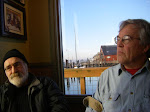
I met Peter Roberge, the new Executive Chef at Skagit Valley Hospital. He is masterminding a culinary revolution at the hospital, and I am more than thrilled to see this happening.
The hospital, until recently, served typical institutional cooking -- instant mashed potatoes, industrial-strength gravy and overcooked frozen vegetables.
They didn't cook. They defrosted. I know. I worked at the hospital these past two years. The salad bar was a little bit decent, I must admit, but a large portion of the staff avoided the cafeteria and brought takeout or food from home.
Comes now Peter Roberge, representing Thomas Cuisine, a company that has been awarded a contract for the hospital kitchen.
Roberge said, "We make everything from scratch." I could not believe my ears, but I went to the cafeteria yesterday to check it out --- fresh string beans! Tasty, al dente. Red cabbage shredded and served in a mound. I like cabbage to be cooked until tender, so Roberge did it just right for me. I figure if you want raw cabbage you can have coleslaw.
Anyway, the meal included pork tenderloins -- not overcooked until they were dry as a bone, but still juicy, served with a lightly-herbed mustard sauce.
I no longer work at the hospital, but I dreamed of this day. You can eat at the cafeteria now -- the food is good.
Local Produce. I met Roberge at the Farm-to-Table conference on Monday -- a meeting of local growers and those who would buy from them -- like the Food Co-op, some of the area restaurants, and people who organize farmers markets.
Roberge was there because he wants to buy the best of the local produce -- and he will find it, from potatoes to leeks to endive to mushrooms.
I challenged him. Isn't it more expensive to buy fresh produce, plus the extra labor in preparing it for the table? He said, "I don't care what it costs."
Roberge was not being glib, but quite practical. In fact, he has raised prices at the hospital cafeteria, but, because the food is so much better, more people are eating there. In other words, the fresh local produce is paying for itself. Isn't that good news? People will pay for quality.
It ties into the great health care debate. Americans spend 10 percent of their money on food, and 17 percent of their money on health care. The proportions are exactly backward. If we spent more money on good food, we would get sick less often and our health care costs would decline.
Friendship: an excerpt from the Frog Hospital book, to be published this summer
Much has been said about the American family -- the family is the strength of our nation, the values of a family are so very important, and we need to keep and cherish those values.
Not to defend or define those values here, but to mention something equally important -- friendship.
Friendship is not unique to America, but we might compare our society to the undeveloped world where the extended family is the norm, in Latin America or Africa where a man counts his relatives in the dozens -- large families that depend on and care for each other. In countries where the government is often rapacious and confiscatory, where social services are nonexistent, the extended family is the sole tool for survival. Care of the elderly falls on the children and grandchildren -- there is no choice in that, and less virtue because there is no choice.
The extended family, this large and warm unit, is also the main source of corruption in poorer countries. If you have a government post, and your cousin needs a job, you will take care of him. If your business prospers, all your relatives will line up with their hands out. It is your duty to care for them above others.
It’s not merit, but relation, that allocates the rewards of society in those countries.
America is different. We send our cousins Christmas cards, but we don’t expect to feed them. Even a brother, applying for a position, would be subject to close scrutiny. “Sure, if he’s qualified,” we would say, but not for a favor.
Blood is thicker than water, and many of us would make a great sacrifice for our close kin, but the sense of fairness, and of equality for all, is so strong here, that the corruption of family ties is at a minimum.
What we have instead is friendship -- smaller, nuclear families and a web of friendship that unites and levels the country. Friendship is freedom. You choose your friends. Friendship is responsibility, because the friends you choose are a reflection on your character. Friendship is voluntary, even a long-standing friendship must be earned from time to time in small or large ways.
We might do a favor for a friend, or even surrender our lives, we might support them in illness, or go their bail, but it is always because we choose to. That’s freedom in America.
The family is good and essential, but it has never been enough.
--
Fred Owens
cell: 360-739-0214
send mail to:
Fred Owens
Box 1292
LaConner WA 98257
Thursday, February 25, 2010


Wednesday, February 17, 2010
It's Time for Obama to go Home
It's time for President Obama to go home to that place which gives him the strength and spirit to be our leader. He needs to go back to the South Side of Chicago. He needs to go back to the Trinity Church and join in the choir singing -- being there with Michele, with his two girls by his side.
I wish he was back there now, instead of in the White House, where he gets paler and weaker every day. Washington DC is just sucking the life out of that man. Those people aren't his true friends.
Go home, Mr. President. Go home to the South Side of Chicago.
I've been talking with a woman who comes from the South Side. She's a white woman, from the far, far South Side, but that doesn't matter. I recognize the energy that she has -- a kind of energy that comes from what may be America's largest and most powerful neighborhood.
Mayor Daley, father and son, are from the South Side. It's real.
The most important decision Barack Obama ever made was to choose that neighborhood as his home. He had a rootless childhood and then earned a law degree from Harvard. He could have lived anywhere in the country and made a very handsome living. He could have lived in San Francisco, or Manhattan, or Honolulu -- the world was at his feet.
But he choose Chicago, and he chose the South Side, and that's why he's the President.
He could have had a good and prosperous life in San Francisco or Manhattan, but he would not have become President.
I know, and he knows, it was that neighborhood that got him where he is today. That neighborhood and his remarkable wife Michelle who is rooted on those streets.
And that "reviled" church, that wonderful, soulful, gospel-truth church, where he sat in the pews every Sunday morning for so many years -- appearing diffident, appearing detached. That doesn't matter. He heard the singing and the preaching, and those words gave him the power to become President.
Go back home, Mr. President. Go back to your church and your barber shop and your streets of gold. Yes, they are streets of gold, if you have the eyes to see that.
Big City Values. I support President Obama because he represents big city values. The vast majority of Americans live in the big cities and their suburbs. This is who we really are, and this is where we will solve our problems and make our future.
I think this small town talk is all nonsense. I have lived most of my adult life in a very small town, LaConner, with less than one thousand people. I love it here. It's a great place to live and raise a family.
But to say that a small town is the embodiment of civic virtue -- that's a joke. We are no more honest, no more courageous, no more generous, and no more patriotic than our friends in the big city.
The people of small towns have no more virtue, and no fewer vices, than those who live in the big cities.
LaConner is my home and my source of strength, but our President needs to spend more time in his home and find his strength again, and that's in the South Side of Chicago.
The Frog Hospital T-shirt. The spring subscription drive will be underway soon. And this year we have something new and special -- a Frog Hospital T-shirt. As soon as we get it finished and ready to ship, we can make this offer -- when you a buy a srubscription you will receive a free T-shirt. This is going to really awesome.
The Frog Hospital Book. Sometime after the T-shirt extravaganza, the Frog Hospital book will be published, probably this summer. I got the manuscript back from the editor and I am making revisions. I have read the manuscript numerous times, and I still like it, so I think it will be a pretty good book.
When I'm finished revising, the manuscript will to to a proofreader and then to the book designer, and then to the printers. I'm working with a great group people on this.
I wish he was back there now, instead of in the White House, where he gets paler and weaker every day. Washington DC is just sucking the life out of that man. Those people aren't his true friends.
Go home, Mr. President. Go home to the South Side of Chicago.
I've been talking with a woman who comes from the South Side. She's a white woman, from the far, far South Side, but that doesn't matter. I recognize the energy that she has -- a kind of energy that comes from what may be America's largest and most powerful neighborhood.
Mayor Daley, father and son, are from the South Side. It's real.
The most important decision Barack Obama ever made was to choose that neighborhood as his home. He had a rootless childhood and then earned a law degree from Harvard. He could have lived anywhere in the country and made a very handsome living. He could have lived in San Francisco, or Manhattan, or Honolulu -- the world was at his feet.
But he choose Chicago, and he chose the South Side, and that's why he's the President.
He could have had a good and prosperous life in San Francisco or Manhattan, but he would not have become President.
I know, and he knows, it was that neighborhood that got him where he is today. That neighborhood and his remarkable wife Michelle who is rooted on those streets.
And that "reviled" church, that wonderful, soulful, gospel-truth church, where he sat in the pews every Sunday morning for so many years -- appearing diffident, appearing detached. That doesn't matter. He heard the singing and the preaching, and those words gave him the power to become President.
Go back home, Mr. President. Go back to your church and your barber shop and your streets of gold. Yes, they are streets of gold, if you have the eyes to see that.
Big City Values. I support President Obama because he represents big city values. The vast majority of Americans live in the big cities and their suburbs. This is who we really are, and this is where we will solve our problems and make our future.
I think this small town talk is all nonsense. I have lived most of my adult life in a very small town, LaConner, with less than one thousand people. I love it here. It's a great place to live and raise a family.
But to say that a small town is the embodiment of civic virtue -- that's a joke. We are no more honest, no more courageous, no more generous, and no more patriotic than our friends in the big city.
The people of small towns have no more virtue, and no fewer vices, than those who live in the big cities.
LaConner is my home and my source of strength, but our President needs to spend more time in his home and find his strength again, and that's in the South Side of Chicago.
The Frog Hospital T-shirt. The spring subscription drive will be underway soon. And this year we have something new and special -- a Frog Hospital T-shirt. As soon as we get it finished and ready to ship, we can make this offer -- when you a buy a srubscription you will receive a free T-shirt. This is going to really awesome.
The Frog Hospital Book. Sometime after the T-shirt extravaganza, the Frog Hospital book will be published, probably this summer. I got the manuscript back from the editor and I am making revisions. I have read the manuscript numerous times, and I still like it, so I think it will be a pretty good book.
When I'm finished revising, the manuscript will to to a proofreader and then to the book designer, and then to the printers. I'm working with a great group people on this.
Sunday, February 07, 2010
J.D. Salinger
J.D. Salinger died last week. I always wondered about these people who read Catcher in the Rye and then figured that Salinger owed them an explanation.
Why did anybody pester him? I took him at face value. He wanted to be left alone. Then you don't get to ask why, you just leave him alone.
Or he was supposed to write more books. Didn't Salinger know, better than anyone else, if he had another book to write? Again, take Salinger at face value. He wrote one American classic, Catcher in the Rye, and another very good book, Franny and Zooey, and a few short stories.
That's all he wrote. He gave us something wonderful, so who are these people saying they didn't get enough? Geez!
Catcher in the Rye was wonderful, but the book I really loved was Franny and Zooey. I loved their warm, over-stuffed apartment in Manhattan in the 1950s. It was such a nice family.
The oldest brother had committed suicide, which was a tragedy that can strike anyone's family. And the story in the book, is about how Franny Glass, the youngest child, was having a nervous breakdown.
But she had a home to come to, that large, wonderful, boisterous apartment, and she collapsed on the living room couch and slept all day. Her mother kept bringing her food and tried to get her to talk, but Franny would just turn her face to the wall and cry.
Her older brother Zooey, who still lived at home, was able to help Franny deal with her crisis, and that's the story of the book.
I've heard critics say that the Glass family was dysfunctional. No, they weren't. They were about average. They were more like everybody's else's family. They had crisis and tragedy, but it felt like such a good home when you read the book.
This is my favorite scene. It has one very long sentence, which is triumph of writing in the English language.
Zooey Glass, age 25 or so, is taking a bath in his parents' large, over-furnished old apartment in Manhattan. The Glass family is Jewish-Irish. His mother walks into the bathroom. The year is 1955. The passage begins:
Zooey's voice suddenly and suspiciously spoke up: "MOTHER? What in Christ's name are you doing out there?"
Mrs. Glass undressed the package and now stood reading the fine print on the back of a carton of toothpaste. "Just kindly button that lip of yours," she said, rather absently. She went over to the medicine cabinet. It was stationed above the washbowl, against the wall. She opened it's mirror-faced drawer and surveyed the congested shelves with an eye—or rather the masterly squint—of a dedicated medicine-cabinet gardener. Before her, in overly luxuriant rows, was a host, so to speak, of golden pharmaceuticals, plus a few technically less indigenous whatnots. The shelves bore iodine, Mercurochrome, vitamin capsules, dental floss, aspirin, Anacin, Bufferin, Argyrol, Musterole, Ex-Lax, Milk of Magnesia, Sal Hepatica, Aspergum, two Gilette razors, one Shick injector razor, two tubes of shaving cream, a bent and somewhat torn snapshot of a fat black-and-white cat asleep on a porch railing, three combs, two hairbrushes, a bottle of Wildroot hair ointment, a bottle of Fitch Dandruff Remover, a small, unlabelled box of glycerine suppositories, Vicks Nose Drops, Vicks VapoRub, six bars of Castile soap, the stubs of three tickets to a 1946 musical comedy ("Call Me Mister"), a tube of depilatory cream, a box of Kleenex, two seashells, an assortment of used-looking emery boards, two jars of cleansing cream, three pairs of scissors, a nail file, an unclouded blue marble (known to marble shooters, at least in the twenties, as a "purey"), a cream for contracting enlarged pores, a pair of tweezers, the strapless chassis of a girl's or woman's gold wristwatch, a box of bicarbonate of soda, a girl's boarding-school class ring with a chipped onyx stone, a bottle of Stopette—and inconceivably or no, quite a good deal more.
J.D. Salinger. May he rest in peace.
Man dies in torch fire accident on farm
ELTOPIA, Wash. (AP) -- A man was killed in an accident on a farm near Eltopia.
The Franklin County sheriff's office says 75-year-old Everett D. Monk was cutting scrap metal in a field with a torch Saturday when his clothes caught fire. The Tri-City Herald reports he apparently died of burns.
A friend found the body.
I read this story in a farming newspaper. Eltopia is only a stop on the highway, way out in Eastern Washington in the sagebrush country.
The accident happened last November. Something about this very short news story struck a chord with me, and I began to imagine this man's life. Everett Monk, 75, cutting scrap metal with a torch, working out in a field. Then his clothes caught on fire and the fire killed him.
Age 75, working out in the field his whole life. He was always careful, but you know you can catch it anytime, and he did. I wondered, his family must have wondered, how much he suffered, how long the flames tormented him, how long he laid on the ground before they found him.
Maybe a younger man could have rolled quickly on the ground and put out the flames. But Everett Monk was 75 and he kept working because that's what he knew how to do. He was not being careless, but these things can happen.
He lived his whole life until it ended. That's the feeling I got when I read this very short story, and I admired Everett Monk for the kind of man he was.
Two Deaths. Two deaths in this issue of Frog Hospital. Two men, one famous and one not. It's February now and the light is coming back to the Skagit Valley. People are coming out of their caves and starting to smile again. The weather has been very mild. The daffodils are coming up early.
I like living in 2010 so far. I like that number -- how it sounds and how it looks on the page, so I'm hoping we all have a very good year.
--
Fred Owens
cell: 360-739-0214
send mail to:
Fred Owens
Box 1292
LaConner WA 98257
Why did anybody pester him? I took him at face value. He wanted to be left alone. Then you don't get to ask why, you just leave him alone.
Or he was supposed to write more books. Didn't Salinger know, better than anyone else, if he had another book to write? Again, take Salinger at face value. He wrote one American classic, Catcher in the Rye, and another very good book, Franny and Zooey, and a few short stories.
That's all he wrote. He gave us something wonderful, so who are these people saying they didn't get enough? Geez!
Catcher in the Rye was wonderful, but the book I really loved was Franny and Zooey. I loved their warm, over-stuffed apartment in Manhattan in the 1950s. It was such a nice family.
The oldest brother had committed suicide, which was a tragedy that can strike anyone's family. And the story in the book, is about how Franny Glass, the youngest child, was having a nervous breakdown.
But she had a home to come to, that large, wonderful, boisterous apartment, and she collapsed on the living room couch and slept all day. Her mother kept bringing her food and tried to get her to talk, but Franny would just turn her face to the wall and cry.
Her older brother Zooey, who still lived at home, was able to help Franny deal with her crisis, and that's the story of the book.
I've heard critics say that the Glass family was dysfunctional. No, they weren't. They were about average. They were more like everybody's else's family. They had crisis and tragedy, but it felt like such a good home when you read the book.
This is my favorite scene. It has one very long sentence, which is triumph of writing in the English language.
Zooey Glass, age 25 or so, is taking a bath in his parents' large, over-furnished old apartment in Manhattan. The Glass family is Jewish-Irish. His mother walks into the bathroom. The year is 1955. The passage begins:
Zooey's voice suddenly and suspiciously spoke up: "MOTHER? What in Christ's name are you doing out there?"
Mrs. Glass undressed the package and now stood reading the fine print on the back of a carton of toothpaste. "Just kindly button that lip of yours," she said, rather absently. She went over to the medicine cabinet. It was stationed above the washbowl, against the wall. She opened it's mirror-faced drawer and surveyed the congested shelves with an eye—or rather the masterly squint—of a dedicated medicine-cabinet gardener. Before her, in overly luxuriant rows, was a host, so to speak, of golden pharmaceuticals, plus a few technically less indigenous whatnots. The shelves bore iodine, Mercurochrome, vitamin capsules, dental floss, aspirin, Anacin, Bufferin, Argyrol, Musterole, Ex-Lax, Milk of Magnesia, Sal Hepatica, Aspergum, two Gilette razors, one Shick injector razor, two tubes of shaving cream, a bent and somewhat torn snapshot of a fat black-and-white cat asleep on a porch railing, three combs, two hairbrushes, a bottle of Wildroot hair ointment, a bottle of Fitch Dandruff Remover, a small, unlabelled box of glycerine suppositories, Vicks Nose Drops, Vicks VapoRub, six bars of Castile soap, the stubs of three tickets to a 1946 musical comedy ("Call Me Mister"), a tube of depilatory cream, a box of Kleenex, two seashells, an assortment of used-looking emery boards, two jars of cleansing cream, three pairs of scissors, a nail file, an unclouded blue marble (known to marble shooters, at least in the twenties, as a "purey"), a cream for contracting enlarged pores, a pair of tweezers, the strapless chassis of a girl's or woman's gold wristwatch, a box of bicarbonate of soda, a girl's boarding-school class ring with a chipped onyx stone, a bottle of Stopette—and inconceivably or no, quite a good deal more.
J.D. Salinger. May he rest in peace.
Man dies in torch fire accident on farm
ELTOPIA, Wash. (AP) -- A man was killed in an accident on a farm near Eltopia.
The Franklin County sheriff's office says 75-year-old Everett D. Monk was cutting scrap metal in a field with a torch Saturday when his clothes caught fire. The Tri-City Herald reports he apparently died of burns.
A friend found the body.
I read this story in a farming newspaper. Eltopia is only a stop on the highway, way out in Eastern Washington in the sagebrush country.
The accident happened last November. Something about this very short news story struck a chord with me, and I began to imagine this man's life. Everett Monk, 75, cutting scrap metal with a torch, working out in a field. Then his clothes caught on fire and the fire killed him.
Age 75, working out in the field his whole life. He was always careful, but you know you can catch it anytime, and he did. I wondered, his family must have wondered, how much he suffered, how long the flames tormented him, how long he laid on the ground before they found him.
Maybe a younger man could have rolled quickly on the ground and put out the flames. But Everett Monk was 75 and he kept working because that's what he knew how to do. He was not being careless, but these things can happen.
He lived his whole life until it ended. That's the feeling I got when I read this very short story, and I admired Everett Monk for the kind of man he was.
Two Deaths. Two deaths in this issue of Frog Hospital. Two men, one famous and one not. It's February now and the light is coming back to the Skagit Valley. People are coming out of their caves and starting to smile again. The weather has been very mild. The daffodils are coming up early.
I like living in 2010 so far. I like that number -- how it sounds and how it looks on the page, so I'm hoping we all have a very good year.
--
Fred Owens
cell: 360-739-0214
send mail to:
Fred Owens
Box 1292
LaConner WA 98257
Sunday, January 24, 2010
I am not ranting
Scott Brown reminds me of John Edwards -- two very good-looking haircuts. Pick 'em.
But I am not ranting today. I did that on Friday, a wicked rant, and I posted it right below this one -- called "What a Bunch of Scaredy Cats.
You can't be in politics if you don't have a sense of humor. I don't associate with angry people. They're boring me. Their fervor and their intensity -- for what good?
They get mad at the government for paying too much in taxes. Maybe they should be mad at their accountants instead.
I don't pay too much in taxes, because I'm smart. And so I'm not mad at the government. I receive many benefits from the government. So it's simple -- taxes go in, benefits come out. Just try to stay even with it, and you won't get mad.
There is the hypocrisy of people complaining about "government handouts" but keeping pretty quiet about various programs that subsidize their own little cottage industry.
But I am not going to rant today. I did that Friday and it was very satisfying.
And I lost my last election bet, so maybe I'm foolish to make another prediction, but here goes:
A Prediction. It seems that President Obama would rather govern than campaign, and him thinking he was elected to govern, but realizing now that he has get out there and stir it up. That is something Obama knows how to do very well when he sets his mind to it.
I admire Obama because he doesn't live for the adulation of the crowd, but he can do it when it suits him, and he will be doing it, like the master conductor of a symphony orchestra. That's why he got elected by a majority of American voters.
Obama, and the Founders, and most Americans, believe in representative government. So we elect these people, and then we're stuck with them.
But the alternative is government by initiative which is a proven disaster in California, or government-by-radio-talk-shows, which would be even worse.
The Future. I believe in the future of our country. My faith was confirmed Friday night when I attended a play at the LaConner High School. The students actors were marvelous. It's take a lot of work to do that well. I was impressed by their freshness and determination.
These students will become good men and women, and we will be turning responsibilities over to them, and they will do all right, and they will fix some of the messes we have made for them.
The Past. History is a comfort. The times seem terrible because we live in them, but little of what we suffer is new. It's happened many times before and we are still here, and I see a beautiful sunrise outside the breakfast window.
Earthquakes tumble mud-brick homes in poor villages and thousands die.
Do you remember the earthquake in Bam? Bam is a poor and ancient city of 43,000 in the mountains of Iran. Nobody ever heard of it. Then the earth trembled in 2003, and more than 25,000 people died in the rubble. More than half the population died.
Isn't that the most important tragedy of our times? Yes, it is a date seared in memory, December 26, 2003, for those citizens of Bam who survived it.
Has Bam been rebuilt with higher earthquake-proof standards? I hope so, but I don't know. We don't go to Iran with aid missions, and we don't need to because we should be paying all our attention to disaster in Haiti, right now, right nearby.
I don't know why I remember the earthquake in Bam, but I do remember it.
But I am not ranting today. I did that on Friday, a wicked rant, and I posted it right below this one -- called "What a Bunch of Scaredy Cats.
You can't be in politics if you don't have a sense of humor. I don't associate with angry people. They're boring me. Their fervor and their intensity -- for what good?
They get mad at the government for paying too much in taxes. Maybe they should be mad at their accountants instead.
I don't pay too much in taxes, because I'm smart. And so I'm not mad at the government. I receive many benefits from the government. So it's simple -- taxes go in, benefits come out. Just try to stay even with it, and you won't get mad.
There is the hypocrisy of people complaining about "government handouts" but keeping pretty quiet about various programs that subsidize their own little cottage industry.
But I am not going to rant today. I did that Friday and it was very satisfying.
And I lost my last election bet, so maybe I'm foolish to make another prediction, but here goes:
A Prediction. It seems that President Obama would rather govern than campaign, and him thinking he was elected to govern, but realizing now that he has get out there and stir it up. That is something Obama knows how to do very well when he sets his mind to it.
I admire Obama because he doesn't live for the adulation of the crowd, but he can do it when it suits him, and he will be doing it, like the master conductor of a symphony orchestra. That's why he got elected by a majority of American voters.
Obama, and the Founders, and most Americans, believe in representative government. So we elect these people, and then we're stuck with them.
But the alternative is government by initiative which is a proven disaster in California, or government-by-radio-talk-shows, which would be even worse.
The Future. I believe in the future of our country. My faith was confirmed Friday night when I attended a play at the LaConner High School. The students actors were marvelous. It's take a lot of work to do that well. I was impressed by their freshness and determination.
These students will become good men and women, and we will be turning responsibilities over to them, and they will do all right, and they will fix some of the messes we have made for them.
The Past. History is a comfort. The times seem terrible because we live in them, but little of what we suffer is new. It's happened many times before and we are still here, and I see a beautiful sunrise outside the breakfast window.
Earthquakes tumble mud-brick homes in poor villages and thousands die.
Do you remember the earthquake in Bam? Bam is a poor and ancient city of 43,000 in the mountains of Iran. Nobody ever heard of it. Then the earth trembled in 2003, and more than 25,000 people died in the rubble. More than half the population died.
Isn't that the most important tragedy of our times? Yes, it is a date seared in memory, December 26, 2003, for those citizens of Bam who survived it.
Has Bam been rebuilt with higher earthquake-proof standards? I hope so, but I don't know. We don't go to Iran with aid missions, and we don't need to because we should be paying all our attention to disaster in Haiti, right now, right nearby.
I don't know why I remember the earthquake in Bam, but I do remember it.
What a Bunch of Scaredy Cats
The Democrats are engaged in a massive, nationwide Pity Party, following the victory of Scott Brown in Massachusetts. Fifty-nine Democratic Senators are cowering under their desks -- scared of those mean Republicans.
"But Mom, they're not being nice to us."
Aw, poor Democratic Senators, are those mean, nasty Republicans bothering you? Well, you just come inside now and I'll fix you a nice, warm glass of milk and you can have some of your favorite cookies. I won't let those mean, nasty Republican Senators come inside and scare you anymore.
Let me just tuck you in the bed with your favorite Teddy Bear -- poor little Democratic Senators -- don't you be ascared anymore. Momma is watching over you now, and your fairy godmother too.
Fifty-nine Democratic Senators -- cowards, wusses, and weenies. If you're not up to the job, why don't you just go home and let someone else do it.
Scaredy cats! na-na-na-na! Chicken, Chicken -- Bock! Bock! Bock! -- Chicken, Chicken.
Losers! Phonies! You guys have lots of excuses, because you only out number the other team by 59 to 41. Boy, that's sounds really rough.
The Frightful Specter of Glenn Beck -- Satan! Sauron! The Evil One! No! No! Dare we say his name!
Glenn Beck is such a scary guy. We better not do anything that will make him mad. We should try to work out some kind of consensus with him -- have our people talk with his people.
Fox News! Fox News! Oh God, the nightmate continues! Please, please turn it off. Yes, you fifty-nine Democratic Senators, you must surrender, you will now be under our complete control. Because if you do not bow to our wishes, you will be forced to listen to Rush Limbaugh over and over again until you beg for mercy.
No, No, the horror! the horror!
Perhaps the "59" have been subjected to a mass hypnosis or they could have been administered a drug -- something that would explain their extremely passive behavior.
Maybe we should take a more compassionate and understanding attitude to those 59 snivelling cowards with pensions, and travel budgets and far better health insurance than you and I will ever have.
But I don't feel any pity. I feel scorn and contempt. Useless!
"But Mom, they're not being nice to us."
Aw, poor Democratic Senators, are those mean, nasty Republicans bothering you? Well, you just come inside now and I'll fix you a nice, warm glass of milk and you can have some of your favorite cookies. I won't let those mean, nasty Republican Senators come inside and scare you anymore.
Let me just tuck you in the bed with your favorite Teddy Bear -- poor little Democratic Senators -- don't you be ascared anymore. Momma is watching over you now, and your fairy godmother too.
Fifty-nine Democratic Senators -- cowards, wusses, and weenies. If you're not up to the job, why don't you just go home and let someone else do it.
Scaredy cats! na-na-na-na! Chicken, Chicken -- Bock! Bock! Bock! -- Chicken, Chicken.
Losers! Phonies! You guys have lots of excuses, because you only out number the other team by 59 to 41. Boy, that's sounds really rough.
The Frightful Specter of Glenn Beck -- Satan! Sauron! The Evil One! No! No! Dare we say his name!
Glenn Beck is such a scary guy. We better not do anything that will make him mad. We should try to work out some kind of consensus with him -- have our people talk with his people.
Fox News! Fox News! Oh God, the nightmate continues! Please, please turn it off. Yes, you fifty-nine Democratic Senators, you must surrender, you will now be under our complete control. Because if you do not bow to our wishes, you will be forced to listen to Rush Limbaugh over and over again until you beg for mercy.
No, No, the horror! the horror!
Perhaps the "59" have been subjected to a mass hypnosis or they could have been administered a drug -- something that would explain their extremely passive behavior.
Maybe we should take a more compassionate and understanding attitude to those 59 snivelling cowards with pensions, and travel budgets and far better health insurance than you and I will ever have.
But I don't feel any pity. I feel scorn and contempt. Useless!
Tuesday, January 19, 2010
A bit of Fishtown History
“A self-taught painter, Charles Krafft began his career in earnest in 1969 at the age of 20 after relocating from San Francisco to the rural Skagit Valley in northern Washington State. Formerly home to mystic painter Morris Graves, this area became central to a group of artists collectively known as the Northwest School. Influenced by the beauty of their natural surroundings and readings of Eastern philosophy, these elder artists had already developed the acknowledged style of the region by the time Krafft took up residence. He lived in Fishtown, an enclave of a younger generation of artists and poets living in rustic simplicity in abandoned fishermen’s shacks along the banks of the Skagit River.”
If LaConner in the 1960s seemed like something from a dreamtime to Bobby Racanello, then Fishtown was even further from the ordinary. It was far out, off the map, and not found by the usual means. One needed an invitation, as much by the place itself as by its residents. One did not ask directions on how to get to Fishtown, but it might be discovered. One did not ask how to behave when visiting Fishtown – that was either apparent or it was not. The selection process was natural, as un-abstract as possible.
“The splendor of the Skagit delta has always been a draw for artists, but the closest thing to a real art colony the area ever experienced was the emergence of an exotic hippie settlement in the abandoned squatters’ shacks at Fishtown in the late 1960s. Fishtown was a prolonged experiment in the style of deliberate simplicity celebrated by Thoreau and inspired by the example of two legendary Northwest Zen Buddhists, Morris Graves and Gary Snyder. I can say this some authority because I was the self-proclaimed mayor of Fishtown. Throughout the 70s, Fishtown existed as a year-round community and marshy Mecca for a constant stream of nomadic young visitors from Seattle, San Francisco and points beyond. It was one of the region’s most visible symbols of the youth quake that swept the country in the 60s.”
But Fishtown was not visible, it was shrouded in mist. No one saw it, but many people heard about it and knew it was there. It was a word passing from mouth to mouth, but very few photographs were taken.
Bo Miller lived next door to Krafft. Their cabins were connected by a boardwalk that snaked through the marsh. Miller was a sculptor and architect. He designed and built his own cabin in a style that fit in with “established” shacks. Art Jorgensen had his shack further down the boardwalk, he was also a sculptor. Paul Hansen, a poet and Chinese scholar, lived in between Miller and Jorgensen. And there were others, but it was actually a very small place with a very small permanent population.
The boardwalk was never in good repair. It was rickety, some of the boards were loose, and some were missing. The small branch of an alder tree grew across the boardwalk at one place. One had to push the branch down and step over it, or stoop and get under it – but no one ever cut it off. Two seconds with a lopper would have done the job, but the branch remained unharmed for years, and every day it was in the way – in the way of all visitors and all residents, going back and forth.
So some visitors to Fishtown might have thought the residents were too lazy or too spaced out to “fix” the branch, or to nail down the rickety boards. They were welcome to that thought. Yet the branch was there because it was there, and things don’t need to be fixed because they are not broken. The branch was not “in the way” it was the Way – a concrete symbol.
LaConner cherished all its particularity in the 1960s. Every house and every street had its own identity. The streets had no names. They had names from the original town plat, but street signs had never been erected, and lifelong residents literally did not know the name of the street they lived on. And the houses had no numbers. LaConnerites always pick up their mail at the post office, so they had mail box numbers, but no street addresses. Houses were referred to by name – “Whitney’s house,” even in the newspaper. Street locations were “in front of Whitney’s house.” Everybody who lived in LaConner and read that in the newspaper understood what was meant. The few visitors only had to stop and ask directions. The directions were personal and particular, not from a map.
Fishtown was even more particular – trees were known, branches were known, even leafs were known – that was the point, and the point was not subject to explanation. One got the point or one did not.
Not every one in Fishtown was an artist. Keith Brown lived upstream from Krafft, a good hundred yards. A footpath went over the hill, up along a steep rocky path, and then down the other side to where Brown lived, next door to Steve Herrold’s cabin. He was the Village Idiot. Brown was determined to be criminally insane in 1987 and was remanded to the state institution at Steilacoom, and has remained there ever since. But he was cared for in Fishtown for many years. At that time people considered Keith Brown to be about half-crazy. He worked, he did odd jobs and mowed lawns. He occupied his time in his river cabin by constructing electronic devices of alternative energy. He erected a windmill on the roof of his cabin and used it to power his radio and a 15-watt light bulb for reading. He made a switch out of common table fork. He was clever that way, and a friendly fellow as well, but he spouted nonsense at times and behaved crudely toward women. A non-professional analysis is that he lacked social skills.
Brown’s situation is described here because it is a matter of public record and because it is exemplary of a kind of caring by a community that protected him from some of his own impulses. Brown was looked after by his neighbors in Fishtown, although never in a formal way and never in a way that might make it a burden or special responsibility. Keith Brown was just around, and there were plenty of people for him to be around with; they all had the un-hurried time to let his nonsense and crudity pass by like so much wind.
Fishtown was more than a quiet space for artists, it was a shelter for Brown, and his “insights” were the stuff of poetry along with the moonlight and the tide.
When the no-growth people spoke against the construction of the sewer system in LaConner, when they objected to the expansion of the marina, they were speaking for the benefit of an un-hurried pace. Sund wrote in his election pamphlet, “Right now, most people are not satisfied. They feel that things are out of hand, moving too fast….”
Things were moving too fast for people to spend time with Keith Brown, and he began to get out of hand.
A story I wrote in 1986 describes what happened. The story can be considered anecdotal, it does not prove a case.
“Keith Brown, a 14-year resident of LaConner, set fire to the roof of the Lighthouse Restaurant, March 14, and was arrested for First Degree Arson. He is in Western State Hospital now.
“First Degree Arson is a Class A felony, defined as ‘knowingly and maliciously causing a fire or explosion in a building in which there were at the time human beings who were not participants in the crime.’ The maximum penalty is life imprisonment.
“William McCann, Brown’s court appointed attorney, stated that Brown –
‘lacks ability to assist me in his own defense and that the incompetence is due to a mental disease…. Mr. Brown has stated many bizarre and improvable things including the following:
‘That a girl friend by the name of Lisa Elder has either been mutilated or murdered by agents of the federal gov’t.
‘That the federal gov’t. has identified Keith Brown as the “Anti-Christ” and dispatched Ronald Reagan and/or the FBI to kill him.
‘That there is a conspiracy to intercept his mail and that the police agencies in Skagit County are directly involved in this conspiracy.
‘That the day of his arrest, he told the police officer, “I just found out that you killed Lisa.”
‘That at one time Keith Brown apparently contacted the Skagit County Rape Relief for help, claiming that he had been raped by society and was entitled assistance.
‘Brown also “demanded that I contact the ACLU for him…when I suggested that he consider a not guilty plea by reason of insanity plea, he ‘fired’ me.”’
“Brown was determined to be incompetent and was given a civil commitment.”
Fishtown began to change around 1980. Charlie Krafft moved to Seattle, so did Steve Herrold. Bo Miller and his wife had a baby. They moved to LaConner and rented a house. Paul Hansen moved out. He moved to a cabin on the road with electricity and running water. Art Jorgensen remained in his place and became a recluse. He never went to town anymore. The other cabins remained uninhabited. The immigration to rural parts – back to the land – was petering out. The lifestyle of a candle-lit cabin was not winning new adherents.
Brown was isolated in Fishtown and he began to spend more time in LaConner, but his friends were busier and there was more traffic. The voices Brown heard got louder and his antics became more disruptive. His behavior began to strain the tolerance of LaConnerites who were willing to put up with fairly outlandish behavior and took pride in that; but women became frightened by his advances and by his assumption of relations that did not exist. Finally he snapped and started a fire on the Lighthouse roof, and that act gave a closure. Brown was certifiable. And his downfall was part of the cost of development – so people felt at the time.
Tom Robbins, in his art pamphlet of 1974, said more about Skagit Valley artists. Making a generalization or describing a pattern, he said, “[Skagit Valley artists] vary too extremely and attitude to constitute anything vaguely resembling a ‘school.’
“…. The artists who reside in and near LaConner have social relationships that are at best ambiguous. Professionally there scarcely are relationships at all…. never is there heard an approximation of the passionate debates that warm artist bars and lofts on the East Coast or in Southern California.”
Robbins said the artists of the LaConner area had an “aversion to art politics.” But he was speaking of himself. There were passionate debates in LaConner among the artists and poets. There were meetings and collaborations. There were group shows of artists, and group readings of poets. There were alliance and feuds. Especially with the poets, there was a definite school, the evidence for that being a certain poet, Jim Bertolino, who was not considered a part of that school and was not invited to group readings. Bertolino’s poetry was very Italian and gregarious and very non-Zen. He did not fit in.
Gary Snyder’s tight and spare poetry, his extensive education in Japan, and his earth-centered, regional approach – those were the guidelines of the school.
In June two oak fell,
rot in the roots
Chainsaw in September
in three days one tree
bucked and quartered in the shed
The school’s chief exponent was Robert Sund and its name was the Great Blue Heron Society. Sund never compromised in his dedication to being a poet. He never married (Sund married briefly in the 1960’s before moving to LaConner) and he never owned property. He never took a day job.
But he painted as well as wrote poetry, and he could sell his paintings for a few hundred dollars. And he might earn fifty or a hundred dollars for a reading. Nevertheless Sund was frequently broke and constantly on the make. He suffered the indignity of begging and borrowing, but if ever a friend or acquaintance suggested that a poet was not worthy of his labor, then Sund became unyielding and resolute, and was prepared and willing to declaim poetry and its value until the tavern closed.
With that quality of determination and with the quality of his poetry, Sund became a regional leader. Paul Hansen belonged, as did Clifford Burke of Anacortes. Several poets from Port Townsend were also included – Tim McNulty, Sam Hamill, and Finn Wilcox. The list is much larger, but there never was a list. They published many chapbooks and several books, often in collaboration. One was Redding Leaves and Welcome to God’s Country, poems and verse by Glenn Turner, in 1979. Charlie Krafft illustrated this volume, Guy Anderson did the cover, and Clifford Burke did the graphic design.
The new publisher of the Puget Sound Mail was favorably disposed to poetry. Dick Fallis of Mount Vernon bought the paper from Pat O’Leary in 1973. O’Leary had completed 33 years as editor by 1973 and that year also marked the one hundredth anniversary of its founding in 1873.
Fallis was a congenial man, but a garrulous writer and a poor businessman. Fallis wrote, in his first issue, “I have some authority for this from Henry David Thoreau, who is one of my ideals as a journalist. Something of what Thoreau accomplished over 100 years ago, squatting beside New England’s Walden Pond and faithfully reporting his observations, is one of the things I will attempt to do here, sitting besides Swinomish Channel at the edge of Puget Sound.”
Fallis was a thumbsucker! Thoreau would be the last man on earth to turn out a weekly newspaper on deadline. Fallis’s opening statement did not augur well for the economic future of the Puget Sound Mail. Fallis composed no hymns to progress. The Rotary Club lost its front-page prominence and its members took notice.
But this was the decade when George McGovern ran for President and many things seemed possible, a green revolution being one of them; many alternatives to progress were proposed. Fallis published poetry. The small-town weeklies of frontier days had published poetry – the local doggerel and Kiplingesque rhymes, but that custom had died out after World War I.
In LaConner in the 1970s young people were smoking marijuana by the cloud full at the 1890s. They were skinny-dipping out on the Sand Spit and camping everywhere. Fallis gave no notice of these happenings in his paper; he did not promote it or criticize it; but he did publish poetry. In 1974 he published on the front page a Swedish folk song from the island of Gotlund, translated by Robert Sund, with calligraphy by Steve Herrold. There were many others poems published, although not in every issue, and the poems were simply presented, but never promoted or expounded upon.
Poetry and art had its season in LaConner. The tourist trade was building, but it was only beginning. Retired people were building and buying homes in Shelter Bay, but still in small numbers. The economy was not hot and the rents were still cheap. A high point was reached in the early 1980s and what was a culmination, although it did not seem so to the participants at the time. That high point was the LaConner Arts Foundation, guided and organized by Arthur Greeno who owned a frame shop and who had good business skills and an endless patience for the dramatics of artists and their unconventional lives.
Greeno founded the LaConner Arts Foundation as a non-profit. The foundation staged elegant exhibits with good wine and live music. Greeno smoothed and made seamless the endless bickering over whose paintings got the most prominent spot, and over what poet would be featured at a reading.
Kenneth Rexroth was a grand old man to this school. He had once spent a summer at the Sourdough Lookout in the Cascade Mountains, which is now in North Cascade National Park. Gary Snyder occupied that the Sourdough Lookout in the 1950s. This was the lore and Rexroth was one of the ancestors. He came to LaConner in his very old age and gave one of his last public readings, while sitting in an easy chair in front of a log fire at the Garden Club.
That was the culmination, but the source of this creative effort had become less potent, the conditions and circumstances had altered, and opposition was forming. Ronald Reagan became President of the United States and Alan Pentz founded a rival newspaper in LaConner.
Pentz started the Channeltown Press in 1976. Pentz had worked for the Skagit Valley Herald, Skagit county’s daily newspaper, and had worked for O’Leary when O’Leary owned the Puget Sound Mail; but Pentz lost out to Dick Fallis in the bidding to take over the Puget Sound Mail in 1973.
Pentz was a grouch and a cynic. His prose was funny at times, but always with a tone of bitterness. He composed no hymn to progress, nor against it. Like Fallis, he had no point of view concerning the future of the town, at least not deliberately expressed in an editorial. He operated on a shoestring; the battle between the two papers was on and to the death. LaConner could not support two newspapers. Fallis continued to fumble in his vacuous way, but he decided he had had enough. He sold the paper to Bonnie McDade and her husband in 1979.
Fallis then established a bakery in Mount Vernon and he was successful at that. Bonnie McDade story’s is tragic. She and her husband had made a good living in advertising in Seattle. He was the business brain in the partnership, and she was the creative talent. Shortly after they purchased the paper, he died in a plane crash, leaving her in grief and the business in a shambles. Art Hupy donated his considerable professional talent as a photographer to the paper at no charge. Madeleine Free, Bonnie McDade’s sister, put in long hours setting type and laying out pages; Wally Funk, who published the Oak Harbor weekly and who owned the printing press where the Puget Sound Mail was printed, extended credit as far as he possibly could; many people were tender and forgiving for McDade in her travail. But deadlines were missed and bills were not paid. Meanwhile the Channeltown Press – no poetry! no pretty photographs! – but persistent and faultless in its limited scope – was in relentless pursuit. The Puget Sound Mail, the oldest weekly in Washington State, published its last issue in April, 1982 after 109 years.
During this heyday of poetry in LaConner, Robert Sund fought a running feud with every other artist in town. LaConner art was very political in that sense, despite what Tom Robbins suggested: that the artists lived their own lives and pursued their own career with only a casual community identity.
Sund maintained strongly that his poetry, and the poetry of his guides, Gary Snyder, et al., must be regional and earth-centered and inspired by Asian masters of long ago. He recognized no other style. Jim Bertolino lived on Guemes Island, taught at various community colleges, and was a most abundant poet – abundant in productivity, and abundant in style. Bertolino’s style was cheerful, exuberant, generous and of European provenance. Bertolino was Italian via Cincinnati. But Sund was Swedish via Ming China and committed to a spare brevity.
Sund successfully prevented Bertolino from partaking of any poetry events in LaConner – not Bertolino, or any other kind of poet like him. There was a certain kind of poetry, not formally known as the “Great Blue Heron Society” because that was never more than a loose moniker meaning, more or less, “we few drinking sake on the river in the moonlight,” that was acceptable. Bertolino and his ilk, and to Sund it was an ilk, were never invited to the party.
The second part of Sund’s politics were schizophrenic. It can only be posed as a contradiction, “We ought to gather together as a community and be organized, and I ought to be the leader and sole decision-maker of any group so formed.” This is put in psychological terms because Sund drove his compatriots crazy. He was a powerful and attractive leader, but he could fundamentally not cooperate or compromise. Sund broke up meetings and acquired an impressive roster of ex-friends. This was pure art politics, it was never over money, property or women.
At Sund’s funeral celebration in November, 2001, this impressive roster of ex-friends, including Bertolino, came together and sang his praises, because they all loved him. It’s just that none of them could get along with him while he was alive.
Tom Robbins had no part of this. His status was awesome, separate and unique in the LaConner community. Robbins was, by nature, an intensely non-political individualist.
“…it has become my strong impression that human institutions and collectivities, as distinct from individual people, are impervious to grace….I feel that nations, churches, political parties, classes and formal associations of almost all kinds operate at the lowest level of intelligence and moral sensibility. This is, in part, because they are not organized as an individual is organized. They act upon rules and verbal communications which, when compared with the organic nervous system, are of extreme crudity. It is this which gives us the feeling that most social problems are too complicated, for, in the same way, the human body would seem too complicated were it not that the nervous systems—as distinct from conscious attention and memory—can handle an immense number of variables at the same time. Societies, insofar as they are restricted to linear, strung out, forms of communication, can handle very few variables. Therefore government and corporations, in attempting to keep up with the infinitely varied and multi-dimensional process of nature, resort to words on paper—to laws, reports, and other records—which would take lifetimes for any intelligent being to read, much less assimilate. Yet for all these mountains of paper covered in small print, only a tiny amount of the natural process has been described, and we do not really know whether what we select for description are actually the most important features of the process. In other words, our social organizations are not organic.”
Any self-respecting mystic in the Skagit Valley would have endorsed this philosophy declaimed by Alan Watts. To put it quickly, meetings are a waste of time, and Robbins never attended one – never joined, period.
Robbins was born in North Carolina in 1936, and reared in a small town in Virginia of Baptist parents. He served in the Air Force in the 1950’s. He came to Seattle in 1962 and became the art critic of the Seattle Post-Intelligencer. Knowing the work of Morris Graves and Guy Anderson brought him to the Skagit Valley where he gradually became a permanent resident. Robbins firmly rejected the conservative politics and the fundamentalist religious values of his Southern up-bringing, but he retained his Southern grace and courtesy. He used the richness of Southern speech in his writing.
Robbins first novel, Another Roadside Attraction, was published in 1971. It was peopled with recognizable LaConner characters, no novelist being capable of pure invention – Aurora Jellybean and the Asparagus Moonlight Brigade, for instance. They were real people, although those were not their real names. But Robbins was as close to pure invention as humanly possible. It could not be said that his books were “about” anything, much less LaConner.
He was devoted to his working method, which required extensive solitude – when he was writing a book, he was not hanging out, although he was fairly sociable otherwise.
Robbins’ work has escaped from academic investigation and literary entanglement. He actually was an individualist. He never sought an institutional imprimatur.
Robbins was unique in LaConner. A novelist, he made more money than a lawyer. No one in LaConner knew what to make of that, although the phenomenon of his success and celebrity was deemed benign
The books were bestsellers. Nubile women came to LaConner for the sole purpose of getting up close and personal with the author. Robbins could no longer hang out at the tavern. He began to wear dark glasses in public. His phone number was unlisted.
LaConner was proud of his success and protective of his privacy. It became a matter of local integrity to treat him as nobody special and to keep curious outsiders at bay.
Robbins’ novels did have a special relation to the vegetable kingdom of the Skagit Valley. The beets of the valley played a key role in Jitterbug Perfume. Beets grow in the Skagit Valley. They are grown two years and harvested for their seed, and the seed is sold to other farmers, It is a specialized, complicated business – an integral part of LaConner history. Two seed companies, Tillinghast Seed and Puget Sound Seed, existed in LaConner from the beginning.
The key to the mystery of Jitterbug Perfume, not revealed until the end of the book, is that the perfume recipe needed to include jasmine, citron and beet seed. Beet seed has a peculiar musky odor – but who would know that? Only Tom Robbins and his neighbors in LaConner.
Robbins was an accomplished art critic during his years working for the Seattle Post-Intelligencer and other publications, before he became a full-time novelist. In this writer’s opinion, there is very little art criticism worth reading, but Robbins was good. He was accurate and useful. His criticism actually served a purpose. And he maintained a special closeness with painters in the area – those visual artists. Their work inspired him.
Poets, local and otherwise, other novelists, great and small – he never mentioned them as an influence in his work. He did not need their words, but he did need the colors and shapes of artists like Guy Anderson, Richard Gilkey, Clayton James or Bill Slater –all local names – plus many others in Seattle.
Lightning did not strike twice. No other artist or poet in LaConner came near to Robbins in terms of income and fame. But by the 1970’s Guy Anderson was a revered artist with a national reputation and a comfortable income. He had a small house and studio designed and built on Caledonia Street where he lived until his death in 1998. He never bought a car, although he could have afforded one. He was never political either, but he was a gracious and sociable man, always willing to stop and talk to other townsfolk in his walks to the post office.
Anderson was a pure artist. He was no revolutionary.
“I was thinking about this, that there should be more attention, and particularly with young people and new people coming into the arts, more attention should be given to art history, rather than finding little methods of how to do things, and how to become famous over night, or how to be successful out in the world, rather than success within one's self.
“And I know, in knowing a number of painters and artists over the years, and having taught a little bit, that there's always the idea, well, isn't it a good idea to be successful out in the world? Well I suppose that that is one of the gratifications maybe, but I think it should be a secondary thing. That what you really want to do is to be hooked on the greatness of the whole art field for ten thousand years, and also, you should get hooked periodically on not just what is being done today, in the last 20 or 25 years, but what, you know, started in the caves ten thousand years ago.
“And then, also, concerning that whole area, that you should want to be successful within yourself and to accomplish the things that you feel are of the greatest importance. And that has very little to do with what's going out in the world in what would be called the commercial success of the art field today. Because so many of the people who are most successful in the art field today are regular commercial artists.”
Anderson never disparaged anyone, certainly not the new, spontaneous rebels of the counterculture, but he stressed the importance of practice and the importance of drawing from life, even though his paintings were almost entirely abstract. He stressed the importance of art history and that his own work, if it had any value, was a part of something eternal and universal.
Like the novels of Tom Robbins, Guy Anderson’s paintings were never about LaConner or about the Skagit Valley. The local landscape was never the content or the subject of his work, although it was the source of much of his inspiration.
But unlike Robbins and the other artists, Anderson placed himself within a continuum of Western artistic tradition.
Anderson’s paintings were prominently displayed. A mural of his, about five feet by ten feet, is in the foyer of the Skagit County Courthouse. It is purely abstract. It is proudly displayed although, one suspects, not greatly appreciated by the County Commissioners.
So Robbins was half right. There was no recognizable school of Skagit Valley painters. They knew each other and they often liked each other, but no more. There was a school of Skagit Valley poetry, but Robbins did not recognize it or join it.
LaConner, at the close of the period of this Thesis, in the early 1980s, was still a beautiful and inspiring place for artists, but it was no longer quite as cheap. The squeeze was on. The tourists were coming. Tourists do not buy poems, they buy “gifts” as the merchants like to put it, or “trinkets” as some other people say.
Retirees and the first of the long-distant commuters were bidding up property prices. Crafty farmers, who always tolerated hippies drifting across their property, began to sell old farmsteads for top dollars to equity refugees from California. It was over, except for the shouting, and the shouting was the election of 1983 in LaConner, and the final destruction of Fishtown in 1988.
If LaConner in the 1960s seemed like something from a dreamtime to Bobby Racanello, then Fishtown was even further from the ordinary. It was far out, off the map, and not found by the usual means. One needed an invitation, as much by the place itself as by its residents. One did not ask directions on how to get to Fishtown, but it might be discovered. One did not ask how to behave when visiting Fishtown – that was either apparent or it was not. The selection process was natural, as un-abstract as possible.
“The splendor of the Skagit delta has always been a draw for artists, but the closest thing to a real art colony the area ever experienced was the emergence of an exotic hippie settlement in the abandoned squatters’ shacks at Fishtown in the late 1960s. Fishtown was a prolonged experiment in the style of deliberate simplicity celebrated by Thoreau and inspired by the example of two legendary Northwest Zen Buddhists, Morris Graves and Gary Snyder. I can say this some authority because I was the self-proclaimed mayor of Fishtown. Throughout the 70s, Fishtown existed as a year-round community and marshy Mecca for a constant stream of nomadic young visitors from Seattle, San Francisco and points beyond. It was one of the region’s most visible symbols of the youth quake that swept the country in the 60s.”
But Fishtown was not visible, it was shrouded in mist. No one saw it, but many people heard about it and knew it was there. It was a word passing from mouth to mouth, but very few photographs were taken.
Bo Miller lived next door to Krafft. Their cabins were connected by a boardwalk that snaked through the marsh. Miller was a sculptor and architect. He designed and built his own cabin in a style that fit in with “established” shacks. Art Jorgensen had his shack further down the boardwalk, he was also a sculptor. Paul Hansen, a poet and Chinese scholar, lived in between Miller and Jorgensen. And there were others, but it was actually a very small place with a very small permanent population.
The boardwalk was never in good repair. It was rickety, some of the boards were loose, and some were missing. The small branch of an alder tree grew across the boardwalk at one place. One had to push the branch down and step over it, or stoop and get under it – but no one ever cut it off. Two seconds with a lopper would have done the job, but the branch remained unharmed for years, and every day it was in the way – in the way of all visitors and all residents, going back and forth.
So some visitors to Fishtown might have thought the residents were too lazy or too spaced out to “fix” the branch, or to nail down the rickety boards. They were welcome to that thought. Yet the branch was there because it was there, and things don’t need to be fixed because they are not broken. The branch was not “in the way” it was the Way – a concrete symbol.
LaConner cherished all its particularity in the 1960s. Every house and every street had its own identity. The streets had no names. They had names from the original town plat, but street signs had never been erected, and lifelong residents literally did not know the name of the street they lived on. And the houses had no numbers. LaConnerites always pick up their mail at the post office, so they had mail box numbers, but no street addresses. Houses were referred to by name – “Whitney’s house,” even in the newspaper. Street locations were “in front of Whitney’s house.” Everybody who lived in LaConner and read that in the newspaper understood what was meant. The few visitors only had to stop and ask directions. The directions were personal and particular, not from a map.
Fishtown was even more particular – trees were known, branches were known, even leafs were known – that was the point, and the point was not subject to explanation. One got the point or one did not.
Not every one in Fishtown was an artist. Keith Brown lived upstream from Krafft, a good hundred yards. A footpath went over the hill, up along a steep rocky path, and then down the other side to where Brown lived, next door to Steve Herrold’s cabin. He was the Village Idiot. Brown was determined to be criminally insane in 1987 and was remanded to the state institution at Steilacoom, and has remained there ever since. But he was cared for in Fishtown for many years. At that time people considered Keith Brown to be about half-crazy. He worked, he did odd jobs and mowed lawns. He occupied his time in his river cabin by constructing electronic devices of alternative energy. He erected a windmill on the roof of his cabin and used it to power his radio and a 15-watt light bulb for reading. He made a switch out of common table fork. He was clever that way, and a friendly fellow as well, but he spouted nonsense at times and behaved crudely toward women. A non-professional analysis is that he lacked social skills.
Brown’s situation is described here because it is a matter of public record and because it is exemplary of a kind of caring by a community that protected him from some of his own impulses. Brown was looked after by his neighbors in Fishtown, although never in a formal way and never in a way that might make it a burden or special responsibility. Keith Brown was just around, and there were plenty of people for him to be around with; they all had the un-hurried time to let his nonsense and crudity pass by like so much wind.
Fishtown was more than a quiet space for artists, it was a shelter for Brown, and his “insights” were the stuff of poetry along with the moonlight and the tide.
When the no-growth people spoke against the construction of the sewer system in LaConner, when they objected to the expansion of the marina, they were speaking for the benefit of an un-hurried pace. Sund wrote in his election pamphlet, “Right now, most people are not satisfied. They feel that things are out of hand, moving too fast….”
Things were moving too fast for people to spend time with Keith Brown, and he began to get out of hand.
A story I wrote in 1986 describes what happened. The story can be considered anecdotal, it does not prove a case.
“Keith Brown, a 14-year resident of LaConner, set fire to the roof of the Lighthouse Restaurant, March 14, and was arrested for First Degree Arson. He is in Western State Hospital now.
“First Degree Arson is a Class A felony, defined as ‘knowingly and maliciously causing a fire or explosion in a building in which there were at the time human beings who were not participants in the crime.’ The maximum penalty is life imprisonment.
“William McCann, Brown’s court appointed attorney, stated that Brown –
‘lacks ability to assist me in his own defense and that the incompetence is due to a mental disease…. Mr. Brown has stated many bizarre and improvable things including the following:
‘That a girl friend by the name of Lisa Elder has either been mutilated or murdered by agents of the federal gov’t.
‘That the federal gov’t. has identified Keith Brown as the “Anti-Christ” and dispatched Ronald Reagan and/or the FBI to kill him.
‘That there is a conspiracy to intercept his mail and that the police agencies in Skagit County are directly involved in this conspiracy.
‘That the day of his arrest, he told the police officer, “I just found out that you killed Lisa.”
‘That at one time Keith Brown apparently contacted the Skagit County Rape Relief for help, claiming that he had been raped by society and was entitled assistance.
‘Brown also “demanded that I contact the ACLU for him…when I suggested that he consider a not guilty plea by reason of insanity plea, he ‘fired’ me.”’
“Brown was determined to be incompetent and was given a civil commitment.”
Fishtown began to change around 1980. Charlie Krafft moved to Seattle, so did Steve Herrold. Bo Miller and his wife had a baby. They moved to LaConner and rented a house. Paul Hansen moved out. He moved to a cabin on the road with electricity and running water. Art Jorgensen remained in his place and became a recluse. He never went to town anymore. The other cabins remained uninhabited. The immigration to rural parts – back to the land – was petering out. The lifestyle of a candle-lit cabin was not winning new adherents.
Brown was isolated in Fishtown and he began to spend more time in LaConner, but his friends were busier and there was more traffic. The voices Brown heard got louder and his antics became more disruptive. His behavior began to strain the tolerance of LaConnerites who were willing to put up with fairly outlandish behavior and took pride in that; but women became frightened by his advances and by his assumption of relations that did not exist. Finally he snapped and started a fire on the Lighthouse roof, and that act gave a closure. Brown was certifiable. And his downfall was part of the cost of development – so people felt at the time.
Tom Robbins, in his art pamphlet of 1974, said more about Skagit Valley artists. Making a generalization or describing a pattern, he said, “[Skagit Valley artists] vary too extremely and attitude to constitute anything vaguely resembling a ‘school.’
“…. The artists who reside in and near LaConner have social relationships that are at best ambiguous. Professionally there scarcely are relationships at all…. never is there heard an approximation of the passionate debates that warm artist bars and lofts on the East Coast or in Southern California.”
Robbins said the artists of the LaConner area had an “aversion to art politics.” But he was speaking of himself. There were passionate debates in LaConner among the artists and poets. There were meetings and collaborations. There were group shows of artists, and group readings of poets. There were alliance and feuds. Especially with the poets, there was a definite school, the evidence for that being a certain poet, Jim Bertolino, who was not considered a part of that school and was not invited to group readings. Bertolino’s poetry was very Italian and gregarious and very non-Zen. He did not fit in.
Gary Snyder’s tight and spare poetry, his extensive education in Japan, and his earth-centered, regional approach – those were the guidelines of the school.
In June two oak fell,
rot in the roots
Chainsaw in September
in three days one tree
bucked and quartered in the shed
The school’s chief exponent was Robert Sund and its name was the Great Blue Heron Society. Sund never compromised in his dedication to being a poet. He never married (Sund married briefly in the 1960’s before moving to LaConner) and he never owned property. He never took a day job.
But he painted as well as wrote poetry, and he could sell his paintings for a few hundred dollars. And he might earn fifty or a hundred dollars for a reading. Nevertheless Sund was frequently broke and constantly on the make. He suffered the indignity of begging and borrowing, but if ever a friend or acquaintance suggested that a poet was not worthy of his labor, then Sund became unyielding and resolute, and was prepared and willing to declaim poetry and its value until the tavern closed.
With that quality of determination and with the quality of his poetry, Sund became a regional leader. Paul Hansen belonged, as did Clifford Burke of Anacortes. Several poets from Port Townsend were also included – Tim McNulty, Sam Hamill, and Finn Wilcox. The list is much larger, but there never was a list. They published many chapbooks and several books, often in collaboration. One was Redding Leaves and Welcome to God’s Country, poems and verse by Glenn Turner, in 1979. Charlie Krafft illustrated this volume, Guy Anderson did the cover, and Clifford Burke did the graphic design.
The new publisher of the Puget Sound Mail was favorably disposed to poetry. Dick Fallis of Mount Vernon bought the paper from Pat O’Leary in 1973. O’Leary had completed 33 years as editor by 1973 and that year also marked the one hundredth anniversary of its founding in 1873.
Fallis was a congenial man, but a garrulous writer and a poor businessman. Fallis wrote, in his first issue, “I have some authority for this from Henry David Thoreau, who is one of my ideals as a journalist. Something of what Thoreau accomplished over 100 years ago, squatting beside New England’s Walden Pond and faithfully reporting his observations, is one of the things I will attempt to do here, sitting besides Swinomish Channel at the edge of Puget Sound.”
Fallis was a thumbsucker! Thoreau would be the last man on earth to turn out a weekly newspaper on deadline. Fallis’s opening statement did not augur well for the economic future of the Puget Sound Mail. Fallis composed no hymns to progress. The Rotary Club lost its front-page prominence and its members took notice.
But this was the decade when George McGovern ran for President and many things seemed possible, a green revolution being one of them; many alternatives to progress were proposed. Fallis published poetry. The small-town weeklies of frontier days had published poetry – the local doggerel and Kiplingesque rhymes, but that custom had died out after World War I.
In LaConner in the 1970s young people were smoking marijuana by the cloud full at the 1890s. They were skinny-dipping out on the Sand Spit and camping everywhere. Fallis gave no notice of these happenings in his paper; he did not promote it or criticize it; but he did publish poetry. In 1974 he published on the front page a Swedish folk song from the island of Gotlund, translated by Robert Sund, with calligraphy by Steve Herrold. There were many others poems published, although not in every issue, and the poems were simply presented, but never promoted or expounded upon.
Poetry and art had its season in LaConner. The tourist trade was building, but it was only beginning. Retired people were building and buying homes in Shelter Bay, but still in small numbers. The economy was not hot and the rents were still cheap. A high point was reached in the early 1980s and what was a culmination, although it did not seem so to the participants at the time. That high point was the LaConner Arts Foundation, guided and organized by Arthur Greeno who owned a frame shop and who had good business skills and an endless patience for the dramatics of artists and their unconventional lives.
Greeno founded the LaConner Arts Foundation as a non-profit. The foundation staged elegant exhibits with good wine and live music. Greeno smoothed and made seamless the endless bickering over whose paintings got the most prominent spot, and over what poet would be featured at a reading.
Kenneth Rexroth was a grand old man to this school. He had once spent a summer at the Sourdough Lookout in the Cascade Mountains, which is now in North Cascade National Park. Gary Snyder occupied that the Sourdough Lookout in the 1950s. This was the lore and Rexroth was one of the ancestors. He came to LaConner in his very old age and gave one of his last public readings, while sitting in an easy chair in front of a log fire at the Garden Club.
That was the culmination, but the source of this creative effort had become less potent, the conditions and circumstances had altered, and opposition was forming. Ronald Reagan became President of the United States and Alan Pentz founded a rival newspaper in LaConner.
Pentz started the Channeltown Press in 1976. Pentz had worked for the Skagit Valley Herald, Skagit county’s daily newspaper, and had worked for O’Leary when O’Leary owned the Puget Sound Mail; but Pentz lost out to Dick Fallis in the bidding to take over the Puget Sound Mail in 1973.
Pentz was a grouch and a cynic. His prose was funny at times, but always with a tone of bitterness. He composed no hymn to progress, nor against it. Like Fallis, he had no point of view concerning the future of the town, at least not deliberately expressed in an editorial. He operated on a shoestring; the battle between the two papers was on and to the death. LaConner could not support two newspapers. Fallis continued to fumble in his vacuous way, but he decided he had had enough. He sold the paper to Bonnie McDade and her husband in 1979.
Fallis then established a bakery in Mount Vernon and he was successful at that. Bonnie McDade story’s is tragic. She and her husband had made a good living in advertising in Seattle. He was the business brain in the partnership, and she was the creative talent. Shortly after they purchased the paper, he died in a plane crash, leaving her in grief and the business in a shambles. Art Hupy donated his considerable professional talent as a photographer to the paper at no charge. Madeleine Free, Bonnie McDade’s sister, put in long hours setting type and laying out pages; Wally Funk, who published the Oak Harbor weekly and who owned the printing press where the Puget Sound Mail was printed, extended credit as far as he possibly could; many people were tender and forgiving for McDade in her travail. But deadlines were missed and bills were not paid. Meanwhile the Channeltown Press – no poetry! no pretty photographs! – but persistent and faultless in its limited scope – was in relentless pursuit. The Puget Sound Mail, the oldest weekly in Washington State, published its last issue in April, 1982 after 109 years.
During this heyday of poetry in LaConner, Robert Sund fought a running feud with every other artist in town. LaConner art was very political in that sense, despite what Tom Robbins suggested: that the artists lived their own lives and pursued their own career with only a casual community identity.
Sund maintained strongly that his poetry, and the poetry of his guides, Gary Snyder, et al., must be regional and earth-centered and inspired by Asian masters of long ago. He recognized no other style. Jim Bertolino lived on Guemes Island, taught at various community colleges, and was a most abundant poet – abundant in productivity, and abundant in style. Bertolino’s style was cheerful, exuberant, generous and of European provenance. Bertolino was Italian via Cincinnati. But Sund was Swedish via Ming China and committed to a spare brevity.
Sund successfully prevented Bertolino from partaking of any poetry events in LaConner – not Bertolino, or any other kind of poet like him. There was a certain kind of poetry, not formally known as the “Great Blue Heron Society” because that was never more than a loose moniker meaning, more or less, “we few drinking sake on the river in the moonlight,” that was acceptable. Bertolino and his ilk, and to Sund it was an ilk, were never invited to the party.
The second part of Sund’s politics were schizophrenic. It can only be posed as a contradiction, “We ought to gather together as a community and be organized, and I ought to be the leader and sole decision-maker of any group so formed.” This is put in psychological terms because Sund drove his compatriots crazy. He was a powerful and attractive leader, but he could fundamentally not cooperate or compromise. Sund broke up meetings and acquired an impressive roster of ex-friends. This was pure art politics, it was never over money, property or women.
At Sund’s funeral celebration in November, 2001, this impressive roster of ex-friends, including Bertolino, came together and sang his praises, because they all loved him. It’s just that none of them could get along with him while he was alive.
Tom Robbins had no part of this. His status was awesome, separate and unique in the LaConner community. Robbins was, by nature, an intensely non-political individualist.
“…it has become my strong impression that human institutions and collectivities, as distinct from individual people, are impervious to grace….I feel that nations, churches, political parties, classes and formal associations of almost all kinds operate at the lowest level of intelligence and moral sensibility. This is, in part, because they are not organized as an individual is organized. They act upon rules and verbal communications which, when compared with the organic nervous system, are of extreme crudity. It is this which gives us the feeling that most social problems are too complicated, for, in the same way, the human body would seem too complicated were it not that the nervous systems—as distinct from conscious attention and memory—can handle an immense number of variables at the same time. Societies, insofar as they are restricted to linear, strung out, forms of communication, can handle very few variables. Therefore government and corporations, in attempting to keep up with the infinitely varied and multi-dimensional process of nature, resort to words on paper—to laws, reports, and other records—which would take lifetimes for any intelligent being to read, much less assimilate. Yet for all these mountains of paper covered in small print, only a tiny amount of the natural process has been described, and we do not really know whether what we select for description are actually the most important features of the process. In other words, our social organizations are not organic.”
Any self-respecting mystic in the Skagit Valley would have endorsed this philosophy declaimed by Alan Watts. To put it quickly, meetings are a waste of time, and Robbins never attended one – never joined, period.
Robbins was born in North Carolina in 1936, and reared in a small town in Virginia of Baptist parents. He served in the Air Force in the 1950’s. He came to Seattle in 1962 and became the art critic of the Seattle Post-Intelligencer. Knowing the work of Morris Graves and Guy Anderson brought him to the Skagit Valley where he gradually became a permanent resident. Robbins firmly rejected the conservative politics and the fundamentalist religious values of his Southern up-bringing, but he retained his Southern grace and courtesy. He used the richness of Southern speech in his writing.
Robbins first novel, Another Roadside Attraction, was published in 1971. It was peopled with recognizable LaConner characters, no novelist being capable of pure invention – Aurora Jellybean and the Asparagus Moonlight Brigade, for instance. They were real people, although those were not their real names. But Robbins was as close to pure invention as humanly possible. It could not be said that his books were “about” anything, much less LaConner.
He was devoted to his working method, which required extensive solitude – when he was writing a book, he was not hanging out, although he was fairly sociable otherwise.
Robbins’ work has escaped from academic investigation and literary entanglement. He actually was an individualist. He never sought an institutional imprimatur.
Robbins was unique in LaConner. A novelist, he made more money than a lawyer. No one in LaConner knew what to make of that, although the phenomenon of his success and celebrity was deemed benign
The books were bestsellers. Nubile women came to LaConner for the sole purpose of getting up close and personal with the author. Robbins could no longer hang out at the tavern. He began to wear dark glasses in public. His phone number was unlisted.
LaConner was proud of his success and protective of his privacy. It became a matter of local integrity to treat him as nobody special and to keep curious outsiders at bay.
Robbins’ novels did have a special relation to the vegetable kingdom of the Skagit Valley. The beets of the valley played a key role in Jitterbug Perfume. Beets grow in the Skagit Valley. They are grown two years and harvested for their seed, and the seed is sold to other farmers, It is a specialized, complicated business – an integral part of LaConner history. Two seed companies, Tillinghast Seed and Puget Sound Seed, existed in LaConner from the beginning.
The key to the mystery of Jitterbug Perfume, not revealed until the end of the book, is that the perfume recipe needed to include jasmine, citron and beet seed. Beet seed has a peculiar musky odor – but who would know that? Only Tom Robbins and his neighbors in LaConner.
Robbins was an accomplished art critic during his years working for the Seattle Post-Intelligencer and other publications, before he became a full-time novelist. In this writer’s opinion, there is very little art criticism worth reading, but Robbins was good. He was accurate and useful. His criticism actually served a purpose. And he maintained a special closeness with painters in the area – those visual artists. Their work inspired him.
Poets, local and otherwise, other novelists, great and small – he never mentioned them as an influence in his work. He did not need their words, but he did need the colors and shapes of artists like Guy Anderson, Richard Gilkey, Clayton James or Bill Slater –all local names – plus many others in Seattle.
Lightning did not strike twice. No other artist or poet in LaConner came near to Robbins in terms of income and fame. But by the 1970’s Guy Anderson was a revered artist with a national reputation and a comfortable income. He had a small house and studio designed and built on Caledonia Street where he lived until his death in 1998. He never bought a car, although he could have afforded one. He was never political either, but he was a gracious and sociable man, always willing to stop and talk to other townsfolk in his walks to the post office.
Anderson was a pure artist. He was no revolutionary.
“I was thinking about this, that there should be more attention, and particularly with young people and new people coming into the arts, more attention should be given to art history, rather than finding little methods of how to do things, and how to become famous over night, or how to be successful out in the world, rather than success within one's self.
“And I know, in knowing a number of painters and artists over the years, and having taught a little bit, that there's always the idea, well, isn't it a good idea to be successful out in the world? Well I suppose that that is one of the gratifications maybe, but I think it should be a secondary thing. That what you really want to do is to be hooked on the greatness of the whole art field for ten thousand years, and also, you should get hooked periodically on not just what is being done today, in the last 20 or 25 years, but what, you know, started in the caves ten thousand years ago.
“And then, also, concerning that whole area, that you should want to be successful within yourself and to accomplish the things that you feel are of the greatest importance. And that has very little to do with what's going out in the world in what would be called the commercial success of the art field today. Because so many of the people who are most successful in the art field today are regular commercial artists.”
Anderson never disparaged anyone, certainly not the new, spontaneous rebels of the counterculture, but he stressed the importance of practice and the importance of drawing from life, even though his paintings were almost entirely abstract. He stressed the importance of art history and that his own work, if it had any value, was a part of something eternal and universal.
Like the novels of Tom Robbins, Guy Anderson’s paintings were never about LaConner or about the Skagit Valley. The local landscape was never the content or the subject of his work, although it was the source of much of his inspiration.
But unlike Robbins and the other artists, Anderson placed himself within a continuum of Western artistic tradition.
Anderson’s paintings were prominently displayed. A mural of his, about five feet by ten feet, is in the foyer of the Skagit County Courthouse. It is purely abstract. It is proudly displayed although, one suspects, not greatly appreciated by the County Commissioners.
So Robbins was half right. There was no recognizable school of Skagit Valley painters. They knew each other and they often liked each other, but no more. There was a school of Skagit Valley poetry, but Robbins did not recognize it or join it.
LaConner, at the close of the period of this Thesis, in the early 1980s, was still a beautiful and inspiring place for artists, but it was no longer quite as cheap. The squeeze was on. The tourists were coming. Tourists do not buy poems, they buy “gifts” as the merchants like to put it, or “trinkets” as some other people say.
Retirees and the first of the long-distant commuters were bidding up property prices. Crafty farmers, who always tolerated hippies drifting across their property, began to sell old farmsteads for top dollars to equity refugees from California. It was over, except for the shouting, and the shouting was the election of 1983 in LaConner, and the final destruction of Fishtown in 1988.
Monday, January 18, 2010
Gardeners are Smarter
I called Tom Cloud at Filaree Farm in Omak, Washington, over on the east side of the mountains. They raise more than 100 kinds of garlic to sell as seed to gardeners all over the country.
Tom said that he expected a drop in sales because of the recession, but he reports happily that orders remain strong and business is good.
Why? I think it's because gardeners are long-range thinkers. You pay your money up front in the fall to order your garlic seed. You plant it in October for best results, and then you must tend your tender garlic for nine months before you get a harvest.
Growing garlic is not a matter of instant gratification, but requires prudence and forethought. This is a quality that many home gardeners develop, and such people tend to not run out of money during a recession.
That explains why Filaree Farm has not seen a drop in sales -- because gardeners are smarter.
However, if you didn't plant your garlic in October, it's not too late to plant them in the spring. Tom says the softneck varieties do well for that.
Haiti is Closer to Home. I have been watching the news like every one else. It's very awful and disturbing. I expect aid will be getting to the people more and more each day.
The delay was not surprising. One man, with the experience to know, said, "That's why they call it a disaster."
The longer term situation will inspire a debate: Did all the government and NGO aid over the years do any good? Should such aid be increased, or does it foster a climate of dependency and dysfunctional habits?
Either way, Haiti is our neighbor, and we could better serve those closer to us if we were not bogged down with unrealistic military commitments in Iraq and Afghanistan. Charity begins at home.
The Recession. I went to the Bellis Fair Mall in Bellingham this Saturday to exchange a pair of cordoroy pants -- a Christmas gift from my daughter.
I went to the Gap. They didn't have my size, so I got four pairs of colorful socks instead, and I look pretty sharp.
But what surprised is that the Mall was mobbed -- full of shoppers. I thought we were all going broke, but what do I know?
Many Canadians come down from Vancouver to shop at Bellis Fair. It's an hour's drive for them. Maybe they still have money.
Baking Cookies. I am learning how to bake cookies, because I am getting kinder in my old age. You see, the people need good bread, but what they want is cookies.
I have baked a lot of good bread, but I think I have been a little strict about this, and it's time to give the people their cookies.
Predicting a Democratic Win in Massachusetts Tomorrow. I have a one dollar bet that says the Democrats will win Ted Kennedy's Senate seat in Massachusetts tomorrow.
The people of Massachusetts are ready for a change in leadership. And it might delight them to scare the Powers that Be by threatening to elect a conservative Republican. But I don't think they will go through with it.
Massachusetts voters have elected liberal Republicans to high office in the past. William Weld became Governor, and years ago Edward Brooke became a Senator -- both liberal Republicans.
But it's still Massachusetts. The Democrats will win.
Happy MLK Day,
--
Fred Owens
cell: 360-739-0214
send mail to:
Fred Owens
Box 1292
LaConner WA 98257
Tom said that he expected a drop in sales because of the recession, but he reports happily that orders remain strong and business is good.
Why? I think it's because gardeners are long-range thinkers. You pay your money up front in the fall to order your garlic seed. You plant it in October for best results, and then you must tend your tender garlic for nine months before you get a harvest.
Growing garlic is not a matter of instant gratification, but requires prudence and forethought. This is a quality that many home gardeners develop, and such people tend to not run out of money during a recession.
That explains why Filaree Farm has not seen a drop in sales -- because gardeners are smarter.
However, if you didn't plant your garlic in October, it's not too late to plant them in the spring. Tom says the softneck varieties do well for that.
Haiti is Closer to Home. I have been watching the news like every one else. It's very awful and disturbing. I expect aid will be getting to the people more and more each day.
The delay was not surprising. One man, with the experience to know, said, "That's why they call it a disaster."
The longer term situation will inspire a debate: Did all the government and NGO aid over the years do any good? Should such aid be increased, or does it foster a climate of dependency and dysfunctional habits?
Either way, Haiti is our neighbor, and we could better serve those closer to us if we were not bogged down with unrealistic military commitments in Iraq and Afghanistan. Charity begins at home.
The Recession. I went to the Bellis Fair Mall in Bellingham this Saturday to exchange a pair of cordoroy pants -- a Christmas gift from my daughter.
I went to the Gap. They didn't have my size, so I got four pairs of colorful socks instead, and I look pretty sharp.
But what surprised is that the Mall was mobbed -- full of shoppers. I thought we were all going broke, but what do I know?
Many Canadians come down from Vancouver to shop at Bellis Fair. It's an hour's drive for them. Maybe they still have money.
Baking Cookies. I am learning how to bake cookies, because I am getting kinder in my old age. You see, the people need good bread, but what they want is cookies.
I have baked a lot of good bread, but I think I have been a little strict about this, and it's time to give the people their cookies.
Predicting a Democratic Win in Massachusetts Tomorrow. I have a one dollar bet that says the Democrats will win Ted Kennedy's Senate seat in Massachusetts tomorrow.
The people of Massachusetts are ready for a change in leadership. And it might delight them to scare the Powers that Be by threatening to elect a conservative Republican. But I don't think they will go through with it.
Massachusetts voters have elected liberal Republicans to high office in the past. William Weld became Governor, and years ago Edward Brooke became a Senator -- both liberal Republicans.
But it's still Massachusetts. The Democrats will win.
Happy MLK Day,
--
Fred Owens
cell: 360-739-0214
send mail to:
Fred Owens
Box 1292
LaConner WA 98257
Monday, January 04, 2010
The system worked
The system worked. Janet Napolitano, the head of Homeland Security, was right. I don't know why she backed down from saying that. The would-be terrorist remains would-be. I call that success.
The system includes an alert and armed citizenry. We stopped that man from setting the plane on fire. You know, it's not the people versus the government. We are the government, and we are part of that system which prevented a disaster.
It's just too easy for conservatives to criticize the "system" and say that "government never works." Well, it does work, it just doesn't work very well and it never will.
And that's why we have an alert and armed citizenry -- as a kind of back up and last resort.
We might be too heavily armed as far as hand guns are concerned, but that's another issue.
I am a fervent proponent of disarmament -- starting at the top. I want President Obama to publicly, and without apologies, dismantle a thousand nuclear weapons. Only as a gesture of good will and not as part of any agreement. How many nuclear weapons do we have? I could look it up on Google -- we have many thousands of total-destruction bombs that could be used to destroy all life on Planet Earth, but are fairly useless in keeping terrorists off of airplanes.
We maintain a navy in the Indian Ocean to protect two armies in Iraq and Afghanistan, That's very expensive, and let's just say, for the sake of argument, that we're not just doing it to protect our supply of oil. Let's say we're there for the cause of freedom.
It still doesn't work. It still doesn't keep terrorists off of airplanes. I would like to see far less emphasis on military occupation of Middle Eastern countries, and more attention paid to careful screening. We can identify the bad guys, without profiling the good guys. It only takes more effort and more intelligence. But we need to shift our resources away from military solutions. Then the system will work better.
GO HOME. Everybody, go home. Go home now. If you haven't got a home then declare that where you are now is your home.
Usually, I don't tell people what to do, but this is an exception. Just go home.
A survey in the New York Times reports that Americans are spending less time shopping and more time "with family and friends, gardening, cooking, reading, watching television and engaging in other hobbies."
Isn't that great? Just go home.
THE GARLIC NEWS. I found out that most our garlic is imported from China. It is cheaper than garlic grown in the U.S. and it is used primarily in processed food. Hmmmm. I don't know about that, but it could be one more reason to avoid processed food.
Fresh garlic is still largely produced in the U.S. Gilroy in the Santa Clara Valley in California is the center of garlic production, but you can find local sources without too much trouble.
Garlic is so good for you. Good for your heart. Good to fight infection, and it makes so many foods taste wonderful. I love garlic and I eat it all the time. But now I'm going to check this out the next time I go shopping. I want to know where my garlic comes from.
I am not opposed to importing food from China, but we need to be careful about this.
PHIL SPECTOR and AMY WINEHOUSE. It is not good to look into the private lives of some artists.
They do not lead exemplary lives. Phil Spector was convicted of second degree murder. Amy Winehouse is drinking and drugging herself to an early grave.
And yet he wrote this song and she sings it and it's very beautiful. To Know Him Is To Love Him.
I want to dedicate this song to all the women in my life who love men. Back at you, honey.
The system includes an alert and armed citizenry. We stopped that man from setting the plane on fire. You know, it's not the people versus the government. We are the government, and we are part of that system which prevented a disaster.
It's just too easy for conservatives to criticize the "system" and say that "government never works." Well, it does work, it just doesn't work very well and it never will.
And that's why we have an alert and armed citizenry -- as a kind of back up and last resort.
We might be too heavily armed as far as hand guns are concerned, but that's another issue.
I am a fervent proponent of disarmament -- starting at the top. I want President Obama to publicly, and without apologies, dismantle a thousand nuclear weapons. Only as a gesture of good will and not as part of any agreement. How many nuclear weapons do we have? I could look it up on Google -- we have many thousands of total-destruction bombs that could be used to destroy all life on Planet Earth, but are fairly useless in keeping terrorists off of airplanes.
We maintain a navy in the Indian Ocean to protect two armies in Iraq and Afghanistan, That's very expensive, and let's just say, for the sake of argument, that we're not just doing it to protect our supply of oil. Let's say we're there for the cause of freedom.
It still doesn't work. It still doesn't keep terrorists off of airplanes. I would like to see far less emphasis on military occupation of Middle Eastern countries, and more attention paid to careful screening. We can identify the bad guys, without profiling the good guys. It only takes more effort and more intelligence. But we need to shift our resources away from military solutions. Then the system will work better.
GO HOME. Everybody, go home. Go home now. If you haven't got a home then declare that where you are now is your home.
Usually, I don't tell people what to do, but this is an exception. Just go home.
A survey in the New York Times reports that Americans are spending less time shopping and more time "with family and friends, gardening, cooking, reading, watching television and engaging in other hobbies."
Isn't that great? Just go home.
THE GARLIC NEWS. I found out that most our garlic is imported from China. It is cheaper than garlic grown in the U.S. and it is used primarily in processed food. Hmmmm. I don't know about that, but it could be one more reason to avoid processed food.
Fresh garlic is still largely produced in the U.S. Gilroy in the Santa Clara Valley in California is the center of garlic production, but you can find local sources without too much trouble.
Garlic is so good for you. Good for your heart. Good to fight infection, and it makes so many foods taste wonderful. I love garlic and I eat it all the time. But now I'm going to check this out the next time I go shopping. I want to know where my garlic comes from.
I am not opposed to importing food from China, but we need to be careful about this.
PHIL SPECTOR and AMY WINEHOUSE. It is not good to look into the private lives of some artists.
They do not lead exemplary lives. Phil Spector was convicted of second degree murder. Amy Winehouse is drinking and drugging herself to an early grave.
And yet he wrote this song and she sings it and it's very beautiful. To Know Him Is To Love Him.
I want to dedicate this song to all the women in my life who love men. Back at you, honey.
Wednesday, December 30, 2009
Goodbye, California
Goodbye, California. It's been a wonderful three weeks. The weather was very good. I got that needed shot of sunshine and I feel fortified and ready to go home now.
Los Angeles is such a lively place. Everything awful you ever heard about this place is completely true, but the excellence shrines through the smog and debris. I have seen ugly art, hideous architecture, dirty streets, and pathetic people desperate for attention. But the sheer vitality of this city amazes me.
Looked at rationally, Los Angeles shouldn’t even exist. There are too many people living in a desert landscape and the doomsday scenario is compelling, but it’s like riding the big wave -- you’re on the nose of the surfboard riding for hell with a thousand tons of water about to crash over your head and smash your bones on a rocky shore. So you just keep going because there’s no way to go back.
Los Angeles is the future, and with all its problems, this city could turn on a dime. It’s amazing what people can do when they finally get focused. That’s why I said it’s only five years away from paradise.
HAPPY NEW YEAR. Every news writer in the country is posting a ten-year review, and most have said it was a dismal period of failure. I agree. We’re worse off now than we were in 1999.
Personally, I haven’t done so well these past ten years. I can’t wait for this decade to end. There’s a lot of bad luck and poor decisions that I want to put behind me. But we do get more chances. And 2010 is looking sweet. I have plans to work on and dreams that might come true.
Likewise, the nation can rise, and it will rise. It’s such a beautiful country. Maybe we got kicked around and fell flat. So? Stuff like that happens. We just dust ourselves off and get a little smarter because there isn’t anything wrong with this country that can’t be fixed.
THOSE AWFUL CALIFORNIA TOMATOES. Boy, here’s something that needs to be fixed. First I read the harvest report at the Western Farm Press website. In 2009, California growers harvested 13.3 million tons of tomatoes on 308,000 acres, with an average yield of 43.2 tons per acre.
These tomatoes are hard as baseballs, tasting like cardboard, soaked in pesticide, and destined for the processing market, for Hunt’s tomato paste, for wholesale contracts with Domino’s pizza, and for the shelves of Wal-Mart SuperCenters across the land.
California produces more than 90 percent of the nation’s processed tomatoes and nearly half the world’s total processed tomato tonnage. This is industrial production and a lot of us would like it to be better, meaning better tasting and with fewer chemical inputs.
We want the growers to make a profit, but we want the field workers to -- not just get paid better -- but to enjoy a higher status.
California tomatoes need irrigation, but this precious water must be carefully husbanded, and what flows off the field needs to be as clean as when it flowed in.
So, if a can of crappy cardboard tomato paste cost a dollar, would you pay $1.25 for something better? I would.
THE MARKETS. The industrial growers of Central Valley have given California produce a bad reputation. But I visited four farmers markets while I was here -- in Santa Monica, Venice, and nearby communities. I saw mouth-watering beautiful fruits and vegetables. I bought sumptuous table grapes. I tasted fresh, local strawberries that were actually good.
One friendly farmer, as a New Year’s gift, gave me a pint of his own fresh-squeezed pomegranate juice -- it was spine-tingling tasty.
These are the smaller growers. They truck it fresh to market and they get a higher price. They don’t sell much wholesale because they can’t compete with the giant growers.
Instead they sell quality and freshness and the demand is growing year by year.
This is the future in California, and similar changes are taking place in the Skagit Valley and around the country.
We’re going to fix the farm and grow tastier food with fewer chemical inputs. We’re going to husband the soil and use water prudently. We’re going to pay good wages to willing farm workers.
And that isn’t pie in the sky. That’s just something we can do when we decide we really want to do it.
The history of American agriculture is about innovation. Farmer have never been conservative in that respect, but among all professions, most willing to try something different.
PROPS TO THE PEOPLE. I want to give a generous round of applause to my fellow Americans. They can talk all the want about how the system failed on Christmas Day when the Nigerian tried to ignite his underwear in an airplane flying to Detroit -- because we know what a bunch of alert citizens can do. They jumped all over him -- no waiting for instructions -- they put him down and got the fire out.
The government is doing a poor job defending us against terrorists. President Obama is sending 30,000 more troops to Afghanistan. That is a waste of American lives.
But I have a confidence in the strong and alert citizens of America. They kicked the would-be terrorist right where it hurt the most and took him down.
MALIBU, HOME OF THE SURF GODS. On my last day in California, I drove up to Malibu to visit the surf gods. These are men my age who have dedicated their lives to being on the beach at Malibu. Some of them are bums and some of them are millionaires, but it’s all about the beach and the surf. It’s all about being there, and whatever you have to sacrifice or give up in order to be there -- every day, all year, for your whole life, in the waves and riding the surf. These guys are my people.
Los Angeles is such a lively place. Everything awful you ever heard about this place is completely true, but the excellence shrines through the smog and debris. I have seen ugly art, hideous architecture, dirty streets, and pathetic people desperate for attention. But the sheer vitality of this city amazes me.
Looked at rationally, Los Angeles shouldn’t even exist. There are too many people living in a desert landscape and the doomsday scenario is compelling, but it’s like riding the big wave -- you’re on the nose of the surfboard riding for hell with a thousand tons of water about to crash over your head and smash your bones on a rocky shore. So you just keep going because there’s no way to go back.
Los Angeles is the future, and with all its problems, this city could turn on a dime. It’s amazing what people can do when they finally get focused. That’s why I said it’s only five years away from paradise.
HAPPY NEW YEAR. Every news writer in the country is posting a ten-year review, and most have said it was a dismal period of failure. I agree. We’re worse off now than we were in 1999.
Personally, I haven’t done so well these past ten years. I can’t wait for this decade to end. There’s a lot of bad luck and poor decisions that I want to put behind me. But we do get more chances. And 2010 is looking sweet. I have plans to work on and dreams that might come true.
Likewise, the nation can rise, and it will rise. It’s such a beautiful country. Maybe we got kicked around and fell flat. So? Stuff like that happens. We just dust ourselves off and get a little smarter because there isn’t anything wrong with this country that can’t be fixed.
THOSE AWFUL CALIFORNIA TOMATOES. Boy, here’s something that needs to be fixed. First I read the harvest report at the Western Farm Press website. In 2009, California growers harvested 13.3 million tons of tomatoes on 308,000 acres, with an average yield of 43.2 tons per acre.
These tomatoes are hard as baseballs, tasting like cardboard, soaked in pesticide, and destined for the processing market, for Hunt’s tomato paste, for wholesale contracts with Domino’s pizza, and for the shelves of Wal-Mart SuperCenters across the land.
California produces more than 90 percent of the nation’s processed tomatoes and nearly half the world’s total processed tomato tonnage. This is industrial production and a lot of us would like it to be better, meaning better tasting and with fewer chemical inputs.
We want the growers to make a profit, but we want the field workers to -- not just get paid better -- but to enjoy a higher status.
California tomatoes need irrigation, but this precious water must be carefully husbanded, and what flows off the field needs to be as clean as when it flowed in.
So, if a can of crappy cardboard tomato paste cost a dollar, would you pay $1.25 for something better? I would.
THE MARKETS. The industrial growers of Central Valley have given California produce a bad reputation. But I visited four farmers markets while I was here -- in Santa Monica, Venice, and nearby communities. I saw mouth-watering beautiful fruits and vegetables. I bought sumptuous table grapes. I tasted fresh, local strawberries that were actually good.
One friendly farmer, as a New Year’s gift, gave me a pint of his own fresh-squeezed pomegranate juice -- it was spine-tingling tasty.
These are the smaller growers. They truck it fresh to market and they get a higher price. They don’t sell much wholesale because they can’t compete with the giant growers.
Instead they sell quality and freshness and the demand is growing year by year.
This is the future in California, and similar changes are taking place in the Skagit Valley and around the country.
We’re going to fix the farm and grow tastier food with fewer chemical inputs. We’re going to husband the soil and use water prudently. We’re going to pay good wages to willing farm workers.
And that isn’t pie in the sky. That’s just something we can do when we decide we really want to do it.
The history of American agriculture is about innovation. Farmer have never been conservative in that respect, but among all professions, most willing to try something different.
PROPS TO THE PEOPLE. I want to give a generous round of applause to my fellow Americans. They can talk all the want about how the system failed on Christmas Day when the Nigerian tried to ignite his underwear in an airplane flying to Detroit -- because we know what a bunch of alert citizens can do. They jumped all over him -- no waiting for instructions -- they put him down and got the fire out.
The government is doing a poor job defending us against terrorists. President Obama is sending 30,000 more troops to Afghanistan. That is a waste of American lives.
But I have a confidence in the strong and alert citizens of America. They kicked the would-be terrorist right where it hurt the most and took him down.
MALIBU, HOME OF THE SURF GODS. On my last day in California, I drove up to Malibu to visit the surf gods. These are men my age who have dedicated their lives to being on the beach at Malibu. Some of them are bums and some of them are millionaires, but it’s all about the beach and the surf. It’s all about being there, and whatever you have to sacrifice or give up in order to be there -- every day, all year, for your whole life, in the waves and riding the surf. These guys are my people.
Wednesday, December 23, 2009
Love of Nature
On Sunday we drove to the edge of the San Gabriel Mountains in Pasadena, where the city stops and the wilderness begins. The boundary is really quite abrupt. The city lies flat and to the south, extending for many freeway miles. The canyon and the foothills rise to the north, too steep for a road, and no one has ever lived there.
We walked up the canyon in a family party. The first mile is an easy stroll. At the beginning, it's not really a canyon with steep sides, but just a wide stream bed.
The stream runs cold and clear coming out of the foothills. My brother says the creek runs until June and then it dries up. He lives nearby and hikes this trail often.
Here it is late December and it's still autumn -- the sycamore trees have golden brown leaves falling down around their trunks in piles, waiting for the wind to blow them someplace else. The sycamore trees favor the stream side in this dry country and they can get very big. They have beautiful smooth silver trunks.
The other tree is a kind of California oak with shiny, tough leaves, the color of dark green. You look at these oak trees and you know it can get really hot and dry around here. They just look kind of desert tough, like they're going to hold on to their water root by root and leaf by leaf.
Away from the stream, the foothills rise quickly with no trees at all. Looking up you only see brush on this south-facing slope. Of wildlife, there are bears, lions, coyotes, deer, foxes, hawks, eagles, and less glamorous species such as possum, raccoon and rabbit.
The mountains rise up to snow-capped peaks. You can see them in the distance driving on the San Bernardino Freeway -- snowy mountains far away, in the winter-time, when the air is clear.
The Station Fire last August was one of the biggest burns in California history at 250 square miles. After our canyon hike, we drove a few miles to the west where we could view the burned out area. The blackened hills extend for miles.
The fire was not completely extinguished until mid-October. Many residents at the base of the foothills were evacuated. Many others were safe in their homes, but for the choking smoke. The fire was just barely stopped here at the edge of the city. Unfortunately, the stronger winds blew north, and there was nothing to stop it going that way, so the fire just took off like a freight train and raged across the Angeles National Forest until it was spent and then finally corralled.
Now the residents fear the mudslides. In Southern California, mudslides follow brush fires. So the residents at the base of foothills held their breath last week when we got 2.5 inches of rain. There were sandbags installed ahead of time, and concrete abutments in critical areas, and the damage was minimal.
The danger of mudslides will not diminish until the soil is settled with new grass and brush. The winter rains should get things growing again, and it is reasonable to expect a show of green on the foothills fairly soon.
Far into the mountains, the Singing Springs Resort burned to the ground during the fire. It had been a group of small cabins and a big house and barn used by the gatekeeper. The Webb family has owned this 16-acre property since 1947. They used to have a roadside store, a gas station, even a post office. But business dwindled in recent years and maintenance was poor.
The Webb family found that they could rent out the property to film-makers as a location. They made less money than when it was resort, but the costs were lower and they were able to keep the property and pay the taxes. But the Station Fire last August destroyed all the buildings and filled the abandoned swimming pool with ash and debris.
They were at a loss until they discovered they could still rent the property as a movie location -- to people making disaster movies.
Do you need burnt-out ruins amid a bleak ash-ridden landscape for your next apocalyptic film? Then call the Webb family and they will rent you their recently destroyed property. They’ve had three takers so far, and life goes on, because this is Los Angeles, and no matter what the trouble, you just make a movie out of it.
The caretaker has moved a small trailer on to the property with a generator. He reports new shoots of green in the burnt land. He has seen mice and other rodents and even a rattlesnake or two. One of the singed sycamores recently sprouted shoots of new leaves. The Singing Springs Resort has survived another disaster.
The brush fires and mudslides in a desert landscape make you wonder how anybody can live in this desert climate. Throw in the earthquakes, and it’s a miracle that one of the world’s biggest cities exists here at all.
SUBSCRIPTIONS. It's all right to buy a subscription any time of the year. Like right now. For $25 you can become one of the honored subscribers to Frog Hospital. Subscribers have no special influence over what gets written, yet they are held in the highest esteem by this writer. You can mail a check for $25, made out to Fred Owens, and mail it to Box 1292, LaConner, WA 98257. Or go to my Frog Hospital blog and hit the PayPal button and pay that way.
We walked up the canyon in a family party. The first mile is an easy stroll. At the beginning, it's not really a canyon with steep sides, but just a wide stream bed.
The stream runs cold and clear coming out of the foothills. My brother says the creek runs until June and then it dries up. He lives nearby and hikes this trail often.
Here it is late December and it's still autumn -- the sycamore trees have golden brown leaves falling down around their trunks in piles, waiting for the wind to blow them someplace else. The sycamore trees favor the stream side in this dry country and they can get very big. They have beautiful smooth silver trunks.
The other tree is a kind of California oak with shiny, tough leaves, the color of dark green. You look at these oak trees and you know it can get really hot and dry around here. They just look kind of desert tough, like they're going to hold on to their water root by root and leaf by leaf.
Away from the stream, the foothills rise quickly with no trees at all. Looking up you only see brush on this south-facing slope. Of wildlife, there are bears, lions, coyotes, deer, foxes, hawks, eagles, and less glamorous species such as possum, raccoon and rabbit.
The mountains rise up to snow-capped peaks. You can see them in the distance driving on the San Bernardino Freeway -- snowy mountains far away, in the winter-time, when the air is clear.
The Station Fire last August was one of the biggest burns in California history at 250 square miles. After our canyon hike, we drove a few miles to the west where we could view the burned out area. The blackened hills extend for miles.
The fire was not completely extinguished until mid-October. Many residents at the base of the foothills were evacuated. Many others were safe in their homes, but for the choking smoke. The fire was just barely stopped here at the edge of the city. Unfortunately, the stronger winds blew north, and there was nothing to stop it going that way, so the fire just took off like a freight train and raged across the Angeles National Forest until it was spent and then finally corralled.
Now the residents fear the mudslides. In Southern California, mudslides follow brush fires. So the residents at the base of foothills held their breath last week when we got 2.5 inches of rain. There were sandbags installed ahead of time, and concrete abutments in critical areas, and the damage was minimal.
The danger of mudslides will not diminish until the soil is settled with new grass and brush. The winter rains should get things growing again, and it is reasonable to expect a show of green on the foothills fairly soon.
Far into the mountains, the Singing Springs Resort burned to the ground during the fire. It had been a group of small cabins and a big house and barn used by the gatekeeper. The Webb family has owned this 16-acre property since 1947. They used to have a roadside store, a gas station, even a post office. But business dwindled in recent years and maintenance was poor.
The Webb family found that they could rent out the property to film-makers as a location. They made less money than when it was resort, but the costs were lower and they were able to keep the property and pay the taxes. But the Station Fire last August destroyed all the buildings and filled the abandoned swimming pool with ash and debris.
They were at a loss until they discovered they could still rent the property as a movie location -- to people making disaster movies.
Do you need burnt-out ruins amid a bleak ash-ridden landscape for your next apocalyptic film? Then call the Webb family and they will rent you their recently destroyed property. They’ve had three takers so far, and life goes on, because this is Los Angeles, and no matter what the trouble, you just make a movie out of it.
The caretaker has moved a small trailer on to the property with a generator. He reports new shoots of green in the burnt land. He has seen mice and other rodents and even a rattlesnake or two. One of the singed sycamores recently sprouted shoots of new leaves. The Singing Springs Resort has survived another disaster.
The brush fires and mudslides in a desert landscape make you wonder how anybody can live in this desert climate. Throw in the earthquakes, and it’s a miracle that one of the world’s biggest cities exists here at all.
SUBSCRIPTIONS. It's all right to buy a subscription any time of the year. Like right now. For $25 you can become one of the honored subscribers to Frog Hospital. Subscribers have no special influence over what gets written, yet they are held in the highest esteem by this writer. You can mail a check for $25, made out to Fred Owens, and mail it to Box 1292, LaConner, WA 98257. Or go to my Frog Hospital blog and hit the PayPal button and pay that way.
Friday, December 18, 2009
Insulation is Sexy
Before flying to Copenhagen to discuss climate control with the important people, President Obama stopped at a Home Depot in northern Virginia to pitch energy independence as a surefire way to produce jobs.
And he said, several times, that weatherizing or insulation is sexy, explaining that it's cool to save money.
"Insulation is sexy." That is probably the most profound thing Obama ever said and I really mean that. It's so totally cool. Let's retrofit the entire country -- caulk every window and seal every crack, and wrap a blanket around every hot water heater in the land.
Insulate the ceiling, then crawl under the house and insulate the floor.
Good insulation makes your house warmer in winter, cooler in summer, and helps to keep out the noise from traffic. It's an investment that pays off in the long run.
That's why President Obama said insulation is sexy.
Now I would like to hear someone like Glenn Beck say otherwise. I would like to hear Glenn Beck say that insulation is stupid and a waste of money.
Glenn Beck would say, why those people in China and India aren't going to insulate their homes, so why should we?
Then Glenn Beck would start to wonder about those people at Home Depot who sell insulation -- they're communists. They hate America. They want to take control of the government and bury us under intense regulation and taxation.
Boycott Home Depot! We're madder than hell.
That's probably what Glenn Beck is saying right now, as President Obama flies to Copenhagen.
Well, Obama is no angel of environmental perfection, and Air Force One spews a fair amount of carbon dioxide in a trans-Atlantic journey, but I think he's working in the right direction when he talks about weatherization and the benefits of insulation.
There is no dramatic solution to global warming. It's going to take a thousand small steps and adjustments to make our economy fit the changing conditions.
And one of the things to keep in mind is the following principle:
EVERY SOLUTION CREATES ANOTHER PROBLEM. An important principle that undergirds any attempt to improve our environment and conserve our natural resources is this: every solution creates another problem.
Here's a very clear example. Municipalities across the country have been replacing the incandescent bulbs in traffic lights with LEDs -- or Light Emitting Diodes.
The LEDs consume far less electricity and the bulbs last much longer. This brings considerable savings in energy and money.
So it's all good, right? No, it's only partly good because this solution has created another problem.
It was something nobody expected. The old incandescent bulbs generate a lot of heat, which is wasted energy, but that heat comes in handy on a cold snowy day in the Midwest.
Because when snow falls on the traffic lights, the heat from the bulbs melts the snow, and traffic lights remain visible -- in places like Minneapolis and Chicago.
Now, when the LEDS were installed in the traffic lights, they don't generate any heat, which is great, except when the snow falls.
When the snow falls, the LEDS cannot melt it, and traffic lights becomes obscured and invisible.
This has resulted in a rash of accidents -- fender benders mostly, but people have been injured.
So we can see that this energy-saving solution, to replace incandescent bulbs with LEDs, has created another problem.
Now, we'll listen to what Glenn Beck might say about this -- with dramatic emphasis, with tears in his eyes, he says, "LEDs are killing Americans! Killing them! Environmental wackos, intent on taking over the government and forcing us all to submit to tyranny, have forced LED traffic lights on unsuspecting communities in the Midwest.
"LEDS are dangerous, This is further evidence of a terrorist/communist plot. Real Americans use incandescent bulbs. Only pinkos and wackos use LEDS."
But the rest of us, guided by the principle that every solution creates another problem, are not dismayed. We simply have to figure out a way to remove or melt the snow that can obscure LED traffic lights. We just tap into that can-do spirit, that All-American ingenuity, that Yankee know-how that is our birthright and tradition.
We just tinker with it until we get it right.
You want to know who my guiding spirit is? Not Glenn Beck, that's for sure, but Thomas Edison.
Edison invented the incandescent bulb, and I'll bet a hundred dollars that he would be a champion of the new LEDS if he were alive today.
Edison would say, "LEDs are the future. They burn cooler. They use less electricity, and the bulbs last much longer. Sure we might discover a few problems as we develop their uses, but we're not going back to the old way of doing things. We're headed to the future, and the future is lit with LEDs."
SUBSCRIPTIONS. It's all right to buy a subscription any time of the year. Like right now. For $25 you can become one of the honored subscribers to Frog Hospital. Subscribers have no special influence over what gets written, yet they are held in the highest esteem by this writer. You can mail a check for $25, made out to Fred Owens, and mail it to Box 1292, LaConner, WA 98257. Or go to my Frog Hospital blog and hit the PayPal button and pay that way.
And he said, several times, that weatherizing or insulation is sexy, explaining that it's cool to save money.
"Insulation is sexy." That is probably the most profound thing Obama ever said and I really mean that. It's so totally cool. Let's retrofit the entire country -- caulk every window and seal every crack, and wrap a blanket around every hot water heater in the land.
Insulate the ceiling, then crawl under the house and insulate the floor.
Good insulation makes your house warmer in winter, cooler in summer, and helps to keep out the noise from traffic. It's an investment that pays off in the long run.
That's why President Obama said insulation is sexy.
Now I would like to hear someone like Glenn Beck say otherwise. I would like to hear Glenn Beck say that insulation is stupid and a waste of money.
Glenn Beck would say, why those people in China and India aren't going to insulate their homes, so why should we?
Then Glenn Beck would start to wonder about those people at Home Depot who sell insulation -- they're communists. They hate America. They want to take control of the government and bury us under intense regulation and taxation.
Boycott Home Depot! We're madder than hell.
That's probably what Glenn Beck is saying right now, as President Obama flies to Copenhagen.
Well, Obama is no angel of environmental perfection, and Air Force One spews a fair amount of carbon dioxide in a trans-Atlantic journey, but I think he's working in the right direction when he talks about weatherization and the benefits of insulation.
There is no dramatic solution to global warming. It's going to take a thousand small steps and adjustments to make our economy fit the changing conditions.
And one of the things to keep in mind is the following principle:
EVERY SOLUTION CREATES ANOTHER PROBLEM. An important principle that undergirds any attempt to improve our environment and conserve our natural resources is this: every solution creates another problem.
Here's a very clear example. Municipalities across the country have been replacing the incandescent bulbs in traffic lights with LEDs -- or Light Emitting Diodes.
The LEDs consume far less electricity and the bulbs last much longer. This brings considerable savings in energy and money.
So it's all good, right? No, it's only partly good because this solution has created another problem.
It was something nobody expected. The old incandescent bulbs generate a lot of heat, which is wasted energy, but that heat comes in handy on a cold snowy day in the Midwest.
Because when snow falls on the traffic lights, the heat from the bulbs melts the snow, and traffic lights remain visible -- in places like Minneapolis and Chicago.
Now, when the LEDS were installed in the traffic lights, they don't generate any heat, which is great, except when the snow falls.
When the snow falls, the LEDS cannot melt it, and traffic lights becomes obscured and invisible.
This has resulted in a rash of accidents -- fender benders mostly, but people have been injured.
So we can see that this energy-saving solution, to replace incandescent bulbs with LEDs, has created another problem.
Now, we'll listen to what Glenn Beck might say about this -- with dramatic emphasis, with tears in his eyes, he says, "LEDs are killing Americans! Killing them! Environmental wackos, intent on taking over the government and forcing us all to submit to tyranny, have forced LED traffic lights on unsuspecting communities in the Midwest.
"LEDS are dangerous, This is further evidence of a terrorist/communist plot. Real Americans use incandescent bulbs. Only pinkos and wackos use LEDS."
But the rest of us, guided by the principle that every solution creates another problem, are not dismayed. We simply have to figure out a way to remove or melt the snow that can obscure LED traffic lights. We just tap into that can-do spirit, that All-American ingenuity, that Yankee know-how that is our birthright and tradition.
We just tinker with it until we get it right.
You want to know who my guiding spirit is? Not Glenn Beck, that's for sure, but Thomas Edison.
Edison invented the incandescent bulb, and I'll bet a hundred dollars that he would be a champion of the new LEDS if he were alive today.
Edison would say, "LEDs are the future. They burn cooler. They use less electricity, and the bulbs last much longer. Sure we might discover a few problems as we develop their uses, but we're not going back to the old way of doing things. We're headed to the future, and the future is lit with LEDs."
SUBSCRIPTIONS. It's all right to buy a subscription any time of the year. Like right now. For $25 you can become one of the honored subscribers to Frog Hospital. Subscribers have no special influence over what gets written, yet they are held in the highest esteem by this writer. You can mail a check for $25, made out to Fred Owens, and mail it to Box 1292, LaConner, WA 98257. Or go to my Frog Hospital blog and hit the PayPal button and pay that way.
Tuesday, December 15, 2009
It's Only Five Years to Paradise
It rained pretty good on Friday and Saturday. It was a warm, easy rain. The earth smells sweet now and the air is clean.
The roses are getting ready for the Rose Bowl Parade. I was over in Pasadena yesterday -- it's the old part of town. There is no movie money over here, it's too conservative. You see lots of mansions set back from the road behind tall hedges. And lots of roses blooming.
The summer is very hard in Pasadena, because it gets seriously hot and the smog backs up against the San Gabriel Mountains. But it's nice in the winter.
It's also less frantic than the West Side. Everybody on the West Side wants to be like Hollywood or be near the beach and be young, pretty and well-connected. The traffic is terrible, the streets are crowded, and everybody's in a big hurry on their cell phone.
So you get off the West Side and drive east, going through downtown Los Angeles -- past the new skyscrapers, past Staples Center where the Lakers play.
You go past downtown, you go by Chavez Ravine, the home of Dodgers -- a fine ball park nestled in a hillside covered with eucalyptus trees.
But you go keep going east to Pasadena, where the old money lives -- the bankers, the railroad fortunes and the big landowners. It's not Hollywood, not "cosmopolitan," but quieter and the traffic is slower.
I went there to visit my brother. I hate being accurate, but my brother actually lives in "Altadena," which is right next to "Pasadena" so we have to respect local usage.
Okay, they still have some of the movie business in "Pasadena." Like down the street from my brother's house lives a man who makes a living as a "location agent." He represents the owners of more than 600 houses which can be rented and used for location shots.
The shots might be for a movie, a TV show, or a commercial, but the agent has a portfolio of homes and the producer can pick just the right one for his shot.
When I was there, they were using a classic California Craftsman home as a set-up for the new TV hit "Parks & Recreation."
Now, the owners of the home have to vacate the premises for several days, and then ALL their furniture is put out on the sidewalk, to be replaced by furniture suitable for the film or TV show. But the owners get paid well for the inconvenience.
So, if you watch Amy Poehler come home from work on "Parks & Recreation," then you will see her enter a house just down the street from my brother's house.
As I said in the previous newsletter, it's how people in Los Angeles make a living, and there are hundreds if not thousands of jobs involved besides the the famous names and faces you see on TV -- like all those guys we saw moving the furniture in and out of the house and setting up lights, bringing in the portable toilets, and taping NO PARKING signs to the trees so that residents nearby won't interrupt the shoot.
It's a big deal and it's really cool to watch.
THEME. Now we have arrived at the THEME of today's newsletter, titled "It's Only Five Years to Paradise."
Or it's more like a hope. I look around Los Angeles -- the air is dirty and the traffic is terrible, but it would only take five years to turn this city back into a paradise.
A paradise, if only the people who lived here wanted it to happen. You shut down the freeways, and you rebuild what was once the nation's biggest system of street cars. That solves the traffic problem. Then you tear up all the lawns and build luscious organic gardens on every block.
You retrofit every house and building with a roof-top rainwater collection system that drains into an underground cistern. That solves the water problem.
Then you put solar panels on every one of those same roof tops, and the solves the energy problem
Bingo, the air is clean, the streets are quiet, and every one is happy. It wouldn't cost that much money. You could still use some stretches of the old freeways for racetracks and custom car shows.
It would take five years to do this, whenever the people around here decide that's what they want.
Five years to paradise. I can see it right over the horizon.
SUBSCRIPTIONS. It's all right to buy a subscription any time of the year. Like right now. For $25 you can become one of the honored subscribers to Frog Hospital. Subscribers have no special influence over what gets written, yet they are held in the highest esteem by this writer. You can mail a check for $25, made out to Fred Owens, and mail it to Box 1292, LaConner, WA 98257. Or go to my Frog Hospital blog and hit the PayPal button and pay that way.
The roses are getting ready for the Rose Bowl Parade. I was over in Pasadena yesterday -- it's the old part of town. There is no movie money over here, it's too conservative. You see lots of mansions set back from the road behind tall hedges. And lots of roses blooming.
The summer is very hard in Pasadena, because it gets seriously hot and the smog backs up against the San Gabriel Mountains. But it's nice in the winter.
It's also less frantic than the West Side. Everybody on the West Side wants to be like Hollywood or be near the beach and be young, pretty and well-connected. The traffic is terrible, the streets are crowded, and everybody's in a big hurry on their cell phone.
So you get off the West Side and drive east, going through downtown Los Angeles -- past the new skyscrapers, past Staples Center where the Lakers play.
You go past downtown, you go by Chavez Ravine, the home of Dodgers -- a fine ball park nestled in a hillside covered with eucalyptus trees.
But you go keep going east to Pasadena, where the old money lives -- the bankers, the railroad fortunes and the big landowners. It's not Hollywood, not "cosmopolitan," but quieter and the traffic is slower.
I went there to visit my brother. I hate being accurate, but my brother actually lives in "Altadena," which is right next to "Pasadena" so we have to respect local usage.
Okay, they still have some of the movie business in "Pasadena." Like down the street from my brother's house lives a man who makes a living as a "location agent." He represents the owners of more than 600 houses which can be rented and used for location shots.
The shots might be for a movie, a TV show, or a commercial, but the agent has a portfolio of homes and the producer can pick just the right one for his shot.
When I was there, they were using a classic California Craftsman home as a set-up for the new TV hit "Parks & Recreation."
Now, the owners of the home have to vacate the premises for several days, and then ALL their furniture is put out on the sidewalk, to be replaced by furniture suitable for the film or TV show. But the owners get paid well for the inconvenience.
So, if you watch Amy Poehler come home from work on "Parks & Recreation," then you will see her enter a house just down the street from my brother's house.
As I said in the previous newsletter, it's how people in Los Angeles make a living, and there are hundreds if not thousands of jobs involved besides the the famous names and faces you see on TV -- like all those guys we saw moving the furniture in and out of the house and setting up lights, bringing in the portable toilets, and taping NO PARKING signs to the trees so that residents nearby won't interrupt the shoot.
It's a big deal and it's really cool to watch.
THEME. Now we have arrived at the THEME of today's newsletter, titled "It's Only Five Years to Paradise."
Or it's more like a hope. I look around Los Angeles -- the air is dirty and the traffic is terrible, but it would only take five years to turn this city back into a paradise.
A paradise, if only the people who lived here wanted it to happen. You shut down the freeways, and you rebuild what was once the nation's biggest system of street cars. That solves the traffic problem. Then you tear up all the lawns and build luscious organic gardens on every block.
You retrofit every house and building with a roof-top rainwater collection system that drains into an underground cistern. That solves the water problem.
Then you put solar panels on every one of those same roof tops, and the solves the energy problem
Bingo, the air is clean, the streets are quiet, and every one is happy. It wouldn't cost that much money. You could still use some stretches of the old freeways for racetracks and custom car shows.
It would take five years to do this, whenever the people around here decide that's what they want.
Five years to paradise. I can see it right over the horizon.
SUBSCRIPTIONS. It's all right to buy a subscription any time of the year. Like right now. For $25 you can become one of the honored subscribers to Frog Hospital. Subscribers have no special influence over what gets written, yet they are held in the highest esteem by this writer. You can mail a check for $25, made out to Fred Owens, and mail it to Box 1292, LaConner, WA 98257. Or go to my Frog Hospital blog and hit the PayPal button and pay that way.
Friday, December 11, 2009
Los Angeles in Winter
Los Angeles is wonderful in the winter. The cooler temperatures and occasional rain make people subdued, flannel-wrapped, and easier to take. Even the traffic, I swear, is just a hair slower. I was crossing Abbot Kinney Blvd in Venice this morning -- jaywalking -- and the drivers weren't trying to kill me, they weren't even aiming at me. I felt just the barest touch of consideration. It's really great.
I love Los Angeles. I looked at a favorite garden, just down the street from my sister's house. Roses were blooming. They looked so pretty.
Then I went to the coffee shop -- I have some old friends there, habitues, they go there every day. I sat with Eric and Evan and Chaz, reading the Los Angeles Times.
The most beautiful women in the world walk into this coffee shop. One after another, it's so stunning. It's a good show. Don't tell me it's an illusion. It's how people make a living around here. I love the movies and I love being around the people who make them.
Meanwhile, across the world, Obama accepted the Nobel Peace Prize just a week after announcing a troop increase in Afghanistan. He shits diamonds. I don't know how else to put it.
I'm not having such a bad week myself, so I don't complain. I read Thomas Friedman's column on global warming, and I agreed with him. I think it's a problem and we ought to do something about it:
"If we prepare for climate change by building a clean-power economy, but climate change turns out to be a hoax, what would be the result? Well, during a transition period, we would have higher energy prices.
But gradually we would be driving battery-powered electric cars and powering more and more of our homes and factories with wind, solar, nuclear and second-generation biofuels. We would be much less dependent on oil dictators who have drawn a bull’s-eye on our backs; our trade deficit would improve; the dollar would strengthen; and the air we breathe would be cleaner.
In short, as a country, we would be stronger, more innovative and more energy independent."
That's how Friedman puts it, and I agree.
The problem is that I don't know any scientists -- only a few, and them not well, so it's hard for me to make a judgment on this question. It's not something I can verify with my own observation.
I have always kept a small carbon footprint, before it was called a carbon footprint, and before I ever heard of a global warming hypothesis, so I'm already going that way, and there are many compelling reasons to conserve our natural resources besides prevention of global warming.
When they had the climate convention in Copenhagen, there were too many limousines and there was too much conspicuous consumption. We should have seen electric cars, and carpooling, and people walking instead of driving -- even if it was hypocritical posing, it still would have been more persuasive.
These are people with big carbon foot prints telling people like us with small carbon foot prints how to be have. That isn't right.
It bolsters the conservative objection that a global elite is using the climate change hypothesis to impose radical restrictions on personal freedom. This objection is plausible and needs to be addressed squarely.
But then there was the stolen e-mail scandal showing that some scientists in England cooked data to prove a pattern of global warming caused by human activity, and also conspired to prevent opposing views from gaining access to prestigious publications.
Cooking data is cheating, pure and simple, and stifling opposing views is just as wrong. But it only looks like a few bad apples. It doesn't look like a widespread conspiracy.
True, academic people, as I have known them, are subject to fads, social pressure and careerism, just like the rest of us.
Therefore, one remains skeptical. To say one "believes" in global warming is ludicrous. Instead, one makes a judgment based on the best available evidence. Belief has nothing to do with it. Climate change caused by human activity is plausible. We should cultivate a careful regard for whatever emissions we pump into the atmosphere under any circumstances. We can achieve a cleaner environment without excessive austerity and without excessive regulation. This is very possible and a good thing, and it's what I am working for.
THE HYPE. Los Angeles is all about the Hype. I went for a walk on the Venice Boardwalk. I spotted a film crew working in a roped-off area, with bright lights on poles, and electric cables snaking all over the place, generators, utility trailers, tracks laid for the camera to move one, a side tent with a catered meal, and more equipment -- there were at least forty people working there, including one Los Angeles cop astride a motorcycle doing crowd control.
All this was for a short segment of a commercial for Buffalo Wings, I was told -- because I talking to the cop on the motorcycle. He was taking it easy, working a cross-word puzzle. His cycle said "Film Unit." He said the LAPD had 150 retired officers who worked the Film Unit on an as-needed basis.
The cops get a lot of variety on the Film Unit, working all over the city on different days. Plus, it was a fair-weather job -- the film crews can't work on location on rainy days.
I would have said the cop had it easy, but after we lost four policemen in Seattle last week, I won't ever say that again.
Anyway, it was good to see the forty people working on the commercial, plus the cop on the Film Unit. They were all getting paid, even if they weren't producing Art for the Ages.
SUBSCRIPTIONS. It's all right to buy a subscription any time of the year. Like right now. For $25 you can become one of the honored subscribers to Frog Hospital. Subscribers have no special influence over what gets written, yet they are held in the highest esteem by this writer. You can mail a check for $25, made out to Fred Owens, and mail it to Box 1292, LaConner, WA 98257. Or go to my Frog Hospital blog and hit the PayPal button and pay that way.
I love Los Angeles. I looked at a favorite garden, just down the street from my sister's house. Roses were blooming. They looked so pretty.
Then I went to the coffee shop -- I have some old friends there, habitues, they go there every day. I sat with Eric and Evan and Chaz, reading the Los Angeles Times.
The most beautiful women in the world walk into this coffee shop. One after another, it's so stunning. It's a good show. Don't tell me it's an illusion. It's how people make a living around here. I love the movies and I love being around the people who make them.
Meanwhile, across the world, Obama accepted the Nobel Peace Prize just a week after announcing a troop increase in Afghanistan. He shits diamonds. I don't know how else to put it.
I'm not having such a bad week myself, so I don't complain. I read Thomas Friedman's column on global warming, and I agreed with him. I think it's a problem and we ought to do something about it:
"If we prepare for climate change by building a clean-power economy, but climate change turns out to be a hoax, what would be the result? Well, during a transition period, we would have higher energy prices.
But gradually we would be driving battery-powered electric cars and powering more and more of our homes and factories with wind, solar, nuclear and second-generation biofuels. We would be much less dependent on oil dictators who have drawn a bull’s-eye on our backs; our trade deficit would improve; the dollar would strengthen; and the air we breathe would be cleaner.
In short, as a country, we would be stronger, more innovative and more energy independent."
That's how Friedman puts it, and I agree.
The problem is that I don't know any scientists -- only a few, and them not well, so it's hard for me to make a judgment on this question. It's not something I can verify with my own observation.
I have always kept a small carbon footprint, before it was called a carbon footprint, and before I ever heard of a global warming hypothesis, so I'm already going that way, and there are many compelling reasons to conserve our natural resources besides prevention of global warming.
When they had the climate convention in Copenhagen, there were too many limousines and there was too much conspicuous consumption. We should have seen electric cars, and carpooling, and people walking instead of driving -- even if it was hypocritical posing, it still would have been more persuasive.
These are people with big carbon foot prints telling people like us with small carbon foot prints how to be have. That isn't right.
It bolsters the conservative objection that a global elite is using the climate change hypothesis to impose radical restrictions on personal freedom. This objection is plausible and needs to be addressed squarely.
But then there was the stolen e-mail scandal showing that some scientists in England cooked data to prove a pattern of global warming caused by human activity, and also conspired to prevent opposing views from gaining access to prestigious publications.
Cooking data is cheating, pure and simple, and stifling opposing views is just as wrong. But it only looks like a few bad apples. It doesn't look like a widespread conspiracy.
True, academic people, as I have known them, are subject to fads, social pressure and careerism, just like the rest of us.
Therefore, one remains skeptical. To say one "believes" in global warming is ludicrous. Instead, one makes a judgment based on the best available evidence. Belief has nothing to do with it. Climate change caused by human activity is plausible. We should cultivate a careful regard for whatever emissions we pump into the atmosphere under any circumstances. We can achieve a cleaner environment without excessive austerity and without excessive regulation. This is very possible and a good thing, and it's what I am working for.
THE HYPE. Los Angeles is all about the Hype. I went for a walk on the Venice Boardwalk. I spotted a film crew working in a roped-off area, with bright lights on poles, and electric cables snaking all over the place, generators, utility trailers, tracks laid for the camera to move one, a side tent with a catered meal, and more equipment -- there were at least forty people working there, including one Los Angeles cop astride a motorcycle doing crowd control.
All this was for a short segment of a commercial for Buffalo Wings, I was told -- because I talking to the cop on the motorcycle. He was taking it easy, working a cross-word puzzle. His cycle said "Film Unit." He said the LAPD had 150 retired officers who worked the Film Unit on an as-needed basis.
The cops get a lot of variety on the Film Unit, working all over the city on different days. Plus, it was a fair-weather job -- the film crews can't work on location on rainy days.
I would have said the cop had it easy, but after we lost four policemen in Seattle last week, I won't ever say that again.
Anyway, it was good to see the forty people working on the commercial, plus the cop on the Film Unit. They were all getting paid, even if they weren't producing Art for the Ages.
SUBSCRIPTIONS. It's all right to buy a subscription any time of the year. Like right now. For $25 you can become one of the honored subscribers to Frog Hospital. Subscribers have no special influence over what gets written, yet they are held in the highest esteem by this writer. You can mail a check for $25, made out to Fred Owens, and mail it to Box 1292, LaConner, WA 98257. Or go to my Frog Hospital blog and hit the PayPal button and pay that way.
Monday, December 07, 2009
The War on Terror
I heard President Obama speak about Afghanistan and how he was going to send another 30,000 troops to that country. I think it's a bad idea. I don't know what to say -- I voted for him.
Maybe I just heard what I wanted to hear when we had the election last year -- how Obama said he wanted to get our troops out of Iraq. I heard that part. But when he talked about Afghanistan, I thought he was kidding -- you know, some campaign rhetoric to make him look like he wasn't afraid of a fight.
Now I find out he wasn't kidding. Somehow, our military forces are supposed to accomplish something in that far away country. And then the troops will come back home again.
I'm very skeptical. We still have 28, 000 troops in South Korea. We have not yet won the war in Korea. There has been no victory and no parade, just a tense truce, and going on 50 years now.
Why would it be any different in Afghanistan?
Somehow, in Afghanistan, they're going to build up an army which will look respectable in Western eyes, and when that happens the troops come home.
It doesn't make any sense. But I voted for the guy, so I don't know what to say.
LACONNER TOWN COUNCIL REDUCES THEIR OWN BENEFITS. In an almost unheard of development, the LaConner Town Council voted to discontinue their own health care benefits. This should be national news. It is exceedingly rare for a legislative body to reduces its own pay or benefits.
But they did it in LaConner, by a fair and square vote, taking money out of their own pockets, as it were.
The town had been paying the health insurance of town council members at a cost of over $30,000 per year -- which was a nice little fringe benefit if you could manage to get elected. But this year revenue was too tight, and voters were saying to cut back expenses anywhere possible, so the town council did the right thing and eliminated their own town-paid health insurance. It can't be easy to give up something like that
The council members do have alternate means of obtaining health insurance, but it will cost them money out of their own pockets.
THE WINTER OLYMPICS IN VANCOUVER. The Winter Olympics in Vancouver are a looming disaster. It would be a hollow gesture on my part to boycott the event. The fact is that tickets are incredibly expensive and nobody I know can afford to go.
The site of the Olympics is a only a two-hour drive from LaConner, but you have to get across the border.
That used to so easy. Now, crossing the border in to Canada or coming back can be a nightmare -- long waits and being asked stupid question by intimidating border patrol agents.
It's not like it happens very often -- a hassle at the border. But it used to never happen at all.
Anyway, seats at the Winter Olympics are reserved for the global elite. The rest of us can watch it on TV.
WAR
War on Terrorism
War on Drugs
War on Crime
War on Poverty
This dates me, but when I came on the scene, we had the “War on Poverty,” which didn’t work because (a) we didn’t try hard enough, and (b) we got distracted by the War in Viet Nam, which didn’t work either.
Then we had the War on Crime, which worked because crime statistics are way down, But it didn’t really work because everyone is still too scared, and there are too many young men in prison.
Then we had the War on Drugs, which hasn’t worked at all -- there are tons of illegal drugs everywhere.
Now we have the War on Terrorism. In this case expectations are being carefully managed: This war, we are being told, will go on for a long time.
Oh, I forgot: we had the War on Communism. It’s over and we won.
But we still have these four enemies, these four horrifying horsemen: poverty, crime, drugs, and terrorism -- all misery, all connected, each one causing the other.
Taking it all together, I think we should go back to the War on Poverty -- that being the best way to work on solving these problems.
KUKLA, FRAN & OLLIE. Kukla, Fran & Ollie decorate their Christmas tree on YouTube.
SUBSCRIPTIONS. It's all right to buy a subscription any time of the year. Like right now. For $25 you can become one of the honored subscribers to Frog Hospital. Subscribers have no special influence over what gets written, yet they are held in the highest esteem by this writer. You can mail a check for $25, made out to Fred Owens, and mail it to Box 1292, LaConner, WA 98257. Or go to my Frog Hospital blog and hit the PayPal button and pay that way.
Maybe I just heard what I wanted to hear when we had the election last year -- how Obama said he wanted to get our troops out of Iraq. I heard that part. But when he talked about Afghanistan, I thought he was kidding -- you know, some campaign rhetoric to make him look like he wasn't afraid of a fight.
Now I find out he wasn't kidding. Somehow, our military forces are supposed to accomplish something in that far away country. And then the troops will come back home again.
I'm very skeptical. We still have 28, 000 troops in South Korea. We have not yet won the war in Korea. There has been no victory and no parade, just a tense truce, and going on 50 years now.
Why would it be any different in Afghanistan?
Somehow, in Afghanistan, they're going to build up an army which will look respectable in Western eyes, and when that happens the troops come home.
It doesn't make any sense. But I voted for the guy, so I don't know what to say.
LACONNER TOWN COUNCIL REDUCES THEIR OWN BENEFITS. In an almost unheard of development, the LaConner Town Council voted to discontinue their own health care benefits. This should be national news. It is exceedingly rare for a legislative body to reduces its own pay or benefits.
But they did it in LaConner, by a fair and square vote, taking money out of their own pockets, as it were.
The town had been paying the health insurance of town council members at a cost of over $30,000 per year -- which was a nice little fringe benefit if you could manage to get elected. But this year revenue was too tight, and voters were saying to cut back expenses anywhere possible, so the town council did the right thing and eliminated their own town-paid health insurance. It can't be easy to give up something like that
The council members do have alternate means of obtaining health insurance, but it will cost them money out of their own pockets.
THE WINTER OLYMPICS IN VANCOUVER. The Winter Olympics in Vancouver are a looming disaster. It would be a hollow gesture on my part to boycott the event. The fact is that tickets are incredibly expensive and nobody I know can afford to go.
The site of the Olympics is a only a two-hour drive from LaConner, but you have to get across the border.
That used to so easy. Now, crossing the border in to Canada or coming back can be a nightmare -- long waits and being asked stupid question by intimidating border patrol agents.
It's not like it happens very often -- a hassle at the border. But it used to never happen at all.
Anyway, seats at the Winter Olympics are reserved for the global elite. The rest of us can watch it on TV.
WAR
War on Terrorism
War on Drugs
War on Crime
War on Poverty
This dates me, but when I came on the scene, we had the “War on Poverty,” which didn’t work because (a) we didn’t try hard enough, and (b) we got distracted by the War in Viet Nam, which didn’t work either.
Then we had the War on Crime, which worked because crime statistics are way down, But it didn’t really work because everyone is still too scared, and there are too many young men in prison.
Then we had the War on Drugs, which hasn’t worked at all -- there are tons of illegal drugs everywhere.
Now we have the War on Terrorism. In this case expectations are being carefully managed: This war, we are being told, will go on for a long time.
Oh, I forgot: we had the War on Communism. It’s over and we won.
But we still have these four enemies, these four horrifying horsemen: poverty, crime, drugs, and terrorism -- all misery, all connected, each one causing the other.
Taking it all together, I think we should go back to the War on Poverty -- that being the best way to work on solving these problems.
KUKLA, FRAN & OLLIE. Kukla, Fran & Ollie decorate their Christmas tree on YouTube.
SUBSCRIPTIONS. It's all right to buy a subscription any time of the year. Like right now. For $25 you can become one of the honored subscribers to Frog Hospital. Subscribers have no special influence over what gets written, yet they are held in the highest esteem by this writer. You can mail a check for $25, made out to Fred Owens, and mail it to Box 1292, LaConner, WA 98257. Or go to my Frog Hospital blog and hit the PayPal button and pay that way.
Sunday, November 29, 2009
Love and Real Estate
"A large income is the best recipe for happiness I ever heard of. It certainly may secure all the myrtle and turkey part of it." --- Jane Austen
In times of trouble and emotional tribulation, we turn to the calm outlook of Jane Austen. Love may come and love may go, but real estate lasts forever -- or nearly so.
And when Jane Austen talks about income, she means the income from the securest investment of all -- property, land.
With great sympathy to those underwater or facing foreclosure, a good home with the mortgage paid is a wonderful blessing.
A dear relative called me this weekend with news of a love affair gone bad. There were so many tears and such pain. But later, as things calmed down, we began to discuss her property -- the home she owns, what it might be worth on today's market, whether it might be a good time to sell. This was such a soothing topic.
Keeping the house is probably her best option, but prices in her neighborhood are still pretty good, and selling could be a good alternative.
But if you sell, then you have money. Money makes me nervous. It sloshes around and other people want to take it from you. It's better to take your money and put it back into land.
Therapists say we need to be grounded. I take that literally. A good fixed-rate 30-year mortgage is the ticket.
THANKSGIVING. I had Thanksgiving with very good friends in Anacortes. One of them, the one who sat next to me during the meal, insisted on talking about politics. I did not enjoy the meal.
But afterward, over pie, the hostess brought out her advertising inserts, listing all the special sales and bargains on Black Friday. She and her husband were going to make the 4 a.m. show at Wal-Mart, Kohls, Best Buy, and so on. I hate shopping and I am a life-long critic of American consumerism, yet their sheer enthusiasm and dedication won me over. With elbows sharpened, the two of them plunged into the crowd and fought their way to the best bragging deal in town.
They were buying things they could easily do without, but I'm not going to be a party pooper.
WHO'S HAVING THE MOST FUN? This might be the first weekend this year, when I had more fun than Tiger Woods. He's a wonderful man and a superb athlete. Did his wife really try to brain him with a golf club? It's none of my business, really.
FOUR POLICEMEN KILLED NEAR TACOMA. The execution-style slaying of four cops happened this morning in a suburb near Tacoma. This is awful and frightening. A Seattle cop was killed in this manner last month.
I have to think about this. I was going to write about how we all have blessings and so many things to be grateful for, but now I can't. I have to think about these four cops who were killed. What can I do about it?
BARBARA CRAM DIED. Barbara Cram died in the early hours of Thanksgiving morning, at her home in Seattle. I had a chance to say goodbye to her on Wednesday. She was calm and receiving very good care from her family and the hospice nurses. Barbara had so very many good friends in LaConner. For those who didn't know her, she was the founder of Friendship House in Mount Vernon, a homeless shelter.
In times of trouble and emotional tribulation, we turn to the calm outlook of Jane Austen. Love may come and love may go, but real estate lasts forever -- or nearly so.
And when Jane Austen talks about income, she means the income from the securest investment of all -- property, land.
With great sympathy to those underwater or facing foreclosure, a good home with the mortgage paid is a wonderful blessing.
A dear relative called me this weekend with news of a love affair gone bad. There were so many tears and such pain. But later, as things calmed down, we began to discuss her property -- the home she owns, what it might be worth on today's market, whether it might be a good time to sell. This was such a soothing topic.
Keeping the house is probably her best option, but prices in her neighborhood are still pretty good, and selling could be a good alternative.
But if you sell, then you have money. Money makes me nervous. It sloshes around and other people want to take it from you. It's better to take your money and put it back into land.
Therapists say we need to be grounded. I take that literally. A good fixed-rate 30-year mortgage is the ticket.
THANKSGIVING. I had Thanksgiving with very good friends in Anacortes. One of them, the one who sat next to me during the meal, insisted on talking about politics. I did not enjoy the meal.
But afterward, over pie, the hostess brought out her advertising inserts, listing all the special sales and bargains on Black Friday. She and her husband were going to make the 4 a.m. show at Wal-Mart, Kohls, Best Buy, and so on. I hate shopping and I am a life-long critic of American consumerism, yet their sheer enthusiasm and dedication won me over. With elbows sharpened, the two of them plunged into the crowd and fought their way to the best bragging deal in town.
They were buying things they could easily do without, but I'm not going to be a party pooper.
WHO'S HAVING THE MOST FUN? This might be the first weekend this year, when I had more fun than Tiger Woods. He's a wonderful man and a superb athlete. Did his wife really try to brain him with a golf club? It's none of my business, really.
FOUR POLICEMEN KILLED NEAR TACOMA. The execution-style slaying of four cops happened this morning in a suburb near Tacoma. This is awful and frightening. A Seattle cop was killed in this manner last month.
I have to think about this. I was going to write about how we all have blessings and so many things to be grateful for, but now I can't. I have to think about these four cops who were killed. What can I do about it?
BARBARA CRAM DIED. Barbara Cram died in the early hours of Thanksgiving morning, at her home in Seattle. I had a chance to say goodbye to her on Wednesday. She was calm and receiving very good care from her family and the hospice nurses. Barbara had so very many good friends in LaConner. For those who didn't know her, she was the founder of Friendship House in Mount Vernon, a homeless shelter.
Sunday, November 22, 2009
The Flight of the Owl
I got up before dawn this morning and drove four miles to the Conway Store because I was out of coffee, and on the way back to the farmhouse, an owl flew over the road, going home after a night’s hunt.
Owls fly so quietly in the darkness. But I am fairly glad to be a human being who gets his groceries at the store. If I had to fly around at night looking for mice to eat, I would starve. Then you have to eat the mice raw, fur, bones and all. I wouldn’t like it.
Speaking of groceries, I will be interviewing a local potato farmer on Monday for a story in the LaConner Weekly News. Skagit Red potatoes are the number one cash crop in these parts -- some 13,500 acres planted this year. We have a warehouse near our old farmhouse (one of several in the valley) which holds countless tons of red potatoes in a huge pile.
That’s why I live here. Sure the people are friendly and the scenery is beautiful, but I’m here because I’m close to the food. It’s the old Scarlett O’Hara instinct in me. “As God as my witness, I’ll never go hungry again.” Not with all those spuds just down the road.
That reminds me of one of the most important functions of the federal government, the U.S. Department of Agriculture. Conservatives object so strenuously to “government interference” and burdensome regulations and taxation and so forth.
I have seen some very conservative ranchers and farmers go on at length about this, like it was a matter of principle, and why can’t we just get the government off our backs?
But they change their tune when the farm bill comes up for a vote. All of a sudden agriculture becomes an essential industry that can’t be allowed to fail. Government money is not wasted on their livelihood.
I agree with that. Government support of agriculture has been highly effective over all. The evidence is our fertile fields and the abundance of low-cost food at our grocery stores. It works.
Now, these same conservative farmers and ranchers might consider that the government can provide some useful assistance to other occupations and other problems, don’t you think?
OFF THE ISLAND. I will be moving off Fir Island in a few weeks. I have been living in this beautiful old farmhouse for two years. The view from my window, across the fields to Mount Baker, is a daily inspiration, watching flocks of snow geese in the winter, and flocks of sparrows in the summer.
But it gets cold living in a house with wood heat, and I’m ready for a move into town, to civilization and central heating, where you just twist the dial on the thermostat and pay the bill every month.
Besides that, I feel like being more sociable. In a compact town like LaConner, you just walk to the grocery store or the post office and you see people you know, and there’s always someone to talk to, and generally we talk about the other people we live with -- not that I’m a gossip.
I will be engaged in a three-month house-sitting situation, which is a great opportunity to concentrate on the book I am writing. Having this low-cost housing plus an advance from the publisher will make it possible.
Speaking of the manuscript -- the working title is “Best of Frog Hospital” -- it will be edited. The publisher and I have agreed to find a good editor and get that thing done just right. This is very re-assuring, because a writer can look at a page of his own words and stare at that page for an hour and know that something just isn’t right, but he can’t quite put his finger on it.
But when a good editor comes along, he or she reads the page, identifies the problem, gets out the old red pencil, and tells you what to do. It’s a wonderful process, although it can be testy at times, because the writer often feels that his own formulations are almost sacred and perfect. When that happens a discussion may ensue between the writer and the editor and things get worked out. For the best, I hope.
LONG-TERM LEAVE FROM THE HOSPITAL. Besides moving off the island, I am taking a long-term leave from the hospital where I have worked the past two years. It is very stressful working on the medical unit in the midst of pain, suffering and death, and I’m not being dramatic in describing it that way because that’s just what goes on at the medical unit.
It’s stressful. Most of the full-time nurses and nursing aides are well under the age of fifty. When nurses get past fifty, they tend to work part-time or to find less stressful assignments
I’m 63, so I need a break. I had a talk about this with a retired doctor and he recommended a long-term break, until mid-January at the earliest. He said to take some long walks and spend time playing with children, and that is what I am doing.
I wish you and your family peace and prosperity and the very best of Thanksgiving.
GARBLED TRANSMISSION. Several readers reported receiving a garbled transmission of the text last time. Thank you for telling me this. I may have identified the problem.
SUBSCRIPTIONS. It's all right to buy a subscription any time of the year. Like right now. For $25 you can become one of the honored subscribers to Frog Hospital. Subscribers have no special influence over what gets written, yet they are held in the highest esteem by this writer. You can mail a check for $25, made out to Fred Owens, and mail it to Box 1292, LaConner, WA 98257. Or go to my Frog Hospital blog and hit the PayPal button and pay that way.
Owls fly so quietly in the darkness. But I am fairly glad to be a human being who gets his groceries at the store. If I had to fly around at night looking for mice to eat, I would starve. Then you have to eat the mice raw, fur, bones and all. I wouldn’t like it.
Speaking of groceries, I will be interviewing a local potato farmer on Monday for a story in the LaConner Weekly News. Skagit Red potatoes are the number one cash crop in these parts -- some 13,500 acres planted this year. We have a warehouse near our old farmhouse (one of several in the valley) which holds countless tons of red potatoes in a huge pile.
That’s why I live here. Sure the people are friendly and the scenery is beautiful, but I’m here because I’m close to the food. It’s the old Scarlett O’Hara instinct in me. “As God as my witness, I’ll never go hungry again.” Not with all those spuds just down the road.
That reminds me of one of the most important functions of the federal government, the U.S. Department of Agriculture. Conservatives object so strenuously to “government interference” and burdensome regulations and taxation and so forth.
I have seen some very conservative ranchers and farmers go on at length about this, like it was a matter of principle, and why can’t we just get the government off our backs?
But they change their tune when the farm bill comes up for a vote. All of a sudden agriculture becomes an essential industry that can’t be allowed to fail. Government money is not wasted on their livelihood.
I agree with that. Government support of agriculture has been highly effective over all. The evidence is our fertile fields and the abundance of low-cost food at our grocery stores. It works.
Now, these same conservative farmers and ranchers might consider that the government can provide some useful assistance to other occupations and other problems, don’t you think?
OFF THE ISLAND. I will be moving off Fir Island in a few weeks. I have been living in this beautiful old farmhouse for two years. The view from my window, across the fields to Mount Baker, is a daily inspiration, watching flocks of snow geese in the winter, and flocks of sparrows in the summer.
But it gets cold living in a house with wood heat, and I’m ready for a move into town, to civilization and central heating, where you just twist the dial on the thermostat and pay the bill every month.
Besides that, I feel like being more sociable. In a compact town like LaConner, you just walk to the grocery store or the post office and you see people you know, and there’s always someone to talk to, and generally we talk about the other people we live with -- not that I’m a gossip.
I will be engaged in a three-month house-sitting situation, which is a great opportunity to concentrate on the book I am writing. Having this low-cost housing plus an advance from the publisher will make it possible.
Speaking of the manuscript -- the working title is “Best of Frog Hospital” -- it will be edited. The publisher and I have agreed to find a good editor and get that thing done just right. This is very re-assuring, because a writer can look at a page of his own words and stare at that page for an hour and know that something just isn’t right, but he can’t quite put his finger on it.
But when a good editor comes along, he or she reads the page, identifies the problem, gets out the old red pencil, and tells you what to do. It’s a wonderful process, although it can be testy at times, because the writer often feels that his own formulations are almost sacred and perfect. When that happens a discussion may ensue between the writer and the editor and things get worked out. For the best, I hope.
LONG-TERM LEAVE FROM THE HOSPITAL. Besides moving off the island, I am taking a long-term leave from the hospital where I have worked the past two years. It is very stressful working on the medical unit in the midst of pain, suffering and death, and I’m not being dramatic in describing it that way because that’s just what goes on at the medical unit.
It’s stressful. Most of the full-time nurses and nursing aides are well under the age of fifty. When nurses get past fifty, they tend to work part-time or to find less stressful assignments
I’m 63, so I need a break. I had a talk about this with a retired doctor and he recommended a long-term break, until mid-January at the earliest. He said to take some long walks and spend time playing with children, and that is what I am doing.
I wish you and your family peace and prosperity and the very best of Thanksgiving.
GARBLED TRANSMISSION. Several readers reported receiving a garbled transmission of the text last time. Thank you for telling me this. I may have identified the problem.
SUBSCRIPTIONS. It's all right to buy a subscription any time of the year. Like right now. For $25 you can become one of the honored subscribers to Frog Hospital. Subscribers have no special influence over what gets written, yet they are held in the highest esteem by this writer. You can mail a check for $25, made out to Fred Owens, and mail it to Box 1292, LaConner, WA 98257. Or go to my Frog Hospital blog and hit the PayPal button and pay that way.
Subscribe to:
Posts (Atom)