Rebecca -- Sunday, November 27, 1989
A day at the Farm and an evening at Barkley’s Pub, rather ordinary
-- as the world turns, and things happening in Eastern Europe are
changing our lives in more ways than anything that has happened here
lately.
I worked all morning on the farm, cutting and splitting wood,
pulling weeds, raking up debris and re-planting daffodil bulbs. Martin
had the hardest work, he was crawling underneath the house to put
insulation on the plumbing and did not come up for hours. Paul slept
until 11:30, by permission. When he got up he stacked all the new wood
on the front porch.
I was going to cut the wood with the handsaw when I got up that
morning because we do not yet have a chainsaw. But caution and past
experience was guiding me and telling me to approach this arduous task
very slowly.
As I approached the pile of 6-foot limbs which we had snaked out
of the woods, a man drove into the yard with a pickup truck. His name
was Kelly; he lives in Avon. He asked me about the old boat in the barn,
and he said that a friend of his wanted to buy it, to plant in his
front yard and fill with flowers.
The boat had been in the front yard for two years. It was 17-feet
long, built of wood, with a stout keel and mounting for an inboard
engine. It had been recovered with fiberglass and was painted red. The
boat had been stored in a shed at Fishtown for many years. Bo Miller was
the nominal owner. During the Fishtown Woods Massacre, we decided to
have a fundraising auction, so Bo and Jack Hubbard somehow manhandled
the old boat on to a truck and brought it over to the farm.
The auction fizzled out due to a lack of planning and interest and
there the boat sat. Six months later I moved off the farm into an
office-cum-lodging facility in LaConner -- but I was rudely evicted from
that spot when the landlord sold the building to a new owner who simple
didn’t want me around. After a three-month odyssey of temporary
quarters, I moved back to the farm, which is at 3325 Martin Road in
Mount Vernon, under the auspices of Friendship House. The boat was still
there.
And Kelly wanted to buy, but I didn’t really want to sell it -- I
like old boats. I was planning to drag it out of the barn someday and
turn it upside down on blocks and just let it set there for decades, so I
could admire its beautiful lines.
So I said “$50”, hoping to discourage him. Then he said he really
didn’t want it, that it was for a friend, it wasn’t really worth much...
Obviously he preferred to pay nothing, and I began to think that
he was lying, that he wanted the boat for himself, because he told me he
was a fisherman and had three other boats. His little lie did not
disturb me because I felt that if he really wanted the boat, he might
give it a good home.
I was thinking this as I stood by the woodpile with my handsaw
trying to avoid brute labor. Then I got a flash, I asked “Do you have a
chainsaw?” Kelly said yes, he was cutting cords of wood for spare money
at the time. “How about if you cut up this wood, and help us cut up some
more wood in the forest by the road, and we’ll give you the boat?”
And I thought, thanks, Dad, for sending me to college -- so I can use my brain because my back is not that brawny.
The wood was cut, the boat was hauled out of the barn and on to Kelly’s truck, and we have not seen him since.
Later in the day, about 3 o’clock, Paul and I took a walk around
the farm. The farm is 40 acres -- about 15 acres of overgrown unfenced
pasture, and 25 acres of woods. It lies on top of a hill just to the
north of Skagit Valley College. On the south and east sides of the farm,
it is abutted by new housing developments, but the north side joins
other farmland, and the eastside is just up the hill from Barney Lake,
where the trumpeter swans line in the winter. Rainwater from the farm
drains into the Nookachamps River. And although our farm is located
within the city limits of Mount Vernon, we consider ourselves to be
Nookachampions just like the folks in Big Lake and Clear Lake.
The farm forest is primarily alder interspersed with towering
cottonwood trees, vine maple, wild cherry, and here and there a
heavenly-scented grove of young cedar trees. A small herd of deer
inhabit the woods and have left well-marked trails.
Paul and I call our walks “surveying the property.” We found a
lovely fern garden, and I discovered red berries growing on a small
tree, of a kind which I have never seen before. We picked small branches
of the red berries plus some ferns to put in the cookie jar (we use it
as a vase) on the dining room table. Martin got the cookie jar at the
Salvation Army thrift store where he works. It looks like a pig sitting
up on his hind legs and wearing overalls and a straw hat -- we call him
Farmer Pig.
The Friendship House Farm is probably the last low-rent old
farmhouse in the valley. The property is owned by a logging company
which owns extensive acreage throughout the area. The owners plan to log
off the woods and then sell the property to a developer who will build
more housing. In the meantime it has been offered for our use free of
charge. The house needs a lot of work, especially the plumbing and
insulation. So we make improvements in lieu of rent. The farm is ideally
suited for additional housing because of its flat hill top location. We
don’t object to the plan, but only hope that some of the trees are
spared, especially the cedar groves. We also hope that the farmhouse and
barn plus a few acres around it could be sold to Friendship House at a
reasonable price -- we have plans to do some serious gardening and
chicken-raising.
Oh, we also have a cat with two tails. Her name is Twig, she’s a
calico, about five months old. It’s really a split tail, about four
inches long; one part has the bone and it doesn’t move, the other part
has the muscle and it wiggles around.
At four o’clock I took a bath; I was very tired. I put on nice
clothes and went to visit Susan and the kids. The kids were playing
upstairs. Susan had laryngitis and was talking in a whisper. She had
made a beautiful quilted wall-hanging with warm, rich winter colors. She
invited me to dinner and heated up some turkey, gravy and dressing.
I left Susan’s house, got into the car and didn’t want to go back
to the farm. I tried to think of any place to go besides Barkley’s Pub
in LaConner. I had not been to Barkley’s for a week because I had drunk
too many brandies on the Saturday night previous and felt stupid about
that.
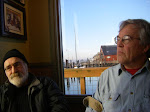
But I went there and had only one. I sat with Rebecca and artist
Richard Gilkey of Fir Island. I sat with them in the booth and listened
mostly because I was too tired to talk. Steve was sitting on a barstool
with his back to us. He turned and asked Rebecca if Amy had come back
for Thanksgiving. Amy is Rebecca’s daughter. She is a freshman at Smith
College in Massachusetts.
“No, she’s not,” Rebecca answered, and she said that Amy had been a
bit homesick, but she has a boyfriend now. The boyfriend drove Amy down
to Baltimore to stay with friends for the holiday and then continued on
to South Carolina.
Steve remarked that it had been snowing back East. Steve is from
Massachusetts and travels frequently on business, going from one big
city to the next, although he rarely has time or energy to look around
these distant places -- just the airport and the hotel. He lives with
Sue Dental in Bonnie McDade’s old house on Snee Oosh Road.
Steve has a round head and face. A rim of black hair surrounds his
evenly bald head and is balanced by a neatly trimmed beard of the same
proportions. He is both cheerful and quiet.
He mentioned that he had a frequent flier discount coupon good for
a roundtrip to the east coast for only $175 and offered it to Rebecca,
who said she was interested.
Then Rebecca began talking about what she calls “mama drama” and
she as able to embarrass her 18-year-old daughter at a distance of 3,000
miles. Amy had been calling home more frequently in the past week
because she was homesick. So Rebecca wrote a note to the senior student
in Amy’s dormitory, telling her that it would soon be Amy’s birthday and
asking her to give Amy a birthday hug from Rebecca. Apparently the
senior student made a big production of this at dinnertime in front of
all the other students.
Rebecca and Amy are a two-person family. They moved here to
LaConner from Mukilteo about seven years ago. Rebecca works as a
waitress at the Lighthouse Inn and has rented several housse and
apartments in LaConner since then. She does not like waitress work
although she has no complaints about her employers at the Lighthouse,
who provide Scandinavian security and stability to their employees, who,
in return, do not leave to work elsewhere. Both mother and daughter are
gifted with a fine intelligence and a yearning to do and be more than
what they are.
Richard Gilkey, the artist, sat across the booth from Becky and
me. He is over sixty. He has short, grey hair, rugged wrinkles and dark,
sparkling eyes. He was wearing a logger’s hickory shirt and drinking
Cutty Sark and water. He had a car accident about five year’s ago which
messed up his shoulder. It has pained him ever since. Two months ago he
had an operation which repaired the rotator cuff and “cleaned up the
debris”, as he put it. The operation had been successful and Richard
praised the doctors. But he talked about how awful it was for him to be
running down to Seattle for treatment. Truck drivers splashed mud on his
car as they passed him.
Rebecca agreed that truck drivers drove much too fast, were strung
out on amphetamines -- how they tail-gated at 65 mph, etc. This was
said without any animosity, but more to continue the conversation which
seemed to want another topic altogether. I supplied one. I mentioned
that Lloyd Trafton commuted down that same freeway everyday to his job
in downtown Seattle.
That reminded Richard that he and Lloyd had been high school
classmates years ago at Ballard High School. Lloyd is in middle
management at IBM and has a 25-year pin. “I don’t know how he does it,”
Richard said. Lloyd frequents Barkley’s and provides an interface
between the corporate world and the rest of us.
Rebecca sat next to me in the booth with her knees up, relaxed as
if she had her shoes off. She told me two times, first when I entered,
and second when I left, how much she liked my red shirt. I replied,
“Yes, I took a bath”, and she laughed.
What I meant was that I looked good because I felt good, and I
felt good because I had done some good outdoor work and got cleaned and
got dressed afterwards. But I was tired and I could only manage that
short phrase. I would also have said that I bought the shirt one day
when I was feeling low. I had driven over to Clear Lake to visit Helen
Farias. She was wearing a red dress which I found very cheerful. She and
talked about how different colors create different moods. I left
Helen’s house and drove directly to J.C. Penney’s where I bought the
reddest flannel shirt I could find for $30. It does tend to cheer people
up.
No one else was in the bar except Ben, the cook, who fills in as
bartender on Sunday night. Ben was wearing his special paisley vest
which everyone admires. He has a long and rather interesting story about
how he acquired it in exchange for a painting. I have offered to rent
the vest from him by the week, but he declines. He lives in Burlington
and is devoted to his work at Barkley’s and to his employer, Michael
Hood.
Michael came in just then, stood behind me and talked to Richard.
Michael and I do not get along well. We ought to get along well, but we
don’t.
He talked to Richard about the opening of the Kaleidos Gallery on
December 1. Susan, the owner of the gallery, had mailed out over 2,000
invitations to God-knows-who. Michael was wondering how many people
would actually show up, since he was catering the event. Richard said,
“Put out a lot of peanuts”.
Richard talked about Janet Huston’s gallery. She is Richard’s dear
friend and show his paintings. She has been collecting names for her
mailing list for 15 years, he said. She is very sharp and professional
about this. The artists approve of Janet because she shows many of them
and brings in buyers with big bucks.
Michael has been a bit short lately, not his usual gracious,
humorous self -- most likely because he lost the election for town
council to Jerry Hedbom by only three votes. Ben had turned the radio
to KPLU in order to hear the jazz and blues program which starts at 7
p.m. and which everyone likes. The problem is that it was only 6:45, so
we were listening to “Car Talk” with Click and Clack from Massachusetts
-- two guys bantering about mechanical problems and fielding calls from
the listeners. Michael wanted the station changed. Ben registered a
mildly strained expression on his face and then switched to classical
music for the remaining 15 minutes.
During a lull in the conversation between Rebecca and Richard, I
decided to talk about recent events in Czechoslovakia. I said that I
enjoyed watching the huge crowds on television -- so full of life and
hope. They both nodded with approval and looked like they were ready for
me to continue on that subject and all the big changes in eastern
Europe, but I was too tired to elaborate.
The conversation drifted on, but slowly my mind came into focus,
and I said, “Can you imagine the conversations and the people talking
about things they never could talk about before, and people talking to
complete strangers, pouring their hearts out -- endless exciting talk?”
Again they nodded with genuine sympathy. And I wanted to say more,
even loudly something like this, Look, I read the newspapers every day
and often watch the TV news. Every little story they cover, they
smother, they frame it up tight and interpret it; they make it clear
that this little bit of news has been “brought to you by CBS” and Dan
Rather is spoonfeeding this little slice of life to you from the network
government.
But what is happening in Eastern Europe is so alive and incredible
that the media cannot interpret or filter or “present” this torrent of
life and awakening. The wall has been torn down, the East Germans are
flooding across, real life is cascading through the airwaves and into
our newspapers and living rooms -- real life, direct, live, unedited.
It’s wonderful.
But I didn’t say it, I was happy just to sit and listen. I left
after one brandy and drove back to the farm. I stopped at Safeway to buy
cornflakes, milk and sugar, which Paul had earnestly requested. I also
bought ten Medjool dates at $2.98 per pound and three golden delicious
apples.