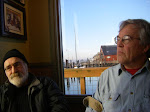
Rick Epting walked into the LaConner Tavern one night in the late spring of 2002. He had been in town for the poetry festival. His poet friends were gathering at Nell Thorn’s pub, but Rick decided to go down market and have a Rainier on tap at the LCT as the locals called it.
Gordy Bell occupied a stool midway and he gave out a Hey to Rick, so they joined company and began to drink the beer, paunch and paunch, side by side. Gordy was a hands-on working man of a liberal persuasion. He ran LaConner’s public works crew, fixing potholes and such. There were two men on his crew, Lynn Berry, wide and squat, an expert with the weed-whacker and twice as smart as he looked, and that other younger guy Brian who looked good but wasn’t really that smart.
Anyway, Gordy had but public works aside for the day and was enjoying the view – although sitting on a bar stool all he saw was the bartender and all those bowls of lottery tickets – meaning he enjoyed the view in his mind, maybe thinking of some good day he had out on Skagit Bay on his boat, and secret places near Hope Island where he could trap the best crabs.
It was that far-away look that grabbed Rick’s attention, and the reason he grabbed a stool next to Gordy, Rick being a word guy, and Rick being a guy who had spent most of last two days listening to poets who were all gathering at Nell Thorn’s to detox from the word-fest with plenteous booze.
“So, Gordy, how does it look?” Rick asked. Gordy raised his glass in response. “I just finished the poetry festival,” Rick began, “I got all these thoughts buzzing in my brain. I got that feeling like a balloon head. I’ve been a musician, you remember Future Pastures? That was my group. Then I helped with the Ducks when they played at Rexville Grange, or you can go back all the way to the beginning of hippie world at Toad Hall in Bellingham, I was there. Then I worked at the newspaper. I interviewed various Berentsons serving in public office. I visited Bud Norris in his county commissioner some-time-Democrat, sometime-Republican office with his feet up on the desk. I convinced Norris to deny the nuclear power plants proposed for Sedro-Woolley, although I can only a take a little credit for that one – but I was part of it. And the Food Co-op, I helped get that going when all they had was 25-pound sacks of brown rice and a cup full of brewers yeast, when the broken down hippies – I mean the hippies in their broken down cars – came in from Walker Valley to spend their food stamps and one of them always needed a jump start to get back to camp. I helped that to go. And I prayed, or I should say I learned not to pray. I learned to be a Buddhist, which means I learned to be the Buddha, I learned we’re all the same inside, what do you think, Gordy?” Rick was very earnest.
Gordy smiled beatifically and said, “Let’s move over by the window, we can watch the tide come in, it’s a 12-foot tide today.”
The LaConner Tavern sits on Swinomish Channel and the back part of the tavern, past the bar and the pool tables, opened to picture windows of the ever-changing current of the channel – four movements of the water, and those four being in, out, up and down, meaning the tide comes in and then it goes out, the water rises and then descends, in a rhythm that only the stars can truly understand, those four movements joined by the sublime non-movement, slack tide, when the surface of the water takes on a mirror finish on a windless day and stillness reigns.
So Gordy steered Rick over to a table by the window and the waitress brought them two more flagons. The sunset burnished the sky over the Swinomish Reservation across the channel. “There be Indians,” Gordy intoned, pointing across the channel.
“No, I can’t see them,” Rick replied. “You can’t see them with your eyes wide open,” Gordy said.
Rick closed his eyes and began chanting, “Om, Om, Om.”
“Now, see the salmon,” Gordy said. “They come up from Padilla Bay in flocks and herds and schools, splashing and leaping, mad with sex and desire, salty and driven by wind, they come into the channel and then down the channel, and past the tavern right here, and they go around to Hole-in-the-Wall and then up the river.”
“I can’t see any fish,” Rick cried now in anguish.
“Close your eyes,” Gordy said. “Forget about now. Times goes forward and backward just like the tide. There was lots of salmon back then. Turn your head back one hundred years. Can you see the salmon now?”
“Yes,” Rick said, “I see them leaping!”
Jimmy Schermerhorn walked in to the bar, saw Gordy and Rick and came by to say Hey. Jimmy didn’t drink anymore, he just came in to use the men’s room, but he pulled up a chair for the moment. “Hey, Rick, how did you like the poetry festival?”
Rick said, “It was awesome. The poets chanted and we could see the salmon leaping.”
Later, Rick drove back to his home in Mount Vernon and Gordy went back to his bar stool. He asked the waitress, "Who was that guy I was talking to?”
Thursday, May 31, 2012


Sunday, May 20, 2012
Ben Munsey leaped over the fence
Ben Munsey leaped over the fence that June day in 2002. He crashed the party at the Museum of Northwest Art in LaConner, the annual fundraising auction fueled by high-ticket prices. Munsey didn’t have the money and he didn’t believe he should have paid anyway.
Docents guarded the front gates of the museum that fine summer evening, smiling at the ticket holders, but glaring at street urchins like Munsey.
“I’m too told to be an urchin, I’m past fifty years now. I teach English at Skagit Valley College, but I’ll be damned if I’ll pay $150 to eat shrimp off an ice sculpture and speak nonsense with nobodies from Seattle who come to the valley to ride their bikes past fields full of sweating Mexicans picking strawberries. I live here. I’ve been here a long time, before they built this museum. There was an apple tree right here, the tree was here for years, in a field of tall grass, before they built the museum, which I call a mausoleum, a burial place for the living art which once graced this little town, before the swells came and bought it up, and the before the docents came to keep out the riff-raff. But I am talking to myself,” Munsey said.
He spotted Singin’ Dan, who used to live on the river, a former river rat like himself, a denizen of Fishtown and Shit Creek, a slum dog drummer on Bald Island summer nights. “Dan, I thought you didn’t live here any more,” Munsey said.
“Well, I don’t live here anymore,” Singin’ Dan said, “I sort of got married and I sort of live in Olympia now.”
“Okay, so maybe we can sort of get a beer or something,” Munsey said.
And they stood there on the sidewalk, watching the patrons ensconce from polished vehicles. “Pretty soon they’ll have valet parking,” Singin’ Dan said.
Then it was like – not a plan, no, without any intention, or desire, or any voice of complaint or rebellion, but as natural as the tide rising that Munsey and Singin’ Dan drifted around to the back entrance of the museum, where the busboys unloaded the catered dishes, where the portable fence was installed to guard the premises on this special fund-raising evening -- a fence that looked like a double dare to two old hippies.
Munsey and Singin’ Dan – years later they both said “I thought it was your idea” – but it wasn’t anyone’s idea, more like the purest of action, despite being much too old for such a stunt – they leaped over the fence, Singin’ Dan easily and thinner, but Munsey with a beer-filled paunch dragging over the top rail.
It felt like robbing a bank, Munsey said later, you might spend twenty years in prison, but for a few seconds you feel more freedom than you ever felt in your life – like a vision of ecstasy, like breaking the law is even breaking the law of gravity and you’re flying.
They dashed right into the main gallery of the museum, to the fountain of ice festooned with dainty bowls of shrimp and smoked salmon and real wine glasses for the white wine, people talking in summer dresses and heels and linen sport coats, juggling napkins, and some idiot playing the guitar in the corner to give it that lah-di-dah flavor.
Munsey and Singin’ Dan filled up their dainty plates, but the matron came barreling down – it was Kathleen Willens in a stern, very stern voice who came bearing down with the brunt of the law, because she had been told by the bus boys that two old hippies had crashed the gate and leaped over the fence.
In truth, Munsey and Singin’ Dan stood out from the crowd and, besides that, Willens knew them for who they were, knew that Munsey and Singin’ Dan needed to be watched and suspected. She marched up to them and asked to see their tickets, knowing as well as the skies above that they did not have any tickets
Willens could have let them stay, if only for a hoot. How did all that art get to the musuem if it wasn’t for a hoot?
But the hoot was over, there was no more drinking sake at Fishtown. No, by the summer of 2002 it was all in the can, under lock and key at the museum, and creatures like Munsey and Singin’ Dan may as well move on down the road. If you don’t have a ticket that’s just too damn bad.
What is a Poem? I wrote this little prose poem to prove a point. For the seventh time, I was not invited to read my words at the Skagit River Poetry Festival. The nominating committee gets completely anal about their selections. They turned me down because I'm not a poet and I don't write poetry, which is pretty goddam picky if you ask me...... This obsession with classification and genre really gets pathetic..... I happen to be a writer who does not fit well into any category....Do you know how many times they wouldn't hire me at the newspaper because they thought I was a poet? The newspaper says I'm too much of a poet, go away. Then the poetry committee says I'm not a poet because I have committed acts of journalism -- excuse me for complaining. Have a great day.
the annual spring subscription drive.
Save Frog Hospital!
Actually we don't need saving and we face no crisis, but we sure could use a few checks. Subscription revenue keeps the editor from getting cranky. It makes me feel good. It helps me to point out the good things going on in our trouble world. Subscription revenue prevents the harsh tones of self-righteousness. It helps me to make my point without preaching.
So please make out a check to Fred Owens for $25 and mail it to
Fred Owens
35 West Main Street, Suite B #391
Ventura CA 93001
Or, much easier, go to the Frog Hospital blog and hit the PayPal button.
Docents guarded the front gates of the museum that fine summer evening, smiling at the ticket holders, but glaring at street urchins like Munsey.
“I’m too told to be an urchin, I’m past fifty years now. I teach English at Skagit Valley College, but I’ll be damned if I’ll pay $150 to eat shrimp off an ice sculpture and speak nonsense with nobodies from Seattle who come to the valley to ride their bikes past fields full of sweating Mexicans picking strawberries. I live here. I’ve been here a long time, before they built this museum. There was an apple tree right here, the tree was here for years, in a field of tall grass, before they built the museum, which I call a mausoleum, a burial place for the living art which once graced this little town, before the swells came and bought it up, and the before the docents came to keep out the riff-raff. But I am talking to myself,” Munsey said.
He spotted Singin’ Dan, who used to live on the river, a former river rat like himself, a denizen of Fishtown and Shit Creek, a slum dog drummer on Bald Island summer nights. “Dan, I thought you didn’t live here any more,” Munsey said.
“Well, I don’t live here anymore,” Singin’ Dan said, “I sort of got married and I sort of live in Olympia now.”
“Okay, so maybe we can sort of get a beer or something,” Munsey said.
And they stood there on the sidewalk, watching the patrons ensconce from polished vehicles. “Pretty soon they’ll have valet parking,” Singin’ Dan said.
Then it was like – not a plan, no, without any intention, or desire, or any voice of complaint or rebellion, but as natural as the tide rising that Munsey and Singin’ Dan drifted around to the back entrance of the museum, where the busboys unloaded the catered dishes, where the portable fence was installed to guard the premises on this special fund-raising evening -- a fence that looked like a double dare to two old hippies.
Munsey and Singin’ Dan – years later they both said “I thought it was your idea” – but it wasn’t anyone’s idea, more like the purest of action, despite being much too old for such a stunt – they leaped over the fence, Singin’ Dan easily and thinner, but Munsey with a beer-filled paunch dragging over the top rail.
It felt like robbing a bank, Munsey said later, you might spend twenty years in prison, but for a few seconds you feel more freedom than you ever felt in your life – like a vision of ecstasy, like breaking the law is even breaking the law of gravity and you’re flying.
They dashed right into the main gallery of the museum, to the fountain of ice festooned with dainty bowls of shrimp and smoked salmon and real wine glasses for the white wine, people talking in summer dresses and heels and linen sport coats, juggling napkins, and some idiot playing the guitar in the corner to give it that lah-di-dah flavor.
Munsey and Singin’ Dan filled up their dainty plates, but the matron came barreling down – it was Kathleen Willens in a stern, very stern voice who came bearing down with the brunt of the law, because she had been told by the bus boys that two old hippies had crashed the gate and leaped over the fence.
In truth, Munsey and Singin’ Dan stood out from the crowd and, besides that, Willens knew them for who they were, knew that Munsey and Singin’ Dan needed to be watched and suspected. She marched up to them and asked to see their tickets, knowing as well as the skies above that they did not have any tickets
Willens could have let them stay, if only for a hoot. How did all that art get to the musuem if it wasn’t for a hoot?
But the hoot was over, there was no more drinking sake at Fishtown. No, by the summer of 2002 it was all in the can, under lock and key at the museum, and creatures like Munsey and Singin’ Dan may as well move on down the road. If you don’t have a ticket that’s just too damn bad.
What is a Poem? I wrote this little prose poem to prove a point. For the seventh time, I was not invited to read my words at the Skagit River Poetry Festival. The nominating committee gets completely anal about their selections. They turned me down because I'm not a poet and I don't write poetry, which is pretty goddam picky if you ask me...... This obsession with classification and genre really gets pathetic..... I happen to be a writer who does not fit well into any category....Do you know how many times they wouldn't hire me at the newspaper because they thought I was a poet? The newspaper says I'm too much of a poet, go away. Then the poetry committee says I'm not a poet because I have committed acts of journalism -- excuse me for complaining. Have a great day.
the annual spring subscription drive.
Save Frog Hospital!
Actually we don't need saving and we face no crisis, but we sure could use a few checks. Subscription revenue keeps the editor from getting cranky. It makes me feel good. It helps me to point out the good things going on in our trouble world. Subscription revenue prevents the harsh tones of self-righteousness. It helps me to make my point without preaching.
So please make out a check to Fred Owens for $25 and mail it to
Fred Owens
35 West Main Street, Suite B #391
Ventura CA 93001
Or, much easier, go to the Frog Hospital blog and hit the PayPal button.
Friday, May 11, 2012
Attachment Parenting
Frog Hospital – May 11, 2012 – Unsubscribe anytime
ATTACHMENT PARENTING
By Fred Owens
Attachment parenting is the latest fad. The tenets of attachment parenting are as follows: 1. No strollers, carry the infant at all times. 2. No cribs, bring the baby to your own bed. 3. Keep the child on the breast for a long time, with no early weaning.
When I read about this "exciting new trend in parenting" -- there was something familiar about it, something that rang a bell, and then I remembered -- attachment parenting is nothing but a re-hash of Third World poverty-induced family habits..... This is something I saw everywhere when I was in Africa -- nobody uses a stroller, they don't have the money, none of those Babys-R-Us geegaws either. In Africa, babies are carried on their mother's back, all day long, or their older sister's back, all day long.
In Africa, people live all in one room and sleep on the floor, very commonly. Babies don't have cribs, they lie next to their moms and dads, or very nearby, surely not in some other room -- there is no other room.
And babies are on the breast everywhere in Africa. Who has the money to buy formula?
So we have this curious situation in America where relatively affluent mothers, from choice and not from necessity, are adopting the child-care practices of Third World mothers who really don't have a choice.
I don't object to the practices of attachment parenting per se, but I think this connection with poor African women should be acknowledged.
I only advise young mothers and fathers to trust their own judgment and trust their own instincts. Babies thrive in a relaxed atmosphere.
Obama is a Lucky Man
Obama is a lucky man to have Mitt Romney for an opponent, and Obama will win easily in November. But I am totally dissatisfied with Barack Obama, and I have no place to go. I have no leverage with this man. He doesn't need my help, he doesn't need my money, and when he wins a second term, he won't be working for me.....So the best thing I can do is put my efforts elsewhere, and local issues seem like the best place to go..... I wrote a story in the local paper about the condition of the sidewalks which are crumbling all over. Los Angeles is ten years behind schedule on sidewalk maintenance.
Where did all the money go? Yes, sidewalk maintenance is a totally non-exciting topic but a much better use of my time than going to an Obama election rally.
Alley Cruising in Venice. I have also spent more than 8 hours this week on a personally-guided tour of all the alleys in Venice, the Los Angeles neighborhood where I am staying right now. Again, this is not a glamorous topic, but it’s real. I have taken notes and photos, and discussed the alleys – their uses and abuses – with local residents. I will write another story about alleys for the local paper.
I was walking down the alley – it’s quiet and bare. There’s no traffic – it’s much quieter than the street. The pavement is cracked and crumbling but not really in bad shape. I would call it serviceable. I need to find someone in a motorized or hand-propelled wheel chair and ask them if the Venice alleys are navigable – if they are usable – but they seem okay.
I didn’t see any nasty garbage or fast-foot debris. No foul odors, no creepy corners -- basically folks are picking up after themselves. I saw one unleashed dog. He was a very old fellow, just limping along and no harm to anyone. The good thing is the very widespread custom of dog-owners cleaning up after their dogs – you don’t step in it very often.
I saw one furtive drug transaction – maybe it was drugs – but the young woman handed something to the young man while they both looked around to see if anyone was watching. I just kept walking.
Apart from that one dubious transaction, after some 8 hours of alley walking, I saw only good people going about their business - - like fixing cars and so forth. The alleys are safe.
I saw nasturtiums, wild fennel, lantana, geraniums, and various weeds and wildflowers springing from cracks in the pavement. I did not see any rats, raccoons, possums, feral cats, nor coyotes, but they are surely present. There’s an old saying, which I just made up, “You may not see the coyote, but he sees you.”
This is boring. Boring is good. The alleys in Venice are in good shape, so you can check that one off your list.
Unfortunately Unemployed. The thing is, I’m out of work. So here’s how I spend my day – I budget 45 minutes each morning for anger, resentment and depression because I am not a fully evolved person. My current resentment is against Obama and George Clooney for sponsoring a $40,000 per plate fundraiser -- I don’t like the way this makes me feel small.
But we move on. I look for gainful employment naturally, but that doesn’t take up the whole day. That’s why I come up with volunteer community-service work as a way to fill out my day in a positive manner – like my sidewalk and alley project. I strongly urge and recommend to any who is unemployed like I am right now – do not sit at home waiting for the phone to ring, stewing in your own juices. Get out of the house and do something. If you can’t find paying work, then do volunteer work.
I would say more, but that would be preaching – and we never do that at Frog Hospital.
Thank You. Thank you, Harriet Spanel for your subscription check. Harriet is the former state senator from Bellingham, Washington.
Save Frog Hospital!
Actually we don't need saving and we face no crisis, but we sure could use a few checks. Subscription revenue keeps the editor from getting cranky. It makes me feel good. It helps me to point out the good things going on in our trouble world. Subscription revenue prevents the harsh tones of self-righteousness. It helps me to make my point without preaching.
So please make out a check to Fred Owens for $25 and mail it to
Fred Owens
35 West Main Street, Suite B #391
Ventura CA 93001
Or, much easier, go to the Frog Hospital blog and select the PayPal button
Tuesday, May 08, 2012

Saturday, May 05, 2012
Yard Art. I made this display of yard art when I lived on the old farm up in Ventura. The plant is a cilantro. In back of the plant is a rectangle holding the pale moon, which I painted, and both sit upon an old oak chair. In the background we see more old chairs and the outer edge of the chicken coop. This is how we make our yards beautiful – by taking stuff that is already there – that’s the key – don’t be going to the store and buying things – the key to yard art is artfully re-arranging what you already have. In fact, you can live your whole life this way.


Friday, April 13, 2012
People are like Plants
People are like plants. They need water, nourishment, sunshine, and a certain amount of attention. The cells of people are made of the same stuff as plants -- carbon, hydrogen, oxygen, nitrogen, sulfur, phosphorus, magnesium, calcium, iron and copper ( I hope I got that right ) ...... I think plants need a few trace elements as well -- zinc, molybdenum..... Anyway, that's what my botany book says. It was published in 1963, and the author himself says further research might change the list of the essential cell-building elements. But it would still be safe to say that YOU are LIKE a TULIP in many respects.
The First Law of Thermodynamics: Energy can be changed from one form to another, but it cannot be created or destroyed. The total amount of energy and matter in the Universe remains constant, merely changing from one form to another............. Says who? What if the universe had a leak?
A Wet Spring in Southern California. We had a dry and mild winter, but it seems to be raining well enough this spring – even today, pouring down, where I am staying in the Santa Monica Mountains. The hills are bursting with green grass and the yellow of wild mustard. I saw rocks tumbling off the hill by the highway -- I hope it doesn’t slide.
Mudslides, Earthquakes, and Brush Fires. We have mudslides and earthquakes here, as you know, but the ones that people fear, the ones they talk about with dread, are the fires, the brush fires that can race faster than a car. Just yesterday, I was having coffee with Mike and he said why doesn’t the grounds crew clean up the pine needles that are heaped by the stream -- pine needles are good tinder and set ablaze by the smallest spark during the hot, dry months of late summer.
Bad Weather. Chicago had eighty degree temperatures in March and violent tornadoes sprung up all across the Midwest -- it was much too early in the season. Heat records were broken. Is it global warming? Or is it God’s vengeance? Or does it just happen sometimes?
I won’t settle that question here, but say that no matter what explanation makes sense to you, if we have extremes of weather, we need to be prepared and work together. We need to work with the people who don’t agree with. Tornadoes can kill Republicans and Democrats equally and they might come in unusual places and at unpredictable times. If you live in Oklahoma, you know the drill, but people in California haven’t got a clue.
But what if a tornado did spring up in California? Would you know what to do? Lots of people in California are prepared for an earthquake -- but perhaps a kind all-over preparedness might be better – and a determination to survive, along with a spiritual acceptance of events beyond our control.
I support the climate-change hypothesis, that human activity has become a major cause of it. That’s one of the reasons I am studying the botany text – so that I can make a serious inquiry into the works of climate scientists, because I will never say I “believe” in climate change. The word belief in this context is a casual but damaging mis-use of language.
I’m smart enough, and you are too -- to actually read some of this stuff, and follow the logic and test the scientific evidence -- I think we kind of have to do that -- because it’s not a matter of faith, it’s a matter of rational skepticism.
Or maybe it is the plagues of old Egypt come to visit us and punish the wicked -- either way, it’s best to keep a battery-operated radio on hand, plus some canned goods, and maybe five-gallons of drinking water.
And a couple of one-pounds cans of coffee. If I had a hot cup of coffee in the morning, I could face the Apocalypse.
The First Law of Thermodynamics: Energy can be changed from one form to another, but it cannot be created or destroyed. The total amount of energy and matter in the Universe remains constant, merely changing from one form to another............. Says who? What if the universe had a leak?
A Wet Spring in Southern California. We had a dry and mild winter, but it seems to be raining well enough this spring – even today, pouring down, where I am staying in the Santa Monica Mountains. The hills are bursting with green grass and the yellow of wild mustard. I saw rocks tumbling off the hill by the highway -- I hope it doesn’t slide.
Mudslides, Earthquakes, and Brush Fires. We have mudslides and earthquakes here, as you know, but the ones that people fear, the ones they talk about with dread, are the fires, the brush fires that can race faster than a car. Just yesterday, I was having coffee with Mike and he said why doesn’t the grounds crew clean up the pine needles that are heaped by the stream -- pine needles are good tinder and set ablaze by the smallest spark during the hot, dry months of late summer.
Bad Weather. Chicago had eighty degree temperatures in March and violent tornadoes sprung up all across the Midwest -- it was much too early in the season. Heat records were broken. Is it global warming? Or is it God’s vengeance? Or does it just happen sometimes?
I won’t settle that question here, but say that no matter what explanation makes sense to you, if we have extremes of weather, we need to be prepared and work together. We need to work with the people who don’t agree with. Tornadoes can kill Republicans and Democrats equally and they might come in unusual places and at unpredictable times. If you live in Oklahoma, you know the drill, but people in California haven’t got a clue.
But what if a tornado did spring up in California? Would you know what to do? Lots of people in California are prepared for an earthquake -- but perhaps a kind all-over preparedness might be better – and a determination to survive, along with a spiritual acceptance of events beyond our control.
I support the climate-change hypothesis, that human activity has become a major cause of it. That’s one of the reasons I am studying the botany text – so that I can make a serious inquiry into the works of climate scientists, because I will never say I “believe” in climate change. The word belief in this context is a casual but damaging mis-use of language.
I’m smart enough, and you are too -- to actually read some of this stuff, and follow the logic and test the scientific evidence -- I think we kind of have to do that -- because it’s not a matter of faith, it’s a matter of rational skepticism.
Or maybe it is the plagues of old Egypt come to visit us and punish the wicked -- either way, it’s best to keep a battery-operated radio on hand, plus some canned goods, and maybe five-gallons of drinking water.
And a couple of one-pounds cans of coffee. If I had a hot cup of coffee in the morning, I could face the Apocalypse.
Thursday, March 29, 2012
Hoodies?
Gratitude. Thank you, Barbara Z, for renewing your subscription to Frog Hospital. Your check for $25 is very gratefully received.
Barbara Z is one of many intelligent, socially-concerned subscribers to the Frog Hospital newsletter. You can join this excellent team. For more information on our spring subscription drive, see the bottom of this newsletter.
Ted P. from Boston sent a check. He's been with Frog Hospital since the beginning, in 1999. He sends me postcards from far away places like Cuba or Finland, but he gets around and sees the world. I got to know Ted years ago, in 1993 when I lived in Boston and belonged to the local Tikkun group.
Spring. I left the dahlia farm in Ventura after 17 months. I had hoped to stay long enough to see the sweet peas blooming again because I had worked on that crop all winter. But things didn't work out. I was replaced by another fellow -- I guess you could say he shared the owners' vision, while I did not.
I landed on my feet, and I think that's why I like living in southern California so much. The day after I left the farm, I secured a six-week job restoring two gardens in Altadena, at pay better than I was making on the farm, so I guess that's all right.
It's landscaping work, which pays a lot better than farm work, except it's not steady. You have to hustle and network and accept it that down periods will come and nobody calls. But I put my rate low enough to catch the market and there is more work out there -- I'll find it. They might even find me -- whew!
The weather has been good. We had some decent late-winter rains, so the hills might green up a little bit.
Hoodies?
The only time I ever got beat up by a cop I was wearing a hoodie. This happened in January 1976 in a suburb of Orlando ( not Sanford, but nearby ). It late at night. Wearing a hoodie, you can't see the face too well. I compounded the error by thrusting my hands in my pockets -- a stupid move. The cop worked me over with his night stick. A young man should know -- keep your hands visible and don't cover your face. That's been my custom ever since......... Orlando was kind of a nice place in 1976, before Disney World blew the place all to hell. But back before that it was a sleepy southern time, and we were there that winter, just hanging out in the park downtown, enjoying the sunshine......... The thing is -- what was I doing wandering around at 2 a.m. in the morning? That's when I ran into the cop. I decided, after this one-sided altercation, that I just ought to get off the street and stop hanging around.... Shortly after this, I asked my sweetheart to marry me, and we had two children and the rest is history.... That's how it worked for me.
But I'm still careful about where and when I put on a hoodie. It shows very poor judgment on the part of Trayvon Martin's supporters to be using the hoodie as a symbol of righteousness. I stand with Trayvon and his supporters, and I say keep your face free where I can see all of it and keep your hands out of your pockets and pull up your pants.
And, jeez, I wouldn't ever go back to one of those cracker-barrel redneck towns in Florida. The cops didn't hate Trayvon,. They weren't glad he died, but there's seems to a lot of evidence that they took the easy way out, like how can we resolve this situation with the least amount of paperwork and expense. Because a homicide in a small town is a huge problem. First of all, they don't have their own full-time homicide investigator, so they need to bring one in from the big city, some wise-guy know-it-all who takes over the investigation and makes everyone else look like a bunch of hicks. So they don't want to do that.
What I think is that Trayvon Martin is lying dead on the sidewalk and the cops are strategizing on a plausible scenario and a way to wrap this thing up -- Self Defense! Yes, that could work, and that's where the racial prejudice comes into play. Trayvon Martin. His people are not well-connected. They won't fight the ruling. We can spare ourselves a lot of paperwork.
Not forgetting the expense of a murder trial that could absolutely ruin the budget of a small town in Florida. So they had reasons -- they wanted that self defense ruling. They were all sweating in their socks. They knew their careers were at stake......Or they just wanted to go home that awful night, and maybe they just didn't care enough about the youth bleeding, now dead, on the sidewalk.
the annual spring subscription drive.
Save Frog Hospital!
Actually we don't need saving and we face no crisis, but we sure could use a few checks. Subscription revenue keeps the editor from getting cranky. It makes me feel good. It helps me to point out the good things going on in our trouble world. Subscription revenue prevents the harsh tones of self-righteousness. It helps me to make my point without preaching.
So please make out a check to Fred Owens for $25 and mail it to
Fred Owens
35 West Main Street, Suite B #391
Ventura CA 93001
Or, much easier, go to the Frog Hospital blog and hit the PayPal button.
Cops in Florida. Okay, back to my essay about cops in Florida. It seems that this little town in Florida might be one of those shit-heel places where the mayor's brother gets arrested for running a meth lab, and the town treasurer is embezzling the funds, and the town council members are all first cousins to each other. These places exist and they have lousy cops and the harsh glare of national publicity is what they deserve.
But I wouldn't smear the whole region. Not every small southern town is like that -- some are just as good as anyplace on earth -- you know, Mayberry, with Andy Griffith and Barney Fife -- that's not a total fairy tale, it's real and it's the flip-side to this sordid tale from central Florida.
--
Fred Owens
cell: 360-739-0214
My blog is Fred Owens
send mail to:
Fred Owens
7922 Santa Ana Rd
Ventura CA 93001
Tuesday, March 06, 2012
Native Schmative
I had a cosmic experience at the car lot. Laurie and I went car shopping this Sunday in Santa Barbara. Our first stop was Hughes Pontiac. The salesman, Gary Tschantz, came out to greet us and I told him I owned a Toyota but it was getting old, and did he have a newer one for less than $7,000. He said, "I know just what you need, follow me." So we walked over with him and he showed me a Buick…… What part of Toyota don't you understand I wanted to say.
But instead I let him give me a pitch for the Buick. Well, it was in pretty good shape and only had 88k miles on it, a golden Buick LeSabre from the year 2002. And he would sell it for $6,600 -- or less.....Okay, this is the wonderful thing about the guys who sell cars -- they really know how to read people. They live or die by how well they can read people. And Gary Tschantz had me pegged from the minute I got to his car lot -- that I was, in fact, an Inner Buick man, that I had owned and enjoyed two Buicks and I loved the ride..... This is where we get to the difference between a Japanese car and a car made in Detroit..... I love my Toyota, it runs good, it never breaks, it looks nice, and it doesn't use much gas, that's why I love it. But a good Buick -- you could LOOOOOOOOOOOOVE a good Buick.
Anyway, I knew I liked the car, but I told Gary I was only looking and so we left, and went to three other dealers and looked at some nice Toyotas and Hondas -- reasonable cars at reasonable prices.
That was Sunday. Today is Monday and here's where it gets cosmic, because I left Santa Barbara in the morning and drove to Ventura to pick up my mail and stop by Tuneups UnLimited on Thompson BLVD where my friend Redgie works as a mechanic. He's my go-to guy for car-buying decisions and he had advised me all along to get another Toyota.
But I had this funny feeling. I found him in his office and I was about to tell him about my car shopping venture the day before, but instead I asked him, "Redgie, what kind of car do you drive?"
"A Buick," he said. "It's out on the lot."
(Insert cosmic vibration music, like some kind of telepathic connection to Detroit)
I go out to see Redgie's car and I swear this is true -- he owns and drives the exact same car that I was looking at -- a 2002 Buick LeSabre only it's silver instead of gold.
"Oh, it's a good car," Redgie, "and it gets pretty good mileage on the highway."
So, will I buy the Buick? -- maybe. I won't be back to Santa Barbara until next Sunday, but if the car is still there, I'm going to take it for a test drive.
More Car Talk. We see interesting patterns in car buyers. Left coast liberals buy Japanese cars made by non-union labor in Alabama, but crusty old farmers from Nebraska by Buicks made by union labor in Detroit. Can somebody explain this to me?
Casey Stengel Said. Casey Stengel once said that “most ballgames are lost, not won.”
Harvey Blume Responded. i was just thinking about casey stengel. i remember him well, the things he sd. they prepared me for "finnegan's wake". people quote yogi a lot. that's cause yogi's nonsense made sense. but you won't find good compilations of casey stengel'...
Then I said. Casey Stengel understood a lot of things, and he didn't say "Nice guys finish last." ………… Who did?
MAIMONIDES in the MORNING. Reading Maimonides is a superior way to begin your day. He was a philosopher, legal scholar, and physician, his fame was worldwide, his authority was respected by Moslem and Jew alike. He lived in Cairo for many years and during those times Jews and Moslem lived together well. They sometimes shared a business together, such as goldsmithing. The Jew would go home on Saturday, his Sabbath, and the Moslem would go home on Friday, his Sabbath, and that way the shop could stay open seven days a week -- a pleasant arrangement, don't you think? But the Jews at that time, although prosperous and widely travelled, were a formally dependent people. They must pay a certain respect to the Caliph and they must, in certain ways, recognize the superiority of Islam.That live and let live arrangement lasted until 1948 when the Jews declared independence -- they would no longer bend a knee to the Caliph. The furious reaction to that independence continues since that fateful year of 1948. I wonder what Maimonides would say about that, because his life was dedicated to accommodation, to working things out under the current conditions. The thrust of his scholarship was to bring reason and scientific understanding to bear on traditional biblical studies, but he was no revolutionary and he never defied the Caliph.
I have a friend, an email correspondent, whom I never met, but he's a Jew and he was born in Cairo, and his family was expelled from Cairo in 1948. In that year all the Jews were kicked out of Cairo, where they had lived for several hundreds of years, since the time of Maimonides, but they were kicked out and so his family migrated to Italy where he acquired Italian citizenship as a young boy -- they then moved to Israel and that is where he grew up. Now this man owns a vineyard in the Judean Hills, called Domain du Castel. He makes fine wine and he hopes to stay on this land forever, but ----- BUT, he still keeps his Italian passport, because he knows he might not be able to keep his vineyard for all his days. There is no promise of tomorrow for independent Israel, but for now, he does not bend his knee to the Caliph -- do you think he should?
from Wikipedia
Moses ben-Maimon, called Maimonides and also known as Mūsā ibn Maymūn (Arabic: موسى بن ميمون), or Rambam (רמב"ם – Hebrew acronym for "Rabbi Moshe ben Maimon"), was a preeminent medieval Jewish philosopher and one of the greatest Torah scholars and physicians of the Middle Ages. He was born in Córdoba, Almoravid Empire (present-day Spain) on Passover Eve, 1135, and died in Egypt (or Tiberias) on 20th Tevet, December 12, 1204.[6] He was a rabbi, physician and philosopher in Morocco and Egypt.
Subscription Drive. The annual subscription drive begins today -- we do it every spring and rake in a few hundred dollars as a reward for our effort throughout the year -- doing this newsletter twelve years now.... It is a great group of readers we have, like lawyers -- we have a few lawyers on the mailing list -- Pat Paul in LaConner, Felicia Value, also in LaConner, Aisha Barbeau in Alameda, California, and the inestimable, always Irish Ed Burke in Framingham, Massachusetts.......So, when you read the Farm News/Frog Hospital, you are part of a high-quality crowd.
Send your $25 check today. Make it out to "Fred Owens" and mail it to 7922 Santa Ana RD Ventura, CA 93001. Or use Pay Pal -- go to the Frog Hospital blog and hit the Pay Pal button.
--
Fred Owens
cell: 360-739-0214
My blog is Fred Owens
send mail to:
Fred Owens
7922 Santa Ana Rd
Ventura CA 93001
--
Fred Owens
cell: 360-739-0214
My blog is Fred Owens
send mail to:
Fred Owens
7922 Santa Ana Rd
Ventura CA 93001
But instead I let him give me a pitch for the Buick. Well, it was in pretty good shape and only had 88k miles on it, a golden Buick LeSabre from the year 2002. And he would sell it for $6,600 -- or less.....Okay, this is the wonderful thing about the guys who sell cars -- they really know how to read people. They live or die by how well they can read people. And Gary Tschantz had me pegged from the minute I got to his car lot -- that I was, in fact, an Inner Buick man, that I had owned and enjoyed two Buicks and I loved the ride..... This is where we get to the difference between a Japanese car and a car made in Detroit..... I love my Toyota, it runs good, it never breaks, it looks nice, and it doesn't use much gas, that's why I love it. But a good Buick -- you could LOOOOOOOOOOOOVE a good Buick.
Anyway, I knew I liked the car, but I told Gary I was only looking and so we left, and went to three other dealers and looked at some nice Toyotas and Hondas -- reasonable cars at reasonable prices.
That was Sunday. Today is Monday and here's where it gets cosmic, because I left Santa Barbara in the morning and drove to Ventura to pick up my mail and stop by Tuneups UnLimited on Thompson BLVD where my friend Redgie works as a mechanic. He's my go-to guy for car-buying decisions and he had advised me all along to get another Toyota.
But I had this funny feeling. I found him in his office and I was about to tell him about my car shopping venture the day before, but instead I asked him, "Redgie, what kind of car do you drive?"
"A Buick," he said. "It's out on the lot."
(Insert cosmic vibration music, like some kind of telepathic connection to Detroit)
I go out to see Redgie's car and I swear this is true -- he owns and drives the exact same car that I was looking at -- a 2002 Buick LeSabre only it's silver instead of gold.
"Oh, it's a good car," Redgie, "and it gets pretty good mileage on the highway."
So, will I buy the Buick? -- maybe. I won't be back to Santa Barbara until next Sunday, but if the car is still there, I'm going to take it for a test drive.
More Car Talk. We see interesting patterns in car buyers. Left coast liberals buy Japanese cars made by non-union labor in Alabama, but crusty old farmers from Nebraska by Buicks made by union labor in Detroit. Can somebody explain this to me?
Casey Stengel Said. Casey Stengel once said that “most ballgames are lost, not won.”
Harvey Blume Responded. i was just thinking about casey stengel. i remember him well, the things he sd. they prepared me for "finnegan's wake". people quote yogi a lot. that's cause yogi's nonsense made sense. but you won't find good compilations of casey stengel'...
Then I said. Casey Stengel understood a lot of things, and he didn't say "Nice guys finish last." ………… Who did?
MAIMONIDES in the MORNING. Reading Maimonides is a superior way to begin your day. He was a philosopher, legal scholar, and physician, his fame was worldwide, his authority was respected by Moslem and Jew alike. He lived in Cairo for many years and during those times Jews and Moslem lived together well. They sometimes shared a business together, such as goldsmithing. The Jew would go home on Saturday, his Sabbath, and the Moslem would go home on Friday, his Sabbath, and that way the shop could stay open seven days a week -- a pleasant arrangement, don't you think? But the Jews at that time, although prosperous and widely travelled, were a formally dependent people. They must pay a certain respect to the Caliph and they must, in certain ways, recognize the superiority of Islam.That live and let live arrangement lasted until 1948 when the Jews declared independence -- they would no longer bend a knee to the Caliph. The furious reaction to that independence continues since that fateful year of 1948. I wonder what Maimonides would say about that, because his life was dedicated to accommodation, to working things out under the current conditions. The thrust of his scholarship was to bring reason and scientific understanding to bear on traditional biblical studies, but he was no revolutionary and he never defied the Caliph.
I have a friend, an email correspondent, whom I never met, but he's a Jew and he was born in Cairo, and his family was expelled from Cairo in 1948. In that year all the Jews were kicked out of Cairo, where they had lived for several hundreds of years, since the time of Maimonides, but they were kicked out and so his family migrated to Italy where he acquired Italian citizenship as a young boy -- they then moved to Israel and that is where he grew up. Now this man owns a vineyard in the Judean Hills, called Domain du Castel. He makes fine wine and he hopes to stay on this land forever, but ----- BUT, he still keeps his Italian passport, because he knows he might not be able to keep his vineyard for all his days. There is no promise of tomorrow for independent Israel, but for now, he does not bend his knee to the Caliph -- do you think he should?
from Wikipedia
Moses ben-Maimon, called Maimonides and also known as Mūsā ibn Maymūn (Arabic: موسى بن ميمون), or Rambam (רמב"ם – Hebrew acronym for "Rabbi Moshe ben Maimon"), was a preeminent medieval Jewish philosopher and one of the greatest Torah scholars and physicians of the Middle Ages. He was born in Córdoba, Almoravid Empire (present-day Spain) on Passover Eve, 1135, and died in Egypt (or Tiberias) on 20th Tevet, December 12, 1204.[6] He was a rabbi, physician and philosopher in Morocco and Egypt.
Subscription Drive. The annual subscription drive begins today -- we do it every spring and rake in a few hundred dollars as a reward for our effort throughout the year -- doing this newsletter twelve years now.... It is a great group of readers we have, like lawyers -- we have a few lawyers on the mailing list -- Pat Paul in LaConner, Felicia Value, also in LaConner, Aisha Barbeau in Alameda, California, and the inestimable, always Irish Ed Burke in Framingham, Massachusetts.......So, when you read the Farm News/Frog Hospital, you are part of a high-quality crowd.
Send your $25 check today. Make it out to "Fred Owens" and mail it to 7922 Santa Ana RD Ventura, CA 93001. Or use Pay Pal -- go to the Frog Hospital blog and hit the Pay Pal button.
--
Fred Owens
cell: 360-739-0214
My blog is Fred Owens
send mail to:
Fred Owens
7922 Santa Ana Rd
Ventura CA 93001
--
Fred Owens
cell: 360-739-0214
My blog is Fred Owens
send mail to:
Fred Owens
7922 Santa Ana Rd
Ventura CA 93001
Wednesday, February 22, 2012
Farm News Gospel
FARM NEWS GOSPEL. I read this passage in the Gospel -- the parable where the sower cast seeds upon the rocks and among the thistles and thorns and also on fair ground.
Well, duh, he was a pretty useless sower. I mean, why did the guy throw seeds on the rocks, didn't he know? And the thorns and thistles, it sure was dumb to throw any seeds in there.
The lesson from this parable is get a smarter sower. Here is the text in the King James Version:
Hearken; Behold, there went out a sower to sow: And it came to pass, as he sowed, some fell by the way side, and the birds of the air came and devoured it up. And some fell on stony ground, where it had not much earth; and immediately it sprang up, because it had no depth of earth: But when the sun was up, it was scorched; and because it had no root, it withered away. And some fell among thorns, the thorns grew up, and choked it, and it yielded no fruit. And other fell on good ground, did yield fruit that sprang up and increased; and brought forth, some thirty, and some sixty, some an hundred. He said unto them, He that has ears to hear, let him hear.
— Mark 4:3-9
Bobby and Dixie Mutz talk about their son, Mitchel, a soldier who died in Iraq in 2006
I wrote this story in 2006. I went to interview the parents a few days after their son died in combat in Iraq. I had not met Bobby and Dixie Mutz until the day I knocked on their door for the interview. However, the Mutzes knew and trusted the newspaper I represented, the Wilson County News, and they agreed to give an interview so that local people who did not know Mitchel Mutz personally might learn the story of his life.
It was a difficult interview, as you can imagine. It was important that I become as still as possible and let the Mutzes talk in the way they chose to talk about their son. I also interviewed several people in the very small town of Falls City, where the Mutzes lived.
So I am running this story today because I promised the Mutzes that I would not forget their son. He was a good and brave man who gave his life for his country.
--from the Wilson County News--
FALLS CITY, TEXAS — The last time Sgt. Mitchel Mutz
called home was Oct. 21, the day his brother, Nathan
was married.
“He called us at the reception,” his father, Bobby,
said. “I heard the cell phone ring in my pocket and I
knew it was him.”
Mitchel had stayed up 24 hours straight in order to
make that phone call at the right time, speaking in turn
to Bobby, Dixie, Nathan, and Nathan’s new wife,
Shawna.
“It was the last time I heard his voice,” his mother,
Dixie, said. “He told me he loved me.”
Mitchel sent several e-mails after that, short notes
that said not to worry, but on Nov. 10 he sent a long email
to his brother, Nathan.
The e-mail to his brother described a more dangerous
situation at his new location in Baqubah, asking
Nathan not to share that information with his parents.
Mitchel’s foreboding came to pass Nov. 15 when a
roadside bomb exploded near the Humvee that he and
Sgt. Schuyler Haines, his platoon leader, occupied.
It was not surprising to Mitchel’s parents that he
spent his last moments with a man he admired.
“Mitchel and Sgt. Haynes were pretty tight,” Bobby
said. “Sgt. Haynes was 40, older than the other guys.
He didn’t have kids, but he was like a father to some of
his soldiers.”
Haynes was from New York City. He was buried in
a military cemetery in Albany, New York.
“We’ve spoken to his family several times on the
phone,” Dixie said, indicating a mutual understanding.
Mitchel was a scout in the First Cavalry Division,
based in Fort Hood.
He served in that role during campaigns in Najaf
and Falluja, and it was a dangerous assignment, occupying
advance positions and scoping out the terrain for
troops that would come later in force.
“That’s what he wanted to do,” Bobby said. “That’s
the kind of kid he always was. He wasn’t one to complain.
He never regretted joining the Army.”
When Mitchel was sent back to Iraq this summer for
his second tour, he told his father he was getting bored
at Fort Hood and he was ready to go again.
Kim Moy, his fourth and fifth grade teacher in Falls
City, remembered a much younger Mitchel Mutz. “He
was a very sweet boy,” Moy said. “He had such good
manners.”
“He came to school every day with a pack of his
friends from the neighborhood, and you couldn’t get
them apart,” she said. “Sometimes they would have
furious arguments, but they were all basically pretty
good kids.”
Mitchel’s boyhood home, where his parents still
live, is only two blocks from the school.
Bobby and Dixie said it was just like what the
teacher said, “Those boys were together morning,
noon, and night, playing football in the street,” Bobby
said. “There were four or five boys and one girl, and
that one girl played just like the boys did.”
Sometimes they went fishing at a tank just past the
end of the road or played other games, but the overall
image is one of rip-roaring, good-natured fun, and lessons
learned, and chores done, and other good things
about growing up in a small town in Texas, where
everybody knows you and you can’t get away with too
much, because everybody will find out.
That closeness is what made so many people in Falls
City sad about losing Mitchel.
“It was like it happened to my own child,” one
neighbor said. “I knew him since he was a baby.
Around here you do for someone else’s child just like
you do for your own.”
The town’s grief was palpable.
Mitchel’s “big” brother. Nathan, is four years older
than he was.
“They squabbled a lot when they were young,”
Bobby said. “Mitchel would irritate Nathan, but
Nathan would always stick up for Mitchel when that
was needed.”
As the two brothers grew older, they grew closer,
Dixie said, “but they were very different from each
other.”
Nathan went to Texas A&M and then became a
Texas state trooper, stationed in Floresville.
Mitchel loved the Aggies and always liked going up
to College Station when his brother was in school.
“That’s one of the things he talked about just recently,”
Bobby said. “He said when he got out of the Army,
he wanted to go to Texas A&M.”
Bobby encouraged his son to
continue his education and suggested
that he begin taking classes
online while he was still in the
Army.
The Mutzes had no more words
for a future that did not come to be.
“We’re holding up as best we
can,” Bobby said.
“We’re very grateful for the love
and support we’ve received from so
many people,” Dixie said. The
Mutzes have received cards and letters
from people all over the country,
expressing sympathy and gratitude.
“It’s been hard to bear, but that
makes it a little easier.”
Subscription Drive. The annual subscription drive begins today -- we do it every spring and rake in a few hundred dollars as a reward for our effort throughout the year -- doing this newsletter twelve years now.... It is a great group of readers we have, like lawyers -- we have a few lawyers on the mailing list -- Pat Paul in LaConner, Felicia Value, also in LaConner, Aisha Barbeau in Alameda, California, and the inestimable, always Irish Ed Burke in Framingham, Massachusetts.......So, when you read the Farm News/Frog Hospital, you are part of a high-quality crowd.
Send your $25 check today. Make it out to "Fred Owens" and mail it to 7922 Santa Ana RD Ventura, CA 93001. Or use Pay Pal -- go to the Frog Hospital blog and hit the Pay Pal button.
--
Fred Owens
cell: 360-739-0214
My blog is Fred Owens
send mail to:
Fred Owens
7922 Santa Ana Rd
Ventura CA 93001
Well, duh, he was a pretty useless sower. I mean, why did the guy throw seeds on the rocks, didn't he know? And the thorns and thistles, it sure was dumb to throw any seeds in there.
The lesson from this parable is get a smarter sower. Here is the text in the King James Version:
Hearken; Behold, there went out a sower to sow: And it came to pass, as he sowed, some fell by the way side, and the birds of the air came and devoured it up. And some fell on stony ground, where it had not much earth; and immediately it sprang up, because it had no depth of earth: But when the sun was up, it was scorched; and because it had no root, it withered away. And some fell among thorns, the thorns grew up, and choked it, and it yielded no fruit. And other fell on good ground, did yield fruit that sprang up and increased; and brought forth, some thirty, and some sixty, some an hundred. He said unto them, He that has ears to hear, let him hear.
— Mark 4:3-9
Bobby and Dixie Mutz talk about their son, Mitchel, a soldier who died in Iraq in 2006
I wrote this story in 2006. I went to interview the parents a few days after their son died in combat in Iraq. I had not met Bobby and Dixie Mutz until the day I knocked on their door for the interview. However, the Mutzes knew and trusted the newspaper I represented, the Wilson County News, and they agreed to give an interview so that local people who did not know Mitchel Mutz personally might learn the story of his life.
It was a difficult interview, as you can imagine. It was important that I become as still as possible and let the Mutzes talk in the way they chose to talk about their son. I also interviewed several people in the very small town of Falls City, where the Mutzes lived.
So I am running this story today because I promised the Mutzes that I would not forget their son. He was a good and brave man who gave his life for his country.
--from the Wilson County News--
FALLS CITY, TEXAS — The last time Sgt. Mitchel Mutz
called home was Oct. 21, the day his brother, Nathan
was married.
“He called us at the reception,” his father, Bobby,
said. “I heard the cell phone ring in my pocket and I
knew it was him.”
Mitchel had stayed up 24 hours straight in order to
make that phone call at the right time, speaking in turn
to Bobby, Dixie, Nathan, and Nathan’s new wife,
Shawna.
“It was the last time I heard his voice,” his mother,
Dixie, said. “He told me he loved me.”
Mitchel sent several e-mails after that, short notes
that said not to worry, but on Nov. 10 he sent a long email
to his brother, Nathan.
The e-mail to his brother described a more dangerous
situation at his new location in Baqubah, asking
Nathan not to share that information with his parents.
Mitchel’s foreboding came to pass Nov. 15 when a
roadside bomb exploded near the Humvee that he and
Sgt. Schuyler Haines, his platoon leader, occupied.
It was not surprising to Mitchel’s parents that he
spent his last moments with a man he admired.
“Mitchel and Sgt. Haynes were pretty tight,” Bobby
said. “Sgt. Haynes was 40, older than the other guys.
He didn’t have kids, but he was like a father to some of
his soldiers.”
Haynes was from New York City. He was buried in
a military cemetery in Albany, New York.
“We’ve spoken to his family several times on the
phone,” Dixie said, indicating a mutual understanding.
Mitchel was a scout in the First Cavalry Division,
based in Fort Hood.
He served in that role during campaigns in Najaf
and Falluja, and it was a dangerous assignment, occupying
advance positions and scoping out the terrain for
troops that would come later in force.
“That’s what he wanted to do,” Bobby said. “That’s
the kind of kid he always was. He wasn’t one to complain.
He never regretted joining the Army.”
When Mitchel was sent back to Iraq this summer for
his second tour, he told his father he was getting bored
at Fort Hood and he was ready to go again.
Kim Moy, his fourth and fifth grade teacher in Falls
City, remembered a much younger Mitchel Mutz. “He
was a very sweet boy,” Moy said. “He had such good
manners.”
“He came to school every day with a pack of his
friends from the neighborhood, and you couldn’t get
them apart,” she said. “Sometimes they would have
furious arguments, but they were all basically pretty
good kids.”
Mitchel’s boyhood home, where his parents still
live, is only two blocks from the school.
Bobby and Dixie said it was just like what the
teacher said, “Those boys were together morning,
noon, and night, playing football in the street,” Bobby
said. “There were four or five boys and one girl, and
that one girl played just like the boys did.”
Sometimes they went fishing at a tank just past the
end of the road or played other games, but the overall
image is one of rip-roaring, good-natured fun, and lessons
learned, and chores done, and other good things
about growing up in a small town in Texas, where
everybody knows you and you can’t get away with too
much, because everybody will find out.
That closeness is what made so many people in Falls
City sad about losing Mitchel.
“It was like it happened to my own child,” one
neighbor said. “I knew him since he was a baby.
Around here you do for someone else’s child just like
you do for your own.”
The town’s grief was palpable.
Mitchel’s “big” brother. Nathan, is four years older
than he was.
“They squabbled a lot when they were young,”
Bobby said. “Mitchel would irritate Nathan, but
Nathan would always stick up for Mitchel when that
was needed.”
As the two brothers grew older, they grew closer,
Dixie said, “but they were very different from each
other.”
Nathan went to Texas A&M and then became a
Texas state trooper, stationed in Floresville.
Mitchel loved the Aggies and always liked going up
to College Station when his brother was in school.
“That’s one of the things he talked about just recently,”
Bobby said. “He said when he got out of the Army,
he wanted to go to Texas A&M.”
Bobby encouraged his son to
continue his education and suggested
that he begin taking classes
online while he was still in the
Army.
The Mutzes had no more words
for a future that did not come to be.
“We’re holding up as best we
can,” Bobby said.
“We’re very grateful for the love
and support we’ve received from so
many people,” Dixie said. The
Mutzes have received cards and letters
from people all over the country,
expressing sympathy and gratitude.
“It’s been hard to bear, but that
makes it a little easier.”
Subscription Drive. The annual subscription drive begins today -- we do it every spring and rake in a few hundred dollars as a reward for our effort throughout the year -- doing this newsletter twelve years now.... It is a great group of readers we have, like lawyers -- we have a few lawyers on the mailing list -- Pat Paul in LaConner, Felicia Value, also in LaConner, Aisha Barbeau in Alameda, California, and the inestimable, always Irish Ed Burke in Framingham, Massachusetts.......So, when you read the Farm News/Frog Hospital, you are part of a high-quality crowd.
Send your $25 check today. Make it out to "Fred Owens" and mail it to 7922 Santa Ana RD Ventura, CA 93001. Or use Pay Pal -- go to the Frog Hospital blog and hit the Pay Pal button.
--
Fred Owens
cell: 360-739-0214
My blog is Fred Owens
send mail to:
Fred Owens
7922 Santa Ana Rd
Ventura CA 93001
Saturday, February 18, 2012
Field of Dreams from the Farm News
By Fred Owens
This being Oscar week and the awards coming Sunday, February 26, and this being the Farm News, it is time to nominate the two greatest farm movies of all times, those two being Field of Dreams with Kevin Kline, and the Grapes of Wrath with Henry Fonda.
Now it could be said that, as good as Kevin Kline is, he is only half as good as Henry Fonda, half as tough, half as deep, and half as good-looking.
Can anyone, man or woman, match the sparkling blue eyes of Henry Fonda? And we know that the Grapes of Wrath is the greater movie, and one of the greatest movies ever made, and yet we can also ask, is it a better movie than Field of Dreams?
It is not a better movie, because the Field of Dreams is not just about farming, it's about baseball.
And so I form these words, connecting the farm with baseball, because it's spring, because life is real and life is good, and it's time to play ball on the Field of Dreams.
TRAGIC INTERLUDE. I was watching a replay of Game Six of the 1986 World Series when the Red Sox lost to the Mets. It was like dying all over again..... I first heard this game on the radio in 1986 when I was driving from Anahuac, Texas to Venice, California in a 1978 Buick Electra 225..... The Red Sox lost and my whole life changed..... The weird thing is that, at the time, I wasn't even a Red Sox fan. But it was so real, and majestic, and tragic...... Four years later, I moved to Boston because it was my destiny to be there. I became a Red Sox fan.
The Red Sox loss in 1986 was the ultimate sports tragedy, the cosmic choke of all time, a soul-searing collapse ---- Fate! --- The Red Sox finally won the World Series in 2004, but by then it didn't mean that much to me, and that's when I let the Red Sox go....... Now I live near Los Angeles, and I would LIKE to be a Dodgers fan, if they weren't so screwed up. But no more will I follow a tragic team, I know it's easier, but I want to be with a winner.
The Old Ball Player
He wore a World Series ring with Real Diamonds
I worked for the Wilson County News, a newspaper in South Texas. I was the farm and ranch editor, which was a really cool assignment, going around to ranches and livestock auctions and so forth, talking to people about cows and the price of hay, and the weather, which was always a drought.
But it was a small newspaper and the editor let me write any kind of story I wanted to, so that spring I started driving into San Antonio, to Wolff Stadium, seating 5,000 fans under the starry skies of Texas on warm spring evenings, to watch the San Antonio Missions play their Texas League opponents in Double A ball competition – teams from El Paso, Corpus Christi, Austin, Tulsa, and Oklahoma City.
The young Double A ball players had all the athletic skills of major leaguers – they could throw, hit, run and catch as good as any star player -- but what they lacked and what they needed to learn, if they were ever going to make it to the major leagues, was a kind of baseball maturity – meaning focus, judgment and sustained concentration, which is to say, “you got to keep your eye on the ball if you want to make it to the Show.”
But it was fun watching the kids play. I had a pass to the press box that season, it was like being in baseball heaven, sitting in cushioned seats in air-conditioned comfort with catered fried chicken dinners and all your coke and iced tea and potato salad.
Gathered around the press box most evenings were major leagues scouts and retired ball players talking inside baseball. They were as gods to me, talking about the game at a level that I could not even begin to understand. These men – their whole lives were about baseball. That’s how they lived.
I said nothing, I only listened, but I loved it. One man, older and quieter than the rest, often sat near me and we would exchange greetings and little more.
Then one evening, I noticed his hands, and looking closer, I could see the big ring he wore, a World Series ring, with real diamonds.
I was astounded. Here was a man, like me, or like you, and yet, by evidence of his ring, he had played in the World Series. You can only imagine the respect I had for him. So I asked him his name and that night when I got home, I looked him up on the Internet – Joel Horlen, who won 19 games for the Chicago White Sox in 1967 and pitched a no-hitter – that was the best of his 10 years in the major leagues.
The next time I saw him I asked for an interview. This is the story I wrote:
San Antonio native Joel Horlen began his baseball career in sandlots and summer leagues.
He earned a scholarship to Oklahoma State University and then was drafted by the Chicago White Sox in 1959.
They brought him up from the minor leagues in 1961 to Comiskey Park on the south side of town, a magical place run by owner Bill Veeck, who invented the exploding scoreboard.
Horlen, a 6-footer, 24 years old, and righthanded, took the mound to face awesome hitters such as Mickey Mantle and Roger Maris, who hit 61 home runs that year. It took a lot of confidence for a rookie like Horlen to face down Maris and Mantle.
Horlen didn’t do so well. His record was 1-3 that first year, his ERA a dismal 6.63.
But he must have shown promise, because they kept sending him out there. In 1962, he won seven and lost six.
He got better and stronger every year with the White Sox until his best year, 1967, when he won 19 games. His ERA was 2.06, the lowest in the American League. He pitched a no-hitter against the Detroit Tigers. He was a cinch to win the Cy Young award, but Jim Lonborg of the Boston Red Sox received more votes for that prize because the Red Sox won the pennant.
They called him Hard Luck Horlen after that, but he was playing for a hard-luck team -- the White Sox came in second place behind the Yankees year after year in the 1960s. They were good, but just not good enough.
Horlen stayed with the White Sox until 1971, when he was 34. His speed was off. They traded him to the Oakland Athletics, and that next year was his last one in the majors.
The A’s didn’t use him much. He won three games and lost four. But that year was the beginning of the mighty A’s dynasty -- the team with Rollie Fingers, Catfish Hunter, and Reggie Jackson.
The A’s won the pennant, and Hard Luck Horlen got a chance to pitch in the World Series -- a long way from the sandlots of San Antonio.
Having the grace of a gifted athlete, Horlen decided to retire after that. He quit while he was ahead, because he had seen other players play beyond their years trying to hold on to a career meant only for young men. His lifetime record was 116-117, a respectable and durable achievement.
He went back to San Antonio with his wife and children and started a construction business. “I thought about continuing as a coach, but I had a family to raise, and I had to make a living,” he said.
Major league players did not earn million-dollar salaries in those years.
After 15 years in construction, Horlen returned to baseball as a minor league coach for the San Francisco Giants.
He returned home for good 12 years later, a respected baseball elder.
In that capacity, he often visits the press box at Wolff Stadium to watch the San Antonio Missions play. He listens to the other old-timers talk about baseball, but he doesn’t say much himself.
Horlen was famous for that reticence as a pitcher. Reporters liked his game, but he was no talker. “I probably wasn’t a very good interview,” he admits. “I thought my actions on the field would speak for themselves. I’m still that way today.”
Asked about the enormous salaries of current players, Horlen said, “They deserve what they can get. I was just glad I got to play.”
He did wonder, however, about how often current players get injured. “I played 12 years. I was on the disabled list only two times because of my knees, but my arm never gave me any trouble,” he said.
During his career, the best advice for a pitcher in the off-season was to stay away from the training room.
“I wouldn’t pick up a ball from September until January. All I did was hunt and play golf, and I think that was better.”
Looking over the Missions’ roster this year, Horlen was not willing to choose the rising stars -- the ones who will make it to the major leagues like he did.
“It’s hard to say which ones might make it, but they all have a chance, you know,” he said, a fine sentiment from a man of few words.
Today, he still wears a special ring with a sparkling diamond in the center. Around the stone it says “World Series, 1972, Oakland Athletics.”
Friday, February 10, 2012
Another Visit with Tom and Bathsheba
In Part One, Tom Blethen is introduced, a super-annuated, overly educated farmworker who felt he was stuck in a rut, literally, digging potatoes on Bessie Blume’s farm in Ventura. But there was an undeniable and unspoken attraction between Tom and Bessie building up and they finally made a night of it together, in her bedroom at the farmhouse.
The next scene will have Tom and Bessie waking up at 4 a.m. in her bed and beginning a long conversation. They had avoided talking to each other all these months, for fear of what might happen, but the door is open now. It's the magical quiet of the night when everyone else is asleep.
Your faith was strong but you needed proof
You saw her bathing on the roof
Her beauty in the moonlight overthrew you
Leonard Cohen
It was the quiet of night, four a.m., they lay in Bessie’s bed on the second floor. Through the broad window the half-moon made a blue light and strong shadows. There was no sound anywhere. Tom’s right arm was numb from lying under Bessie’s light body. He tugged it away. She stirred. “Are you awake?” he asked.
“Mmm,” she murmured, “awake and alive.”
Minutes passed. The jostling of small leaves in the field somewhere -- it was the air moving. It was the night beginning to end.
“Let’s talk” Tom said, lying on his back. Bessie moved up on her pillow and looked over to him, seeing his profile.
“You start,” she said.
“No, you,” he said.
“My father’s name is Isaac, “ she began, as if reciting, as if she had waited years to say out loud what she had chanted in her dreams. “He was a dealer in dry goods. That was in the old neighborhood in New York. Pencils, fabric, dinnerware, whatever he could buy, whatever he could sell for a penny more.
“He was a kind man and he didn’t hate his job. Life is with people he always said. You do honest work and the rest doesn’t matter.
“My father did not finish high school. There was trouble at home and he had to work, to find a job. His first job was at the biology lab at Rockefeller University, a big medical school, yes, but he cleaned out the rat cages and the monkey shit. That’s how he started…..Tom, are you listening?” she asked.
“Yes,” he answered, “I’m not sleepy.”
She continued. It was the kind of long story you could tell late at night, with every detail. Bessie spoke quietly, but with an intensity that seemed to lift her off the pillow and bring her to scenes from long ago, a hundred years back, even five hundred years. She had the voice of a distant mountain. And Tom had an alertness of mind much greater than in the daylight.
“And so Isaac, my father, always wanted a piece of the land for his own and his children. But he never left the city. I became his dream. I was his son, not in gender, but I was his destiny. And I have this farm – because of my father’s dream.”
“You could have gone to Israel,” Tom said. “You could go there now and grow oranges and be a real Jew.”
Bessie stared at him. “You are a worse fool than I imagined. Look out the window. Do you see these acres?”
A fine line of light was rising in the east. Tom rose up on his elbow and looked to see the dimmest of dawn’s light. Then he looked over at Bessie’s glimmering eyes.
“My father died a few years ago,” she said, “He never came out here to California. He wouldn’t go. There were so many things that he wanted that he never got. He wanted the land, but something held him back. He was the link from the old world to the new world and the Lower East Side was as far as he could go. So it all came down to me. I was his Kaddish…..”
“Pardon?” Tom interjected.
“His Kaddish. A son, someone to say the Kaddish for him when he died. The prayer we say for our parents. It’s for a boy to say for his father, but I was the only child. His Kaddish.”
“So do you say the prayer for your father?” Tom asked.
“No, I don’t say a prayer for my father Isaac. I plant radishes for him. I plant gladiolas. I plant rue and lovage. And my father is here now. This is Isaac’s farm.”
“Bessie, I love you,” Tom said.
“You don’t,” she said, but she moved closer to him in the bed. “I’m old now, I’m not so pretty. I was never pretty….”
“I love you, Bessie,” Tom said again.
It was lighter now, with orange lights in the sky, a December morning in Ventura, the sky was free of clouds, with only a puff of wind, and a hint of frost settling on the fields.
“You don’t know me,” Bessie said. “I grew up in the city. I was very protected. My parents – I was the dream of what they wanted. And they weren’t selfish, we could have moved to the suburbs, except for their social causes -- to make the world a better place. I was no princess. My mother bought clothes for me at Alexander’s, on sale. My parents were so progressive with books and pamphlets. Then the sixties came along and it didn’t make sense to them.”
“So you’re that kind of girl,” Tom laughed. “But slow down, you’re talking too fast. Gentle is the rising light of dawn, my love.” Tom held on to her a little tighter and stroked her hair.
“That means you came out here to find your father’s dream, is that it?” Tom asked. “I mean, that’s good enough. Most people don’t know what they want.”
“I hitchhiked out west when I was 19,” she said. “My parents were frantic with worry to see me leave and to take such chances, but I couldn’t stay in college. I couldn’t read any more about someone else’s life. I had to do it myself….That seems so dramatic now, but I needed the energy to break out. My home was so loving and close, it was smothering me but I could not complain because my parents were not wrong. They just didn’t see….I left.”
“You don’t have to explain that to me. It’s the young lass who turns down her suburban future and becomes a hippie chick,” Tom said.
“Oh, geez,” Bessie said and pushed him away. The room got cold very quickly. Tom was backing up as fast as he could, and then he began to relax and took a deep breath, and figured he should not have mocked her -- he could have been a little more tender. But he was saved by the early light, only 5 a.m., and too early for Bessie to rise and make her coffee, too early for her to get out of bed, or to give farm orders. Bessie let it go.
“Tom, I don’t care if you categorize me. I’m like a lot of other people – a Jewish girl from Manhattan becomes an Earth Mother. She writes a book about making compost and cooking vegetarian, she has beautiful children. I’m in that group. You’re always in somebody’s group.”
“Sex ruins everything,” Tom said, by way of a response, in the short hand way that two lovers can talk. “I had my eye on you since I got here. I mean I tried not to have any looks at you. I felt a buzz, but it seemed like we could work together and live on the same premises and not end up here in your bed. You could lose a good farm hand after tonight. Things can get very complicated.”
“When is it simple?” Bessie said.
“Listen, we’re not angels,” Tom went on. “The angels live forever. They watch over us and guide us, but they envy us. We have sex and we die. We make love and it changes everything, and the angels watch over us, but they really wish they could be us. I’m not worried about what’s going to happen, but I’m sure glad to be here now… So what about your mother?”
“It was my mother’s idea to name me Bathsheba,” she said. “You didn’t know that, did you? People call me Bessie, but I am Bathsheba, and I just loved it when you told me about her in the book. I’ve read the book, I know who she is. My father was Isaac and I’m Bathsheba”
“And your mother’s name?”
“Rebecca, of course, but that’s enough for one night,” she said.
That was the end or her talking, but it seemed to Tom that it was the beginning of many stories, that Bessie knew many long, deep stories. He was glad for that.
Now came the tenderest moment, after the lovemaking late at night, after the soulful talk in the hour before down, now in the first light of day, there was no more denying what happened, so he looked in her eyes and leaned over and kissed her in a long way and very softly, and she kissed him and squeezed him with her body. They lay back for a time staying warm under the blankets, but then it was morning. They could see each other now.
Tom got out of the bed, put on his clothes, went downstairs and stopped for a minute to think. “No, I don’t want to think. Just go back to like nothing happened. This is still a farm.”
He walked out to the trailer and put on some coffee and cleaned up a bit. He thought about working as he drank his coffee, but he had to look it up, what Bessie told him. He got out a Bible in the box of books under the bed. It was in Second Samuel, Chapter ll, Verses Two and Three.
And it came to pass at eventide, that David arose from off his bed, and walked upon the roof of the king's house; and from the roof he saw a woman bathing; and the woman was very beautiful to look upon.
And David sent and inquired after the woman. And one said: 'Is not this Bathsheba, the daughter of Eliam, the wife of Uriah the Hittite?'
I need to get Bessie to take a bath where I can see her, Tom thought. I would have to climb up on the roof of the barn to peek into her bathroom window. She is beautiful in a homely kind of way. But I am not King David. Not by any chance. I guess I could be some kind of low rider, but a king? I don’t know what to do. Do I just go back to digging potatoes?
--
Fred Owens
cell: 360-739-0214
My blog is Fred Owens
send mail to:
Fred Owens
7922 Santa Ana Rd
Ventura CA 93001
The next scene will have Tom and Bessie waking up at 4 a.m. in her bed and beginning a long conversation. They had avoided talking to each other all these months, for fear of what might happen, but the door is open now. It's the magical quiet of the night when everyone else is asleep.
Your faith was strong but you needed proof
You saw her bathing on the roof
Her beauty in the moonlight overthrew you
Leonard Cohen
It was the quiet of night, four a.m., they lay in Bessie’s bed on the second floor. Through the broad window the half-moon made a blue light and strong shadows. There was no sound anywhere. Tom’s right arm was numb from lying under Bessie’s light body. He tugged it away. She stirred. “Are you awake?” he asked.
“Mmm,” she murmured, “awake and alive.”
Minutes passed. The jostling of small leaves in the field somewhere -- it was the air moving. It was the night beginning to end.
“Let’s talk” Tom said, lying on his back. Bessie moved up on her pillow and looked over to him, seeing his profile.
“You start,” she said.
“No, you,” he said.
“My father’s name is Isaac, “ she began, as if reciting, as if she had waited years to say out loud what she had chanted in her dreams. “He was a dealer in dry goods. That was in the old neighborhood in New York. Pencils, fabric, dinnerware, whatever he could buy, whatever he could sell for a penny more.
“He was a kind man and he didn’t hate his job. Life is with people he always said. You do honest work and the rest doesn’t matter.
“My father did not finish high school. There was trouble at home and he had to work, to find a job. His first job was at the biology lab at Rockefeller University, a big medical school, yes, but he cleaned out the rat cages and the monkey shit. That’s how he started…..Tom, are you listening?” she asked.
“Yes,” he answered, “I’m not sleepy.”
She continued. It was the kind of long story you could tell late at night, with every detail. Bessie spoke quietly, but with an intensity that seemed to lift her off the pillow and bring her to scenes from long ago, a hundred years back, even five hundred years. She had the voice of a distant mountain. And Tom had an alertness of mind much greater than in the daylight.
“And so Isaac, my father, always wanted a piece of the land for his own and his children. But he never left the city. I became his dream. I was his son, not in gender, but I was his destiny. And I have this farm – because of my father’s dream.”
“You could have gone to Israel,” Tom said. “You could go there now and grow oranges and be a real Jew.”
Bessie stared at him. “You are a worse fool than I imagined. Look out the window. Do you see these acres?”
A fine line of light was rising in the east. Tom rose up on his elbow and looked to see the dimmest of dawn’s light. Then he looked over at Bessie’s glimmering eyes.
“My father died a few years ago,” she said, “He never came out here to California. He wouldn’t go. There were so many things that he wanted that he never got. He wanted the land, but something held him back. He was the link from the old world to the new world and the Lower East Side was as far as he could go. So it all came down to me. I was his Kaddish…..”
“Pardon?” Tom interjected.
“His Kaddish. A son, someone to say the Kaddish for him when he died. The prayer we say for our parents. It’s for a boy to say for his father, but I was the only child. His Kaddish.”
“So do you say the prayer for your father?” Tom asked.
“No, I don’t say a prayer for my father Isaac. I plant radishes for him. I plant gladiolas. I plant rue and lovage. And my father is here now. This is Isaac’s farm.”
“Bessie, I love you,” Tom said.
“You don’t,” she said, but she moved closer to him in the bed. “I’m old now, I’m not so pretty. I was never pretty….”
“I love you, Bessie,” Tom said again.
It was lighter now, with orange lights in the sky, a December morning in Ventura, the sky was free of clouds, with only a puff of wind, and a hint of frost settling on the fields.
“You don’t know me,” Bessie said. “I grew up in the city. I was very protected. My parents – I was the dream of what they wanted. And they weren’t selfish, we could have moved to the suburbs, except for their social causes -- to make the world a better place. I was no princess. My mother bought clothes for me at Alexander’s, on sale. My parents were so progressive with books and pamphlets. Then the sixties came along and it didn’t make sense to them.”
“So you’re that kind of girl,” Tom laughed. “But slow down, you’re talking too fast. Gentle is the rising light of dawn, my love.” Tom held on to her a little tighter and stroked her hair.
“That means you came out here to find your father’s dream, is that it?” Tom asked. “I mean, that’s good enough. Most people don’t know what they want.”
“I hitchhiked out west when I was 19,” she said. “My parents were frantic with worry to see me leave and to take such chances, but I couldn’t stay in college. I couldn’t read any more about someone else’s life. I had to do it myself….That seems so dramatic now, but I needed the energy to break out. My home was so loving and close, it was smothering me but I could not complain because my parents were not wrong. They just didn’t see….I left.”
“You don’t have to explain that to me. It’s the young lass who turns down her suburban future and becomes a hippie chick,” Tom said.
“Oh, geez,” Bessie said and pushed him away. The room got cold very quickly. Tom was backing up as fast as he could, and then he began to relax and took a deep breath, and figured he should not have mocked her -- he could have been a little more tender. But he was saved by the early light, only 5 a.m., and too early for Bessie to rise and make her coffee, too early for her to get out of bed, or to give farm orders. Bessie let it go.
“Tom, I don’t care if you categorize me. I’m like a lot of other people – a Jewish girl from Manhattan becomes an Earth Mother. She writes a book about making compost and cooking vegetarian, she has beautiful children. I’m in that group. You’re always in somebody’s group.”
“Sex ruins everything,” Tom said, by way of a response, in the short hand way that two lovers can talk. “I had my eye on you since I got here. I mean I tried not to have any looks at you. I felt a buzz, but it seemed like we could work together and live on the same premises and not end up here in your bed. You could lose a good farm hand after tonight. Things can get very complicated.”
“When is it simple?” Bessie said.
“Listen, we’re not angels,” Tom went on. “The angels live forever. They watch over us and guide us, but they envy us. We have sex and we die. We make love and it changes everything, and the angels watch over us, but they really wish they could be us. I’m not worried about what’s going to happen, but I’m sure glad to be here now… So what about your mother?”
“It was my mother’s idea to name me Bathsheba,” she said. “You didn’t know that, did you? People call me Bessie, but I am Bathsheba, and I just loved it when you told me about her in the book. I’ve read the book, I know who she is. My father was Isaac and I’m Bathsheba”
“And your mother’s name?”
“Rebecca, of course, but that’s enough for one night,” she said.
That was the end or her talking, but it seemed to Tom that it was the beginning of many stories, that Bessie knew many long, deep stories. He was glad for that.
Now came the tenderest moment, after the lovemaking late at night, after the soulful talk in the hour before down, now in the first light of day, there was no more denying what happened, so he looked in her eyes and leaned over and kissed her in a long way and very softly, and she kissed him and squeezed him with her body. They lay back for a time staying warm under the blankets, but then it was morning. They could see each other now.
Tom got out of the bed, put on his clothes, went downstairs and stopped for a minute to think. “No, I don’t want to think. Just go back to like nothing happened. This is still a farm.”
He walked out to the trailer and put on some coffee and cleaned up a bit. He thought about working as he drank his coffee, but he had to look it up, what Bessie told him. He got out a Bible in the box of books under the bed. It was in Second Samuel, Chapter ll, Verses Two and Three.
And it came to pass at eventide, that David arose from off his bed, and walked upon the roof of the king's house; and from the roof he saw a woman bathing; and the woman was very beautiful to look upon.
And David sent and inquired after the woman. And one said: 'Is not this Bathsheba, the daughter of Eliam, the wife of Uriah the Hittite?'
I need to get Bessie to take a bath where I can see her, Tom thought. I would have to climb up on the roof of the barn to peek into her bathroom window. She is beautiful in a homely kind of way. But I am not King David. Not by any chance. I guess I could be some kind of low rider, but a king? I don’t know what to do. Do I just go back to digging potatoes?
--
Fred Owens
cell: 360-739-0214
My blog is Fred Owens
send mail to:
Fred Owens
7922 Santa Ana Rd
Ventura CA 93001
Friday, February 03, 2012
Losing the Farm
LOSING THE FARM. After almost thirty years of farming vegetables on forty acres in Carpinteria, Tom Shepherd is losing the farm. It was leased land all this time, and the owners’ divorce has forced the sale of the property and that means Tom’s departure after such a long tenure.
He seems to be taking this quietly, but there was a palpable sadness in the air when I stopped by the farm office last week and spoke with the manager. Maybe a dozen workers who have made this place their life’s work will have to go elsewhere – oh, they will find something because the demand for fresh organic produce is growing yearly and there is a need for those skills. But it is sad.
Tom has been a presence at the Santa Barbara farmers market every Saturday, and he made the farm fun by doing things like having a pie contest last autumn. People brought their pies for judging, and the rest of us bought tickets to taste all the pies and cast ballots for the winner – eating pies in the midst of an herb garden bursting with aroma and succulent, savory tastes. Well, it’s a movable feast.
Shepherd’s Farm has made no official announcement, but I have talked with the farm manager and a Shepherd family member about the closing.
Let them know you care – they’ve been growing wonderful vegetables for many years and they are good people.
NORM'S HEIRLOOM TOMATOES. Norm Bauer, along with his brother Roland and his son Karl, grow some of the finest heirloom tomatoes in California, grown hydroponically in their greenhouses on the Oxnard Plain, sold in ten-pound flats to the finest restaurants in Los Angeles, under their brand name “West Coast Nurseries.”
I stopped by last week to pick up a sample flat, to carry up to a catering company in Santa Barbara. Norm has four varieties – Great Whites, Cherokees, German Striped, and Brandywine….. so much good flavor. Norm also sells to the public on weekends at the Camarillo farmers market.
LOVE HOUSE DAHLIAS. Meanwhile, back at the ranch, sweet peas are popping and dahlias are perking up. It’s an early spring here in Southern California. Blossoms are coming out ahead of schedule. There has not been enough rain, but the natives tell me this is how it is. Some years are dry, and some years are even drier, and every now and then it gets wet.
Okay, that’s the farm news. Now I will mention the recent boisterous weekend in Oakland where the wild folk had a dustup with the police. This gives me a chance to retail my own story of arrest and detention back in the day.
OCCUPY OAKLAND: Arrests may top 400; City Hall vandalized
“Officials surveyed damage Sunday from a volatile Occupy protest that resulted in hundreds of arrests the day before and left the historic City Hall vandalized after demonstrators broke into the building, smashed display cases, cut electrical wires and burned an American flag.” -- quote from the LA Times.
Hmmm ..... "smashed display cases" ? -- what fun! – perhaps the arrestees issued taunting remarks directed at the gendarmes – add a bit of spray paint here and there, and a few tossed bottles -- ah the joys of shouting "we're taking over" !
LAURA SAID The haves and have-nots are gonna clash because there is too much disparity. I am not for entitlements without working but when jobs are not available and you don't see any prospects...anger gets in the way!
I agree. Too much income inequality causes a great deal of social friction, i.e., smashed display cases. I don't have a solution, but I'm not breaking any glass either.
CAROL SAID most of the protesters have never paid taxes, but use all the roads, schools, and libraries -- freedom good men and women are dying for. Not a good way to make their point.....
They don't need anyone's permission to make their point. I remember when I smashed a window in 1968. It was at the US consulate in Toronto. I was a student at the University of Toronto and I was opposed to the war. So, not being good at participating in organized opposition, I made my own statement, to wit, I got up at 2 a.m. and walked the mile or so across the urban landscape of Toronto, from my student apartment, to the somewhat imposing US consulate.....with no plan, but when I got there at about 3 a.m. and it was totally quiet on the street, I somehow found a LARGE ROCK and heaved it through the plate glass window on the front door of the building. After surveying the damage, I quickly departed.
That was the only time in my life I deliberately damaged something..... I think, years later, maybe I shouldn't have done it..... I mean, Toronto was such a sleepy crime-free big city at that time, so I was truly disturbing the peace.... now US consulates and embassies are like armed fortresses, and I contributed to that necessity.
I was arrested for sleeping in the park in New Orleans along with my good buddy Mark Mikolas. It was Audubon Park and we bedded down near the seals in the zoo, we could hear them barking at night. It seemed innocent enough, we just didn't have a place to stay and we had bedrolls and it wasn't very cold, so we got a good night's sleep........ But our mistake was we didn't get up and move out at the first light or morning. No, we were still sleeping at 9 a.m. when the cops rolled up and put the cuffs on us. From that I learned a lesson -- the cops can look the other way and you can sleep in the park, but get your ass out of bed and be on your way --- unless you think you have a right to a longer term presence, like you say to the cops we ain't living here we're protesting ..... and so on.
Anyway, you could be arrested in this situation. We got arrested that time, but they were easy on us -- on the way downtown to the lockup, they let us stop at a convenience store and cash some travelers checks -- what we would need to pay a fine -- they waited patiently outside the store while we cashed the checks, then they drove us down to lock up, booked us, put us in the holding tank for a few hours, and then we paid our fine and walked out ..... walked out of New Orleans altogether .... and never went back. I tell this story to illustrate some of the logistics of Occupation. I could give a learned seminar on this topic.
Ah yes, I remember my old days as a Hooligan, back in the the 1970s. I suppose nobody was watching at the time, but I was often arrested for challenging the police -- arrested for disorderly conduct, vagrancy, loitering, failure to identify, and having no visible means of support. How many nights did I spend in county jails from California to Florida? -- In California alone, I was in the following jails -- San Luis Obispo, arrested for hitchhiking on US 101, San Bernardino -- arrested for riding a freight train, Riverside County jail -- I don't why they arrested me, but I was there, Grass Valley -- basically for insulting a police officer, Stockton -- not sure why but I was in that jail too.
Anyway, I never got my name in the newspaper because I was not a part of anyone's movement. I'm my own man. I put on my own demonstration, and I got arrested because of my own fight for freedom.....You would think these occupiers in Oakland invented resistance to authority, but it's all happened before, and it will happen again.....I spent enough time with criminals and layabouts and ne'er do wells, and when you spend time with felons and hustlers you inevitably have many encounters with the police. And after several years of consorting with street people, I decided that the police, on the whole, were a better class of citizens, far less likely to act out violently..... so that was my personal research and my conclusion is that cops are better than criminals. But don't take my word for it, go out on the street and spend some time with low lifes -- you will meet all kinds of interesting and dangerous people.
This makes me look like I’m against the Occupiers, but I am not. I’m only saying that most of the police are just working stiffs trying to get through the day. Most of the time they will treat you fairly if you give them a chance.
He seems to be taking this quietly, but there was a palpable sadness in the air when I stopped by the farm office last week and spoke with the manager. Maybe a dozen workers who have made this place their life’s work will have to go elsewhere – oh, they will find something because the demand for fresh organic produce is growing yearly and there is a need for those skills. But it is sad.
Tom has been a presence at the Santa Barbara farmers market every Saturday, and he made the farm fun by doing things like having a pie contest last autumn. People brought their pies for judging, and the rest of us bought tickets to taste all the pies and cast ballots for the winner – eating pies in the midst of an herb garden bursting with aroma and succulent, savory tastes. Well, it’s a movable feast.
Shepherd’s Farm has made no official announcement, but I have talked with the farm manager and a Shepherd family member about the closing.
Let them know you care – they’ve been growing wonderful vegetables for many years and they are good people.
NORM'S HEIRLOOM TOMATOES. Norm Bauer, along with his brother Roland and his son Karl, grow some of the finest heirloom tomatoes in California, grown hydroponically in their greenhouses on the Oxnard Plain, sold in ten-pound flats to the finest restaurants in Los Angeles, under their brand name “West Coast Nurseries.”
I stopped by last week to pick up a sample flat, to carry up to a catering company in Santa Barbara. Norm has four varieties – Great Whites, Cherokees, German Striped, and Brandywine….. so much good flavor. Norm also sells to the public on weekends at the Camarillo farmers market.
LOVE HOUSE DAHLIAS. Meanwhile, back at the ranch, sweet peas are popping and dahlias are perking up. It’s an early spring here in Southern California. Blossoms are coming out ahead of schedule. There has not been enough rain, but the natives tell me this is how it is. Some years are dry, and some years are even drier, and every now and then it gets wet.
Okay, that’s the farm news. Now I will mention the recent boisterous weekend in Oakland where the wild folk had a dustup with the police. This gives me a chance to retail my own story of arrest and detention back in the day.
OCCUPY OAKLAND: Arrests may top 400; City Hall vandalized
“Officials surveyed damage Sunday from a volatile Occupy protest that resulted in hundreds of arrests the day before and left the historic City Hall vandalized after demonstrators broke into the building, smashed display cases, cut electrical wires and burned an American flag.” -- quote from the LA Times.
Hmmm ..... "smashed display cases" ? -- what fun! – perhaps the arrestees issued taunting remarks directed at the gendarmes – add a bit of spray paint here and there, and a few tossed bottles -- ah the joys of shouting "we're taking over" !
LAURA SAID The haves and have-nots are gonna clash because there is too much disparity. I am not for entitlements without working but when jobs are not available and you don't see any prospects...anger gets in the way!
I agree. Too much income inequality causes a great deal of social friction, i.e., smashed display cases. I don't have a solution, but I'm not breaking any glass either.
CAROL SAID most of the protesters have never paid taxes, but use all the roads, schools, and libraries -- freedom good men and women are dying for. Not a good way to make their point.....
They don't need anyone's permission to make their point. I remember when I smashed a window in 1968. It was at the US consulate in Toronto. I was a student at the University of Toronto and I was opposed to the war. So, not being good at participating in organized opposition, I made my own statement, to wit, I got up at 2 a.m. and walked the mile or so across the urban landscape of Toronto, from my student apartment, to the somewhat imposing US consulate.....with no plan, but when I got there at about 3 a.m. and it was totally quiet on the street, I somehow found a LARGE ROCK and heaved it through the plate glass window on the front door of the building. After surveying the damage, I quickly departed.
That was the only time in my life I deliberately damaged something..... I think, years later, maybe I shouldn't have done it..... I mean, Toronto was such a sleepy crime-free big city at that time, so I was truly disturbing the peace.... now US consulates and embassies are like armed fortresses, and I contributed to that necessity.
I was arrested for sleeping in the park in New Orleans along with my good buddy Mark Mikolas. It was Audubon Park and we bedded down near the seals in the zoo, we could hear them barking at night. It seemed innocent enough, we just didn't have a place to stay and we had bedrolls and it wasn't very cold, so we got a good night's sleep........ But our mistake was we didn't get up and move out at the first light or morning. No, we were still sleeping at 9 a.m. when the cops rolled up and put the cuffs on us. From that I learned a lesson -- the cops can look the other way and you can sleep in the park, but get your ass out of bed and be on your way --- unless you think you have a right to a longer term presence, like you say to the cops we ain't living here we're protesting ..... and so on.
Anyway, you could be arrested in this situation. We got arrested that time, but they were easy on us -- on the way downtown to the lockup, they let us stop at a convenience store and cash some travelers checks -- what we would need to pay a fine -- they waited patiently outside the store while we cashed the checks, then they drove us down to lock up, booked us, put us in the holding tank for a few hours, and then we paid our fine and walked out ..... walked out of New Orleans altogether .... and never went back. I tell this story to illustrate some of the logistics of Occupation. I could give a learned seminar on this topic.
Ah yes, I remember my old days as a Hooligan, back in the the 1970s. I suppose nobody was watching at the time, but I was often arrested for challenging the police -- arrested for disorderly conduct, vagrancy, loitering, failure to identify, and having no visible means of support. How many nights did I spend in county jails from California to Florida? -- In California alone, I was in the following jails -- San Luis Obispo, arrested for hitchhiking on US 101, San Bernardino -- arrested for riding a freight train, Riverside County jail -- I don't why they arrested me, but I was there, Grass Valley -- basically for insulting a police officer, Stockton -- not sure why but I was in that jail too.
Anyway, I never got my name in the newspaper because I was not a part of anyone's movement. I'm my own man. I put on my own demonstration, and I got arrested because of my own fight for freedom.....You would think these occupiers in Oakland invented resistance to authority, but it's all happened before, and it will happen again.....I spent enough time with criminals and layabouts and ne'er do wells, and when you spend time with felons and hustlers you inevitably have many encounters with the police. And after several years of consorting with street people, I decided that the police, on the whole, were a better class of citizens, far less likely to act out violently..... so that was my personal research and my conclusion is that cops are better than criminals. But don't take my word for it, go out on the street and spend some time with low lifes -- you will meet all kinds of interesting and dangerous people.
This makes me look like I’m against the Occupiers, but I am not. I’m only saying that most of the police are just working stiffs trying to get through the day. Most of the time they will treat you fairly if you give them a chance.
Saturday, January 28, 2012
Voting for the Farm
In the past month, we have planted 1,600 row-feet of sweet peas. Then we pounded in 8-foot stakes every 15 feet and we are stringing up a 6-foot trellis to support the sweet pea vines when (if) they grow. Now we're waiting for those little darlings to start blossoming with fragrant flowers. I started to get obsessive and worried about the seeds in the second bed because they were not emerging. We reasoned it's January and the soil is cold and that would make it slow, but still I was pacing back and forth.
So I said -- better just walk away and let nature take its course, and I went to another part of the farm and started transplanting all the herbs because Ann wants them by her kitchen door. That makes sense.
Last week in my essay on "sustainable agriculture," I was lying and I need to tell the truth. I made a mockery of the guys with clipboards who come around the farms and tell people what to do and how to conform to regulations. The truth is that I wish I had one of those jobs myself.I can see myself swinging a clipboard and riding around in my car from farm to farm. Of course, then I would have to drive back to the office and write reports and go to meetings. Oh God, I hate going to meetings. But if I had a clipboard job where I didn't have to go to TOO many meetings, then I would like it quite a bit -- steady pay and no sweat.
Farming is not an occupation of choice for me as it may be for others. I do not have a great deal of experience. I write these enthusiastic essays about the joys of working with the soil -- but I am really only trying to convince myself. The truth is that I work on a farm because it's the only job I can get. If I had better pay in town I would be gone tomorrow. Having said that, the farm has been good to me since I know there will always be work for me in this field and, as well, farmers are kind to old guys like me -- they have little prejudice toward youth.
Now, on to what really interests me -- the upcoming election. I enjoy politics very much, although I can't say that I am any good at it. I change my mind frequently, I am not on anyone's side and I don't care who wins...... but I find the process to be fascinating. Here's the Owens Doctrine on how people vote:
You vote where you live, and if you live on a farm, that's how you vote. I'm voting for the farm I live on.
You vote where you live and where you live means where you sleep -- where you come home at night and lay your burdens down. That's where you live and that's where you vote.
And that means nothing matters more than the peace and safety of the night, so that you and your loved ones can rest in peace.
Because you can work during the day, and you can take care of yourself and build a home, but at night you close your eyes and let go of your cares, and when you're sleeping someone needs to keep a watch because the world can be dangerous.
With that simple picture in mind, we can see that the essential purpose of government is to keep the peace, and to keep us safe from dangerous people, whether domestic or foreign. If that's all the government did, and if the government did it well and if we could sleep at peace during the night, then we could take care of the rest ourselves.
Meaning the police, the military, and the administration of justice are essential in government. The rest is optional. We don't need public school or libraries, because, in a safer world, we can make our own arrangements. We might agree to public schools and libraries, and parks, and fire departments, and postal services -- but they are optional and non-essential -- just to keep that in mind.
In the coming election year, the decision to be made is whether to give President Obama another term. It is a luxury for us to be considering the economy as the principle issue. It is the luxury of peacetime to argue about jobs.
But what really matters is that we are alive and we are free and we can sleep well at night, and if can sleep well, we can work during the day and take care of ourselves.
So, are you better off than you were four years ago? That's a good question. But a much more important question is are you free and can you rest in peace at night? That's how you should vote -- you should vote where you live.
I live on a farm, and that's how I will vote.
Now, having established the Owens Doctrine I will document my visits this past week.
I have been an Obama supporter, but I am about to cast him adrift.....I have mixed feelings about this. Arguably, the President's most important duty is to keep the peace and defend our shores. I feel Obama's handling of foreign and military affairs is quite good. He got the bad guy, whereas the previous President couldn't even find the right country to invade. Also cities like Los Angeles and New York are reporting record low levels of violent crime, and that is what you call domestic tranquility. I think you should choose your President on this basis.
The President's second most important duty is debatable -- is it his job to restore and maintain the economy? I take the pragmatic approach -- some gov't programs have worked well and some have not. Right now I think Obama is handling things quite poorly, and I had this moment of clarity the other day watching Our Pres at the Apollo Theater doing a riff on an Al Green song -- Obama sure is cool and he has a wonderful wife and family -- and I compare him to Newt Gingrich who is most decidedly not cool, fat and funny-looking and a marital disaster -- but the fact is that stuff just doesn't matter too much.
So, I have cast Obama adrift, and where does that leave me?
That leaves me interested in Newt Gingrich. Keep this in mind, that doesn't mean I will vote for him, it only means he has caught my attention.
Newt said the most wonderful thing -- we could establish a colony on the moon by 2020. None of this Small Ball that Obama is preaching, but a moon shoot! My fellow Americans, we may succeed and we may fail, but let us do so in the most spectacular manner.
Newt Gingrich irritates me. He irritates everyone. That's why I like him. Gingrich flip flops on the issues. He changes his mind every day -- just like me. And he won't go away. After everyone gets sick to death of him, he's still there and he's still talking -- this is an admirable quality.
I'm not judging Newt's entire presentation, but I did hear him make three memorable comments:
1. He told Juan Williams that it might be good for 12-year-olds to work as school janitors. This is an excellent idea. I earned my first dollar at age 12, caddying and shoveling snow. My two children began work at age 12, working in the fields for farmers. It gives you a great beginning in life.
2. John King asked him about the trash talk from his second ex-wife, and Newt told John King it was none of his business. I was very glad to hear Newt say this because I really don't want to know about the private affairs of our political candidates.
3. Rick Santorum said that Newt had grandiose ideas. Newt responded, yes I have grandiose ideas because America is a grandiose country. Right on. Swing for the fences. Go for broke.
This weekend is probably Newt's highwater mark, but the inevitable Mitt Romney will forge ahead to get the nomination. That will be so dreary -- Romney the button-down white guy versus Obama the button-down black guy, both very corporate and composed and competent, given to a measured response and not easily provoked. My Democratic friends will carefully explain to me why it matters so much that Obama is better than Romney, but I will not be interested because the distinctions seem trivial.
I will vote for the farm this November. It is my shelter -- I will look around these acres and then make a decision.
-- Fred Owenscell: 360-739-0214
My blog is Fred Owens
send mail to:
Fred Owens
7922 Santa Ana Rd
Ventura CA 93001
So I said -- better just walk away and let nature take its course, and I went to another part of the farm and started transplanting all the herbs because Ann wants them by her kitchen door. That makes sense.
Last week in my essay on "sustainable agriculture," I was lying and I need to tell the truth. I made a mockery of the guys with clipboards who come around the farms and tell people what to do and how to conform to regulations. The truth is that I wish I had one of those jobs myself.I can see myself swinging a clipboard and riding around in my car from farm to farm. Of course, then I would have to drive back to the office and write reports and go to meetings. Oh God, I hate going to meetings. But if I had a clipboard job where I didn't have to go to TOO many meetings, then I would like it quite a bit -- steady pay and no sweat.
Farming is not an occupation of choice for me as it may be for others. I do not have a great deal of experience. I write these enthusiastic essays about the joys of working with the soil -- but I am really only trying to convince myself. The truth is that I work on a farm because it's the only job I can get. If I had better pay in town I would be gone tomorrow. Having said that, the farm has been good to me since I know there will always be work for me in this field and, as well, farmers are kind to old guys like me -- they have little prejudice toward youth.
Now, on to what really interests me -- the upcoming election. I enjoy politics very much, although I can't say that I am any good at it. I change my mind frequently, I am not on anyone's side and I don't care who wins...... but I find the process to be fascinating. Here's the Owens Doctrine on how people vote:
You vote where you live, and if you live on a farm, that's how you vote. I'm voting for the farm I live on.
You vote where you live and where you live means where you sleep -- where you come home at night and lay your burdens down. That's where you live and that's where you vote.
And that means nothing matters more than the peace and safety of the night, so that you and your loved ones can rest in peace.
Because you can work during the day, and you can take care of yourself and build a home, but at night you close your eyes and let go of your cares, and when you're sleeping someone needs to keep a watch because the world can be dangerous.
With that simple picture in mind, we can see that the essential purpose of government is to keep the peace, and to keep us safe from dangerous people, whether domestic or foreign. If that's all the government did, and if the government did it well and if we could sleep at peace during the night, then we could take care of the rest ourselves.
Meaning the police, the military, and the administration of justice are essential in government. The rest is optional. We don't need public school or libraries, because, in a safer world, we can make our own arrangements. We might agree to public schools and libraries, and parks, and fire departments, and postal services -- but they are optional and non-essential -- just to keep that in mind.
In the coming election year, the decision to be made is whether to give President Obama another term. It is a luxury for us to be considering the economy as the principle issue. It is the luxury of peacetime to argue about jobs.
But what really matters is that we are alive and we are free and we can sleep well at night, and if can sleep well, we can work during the day and take care of ourselves.
So, are you better off than you were four years ago? That's a good question. But a much more important question is are you free and can you rest in peace at night? That's how you should vote -- you should vote where you live.
I live on a farm, and that's how I will vote.
Now, having established the Owens Doctrine I will document my visits this past week.
I have been an Obama supporter, but I am about to cast him adrift.....I have mixed feelings about this. Arguably, the President's most important duty is to keep the peace and defend our shores. I feel Obama's handling of foreign and military affairs is quite good. He got the bad guy, whereas the previous President couldn't even find the right country to invade. Also cities like Los Angeles and New York are reporting record low levels of violent crime, and that is what you call domestic tranquility. I think you should choose your President on this basis.
The President's second most important duty is debatable -- is it his job to restore and maintain the economy? I take the pragmatic approach -- some gov't programs have worked well and some have not. Right now I think Obama is handling things quite poorly, and I had this moment of clarity the other day watching Our Pres at the Apollo Theater doing a riff on an Al Green song -- Obama sure is cool and he has a wonderful wife and family -- and I compare him to Newt Gingrich who is most decidedly not cool, fat and funny-looking and a marital disaster -- but the fact is that stuff just doesn't matter too much.
So, I have cast Obama adrift, and where does that leave me?
That leaves me interested in Newt Gingrich. Keep this in mind, that doesn't mean I will vote for him, it only means he has caught my attention.
Newt said the most wonderful thing -- we could establish a colony on the moon by 2020. None of this Small Ball that Obama is preaching, but a moon shoot! My fellow Americans, we may succeed and we may fail, but let us do so in the most spectacular manner.
Newt Gingrich irritates me. He irritates everyone. That's why I like him. Gingrich flip flops on the issues. He changes his mind every day -- just like me. And he won't go away. After everyone gets sick to death of him, he's still there and he's still talking -- this is an admirable quality.
I'm not judging Newt's entire presentation, but I did hear him make three memorable comments:
1. He told Juan Williams that it might be good for 12-year-olds to work as school janitors. This is an excellent idea. I earned my first dollar at age 12, caddying and shoveling snow. My two children began work at age 12, working in the fields for farmers. It gives you a great beginning in life.
2. John King asked him about the trash talk from his second ex-wife, and Newt told John King it was none of his business. I was very glad to hear Newt say this because I really don't want to know about the private affairs of our political candidates.
3. Rick Santorum said that Newt had grandiose ideas. Newt responded, yes I have grandiose ideas because America is a grandiose country. Right on. Swing for the fences. Go for broke.
This weekend is probably Newt's highwater mark, but the inevitable Mitt Romney will forge ahead to get the nomination. That will be so dreary -- Romney the button-down white guy versus Obama the button-down black guy, both very corporate and composed and competent, given to a measured response and not easily provoked. My Democratic friends will carefully explain to me why it matters so much that Obama is better than Romney, but I will not be interested because the distinctions seem trivial.
I will vote for the farm this November. It is my shelter -- I will look around these acres and then make a decision.
-- Fred Owenscell: 360-739-0214
My blog is Fred Owens
send mail to:
Fred Owens
7922 Santa Ana Rd
Ventura CA 93001
Thursday, January 19, 2012
Sustainable Agriculture Defined & Discussed
By Fred Owens
Sustainable Agriculture. "Sustainable" is a buzz word in farming. You can get a masters degree in "sustainable agronomics" and then find a position in high five figures at your state ag department or crop association. You can get one of those clipboard jobs where you travel from farm to farm and ask interesting questions like why is that cow standing in the middle of the stream? "The cow is standing in the middle of the stream because it's hot and she's thirsty," said the farmer.
That's an interesting question, but first I will explain sustainability to the average person. Sustainability means staying in business. It means that you made enough money this year and you've been taking good enough care of your land that you can do it all over again next year. You didn't burn out. You didn't go broke. Your farm didn't turn into a toxic desert. It means you were careful and you saved a little bit. It means you left a little of your corn crop at the corner of the field -- left for the poor people who come gleaning, left for the birds to nibble on a cold winter's day, left for the roughage that will return to the soil.
It means you didn't break your back working. You take good care of your body when you're working by easing off a little bit. You don't work yourself into a lather -- but you ease up and keep going. You work slower because you last longer and you get more done that way. You drink plenty of water on a hot day. That's called working on a sustainable basis and you will still be out in the field years from now.
Sustainable farming might mean reading the history of the Nile River in Egypt. They have been farming on the banks of the Nile for how many thousands of years? -- 6,000 years or more. Despite dire warnings of coming disaster -- climate change! acid rain! frogs falling from the sky! -- they are still farming along the Nile River.
Egyptians farmers are supposed to follow simple guidelines of seven fat years followed by seven lean years. I don't know how that got started but it was a good plan. Of course, over that entire period of 6,000 years, there have been dust storms and plagues of locusts, and human depravity and violence of the worst kind, but they are still farming in Egypt, and I would call that sustainable agriculture.
Currently, Egypt has a much larger urban population than can be fed from Egyptian farms. But you must understand, one of the tenets of sustainability is that disaster is always looming. There is no guarantee or promise of tomorrow. Only hope. So work as hard as you can, but take a break now and then, and you will be sustainable.
I'm going to bill the US Dept of Agriculture $43,768 for this essay. If they have enough sense to implement these guidelines they will save millions.
But I'm not done.
The question I asked was far form innocent. The guy with the clipboard was coming directly from environmental protection and wanted to know -- Sir, why is your cow standing in the middle of the stream? The implication was that the cow should not be there, dropping her abundant nitrogen-rich manure into a public waterway, thereby encouraging algae bloom downstream and clouding the water for the sweet little fishes upstream,
Well, if it was only one cow, it cannot be too much trouble, but a herd of cows watering in a stream can be a problem, and the guy with the clipboard might want the farmer to fence off the stream and find the cows a land-based source of drinking water so that the manure falls on the ground where it can do some good, and the branches and bushes and little trees can once more grow by the side of the stream and cool the water, and provide shelter for the sweet little fishes that hide in the nooks and crannies, safe from herons and hawks and bigger fishes.
Yes, that would be good, and it would be sustainable -- to fence off the stream. Except for one little problem -- who is going to pay for the fence? The farmer says, "I cannot sustain that cost. My cows have been wandering in that stream ever since I was a small boy and this place belonged to my grandfather. We're still here, and we want to stay here and keep on farming."
This is a problem, and I propose no solution. Agriculture is full of problems and costs and expenses and bad weather and bankers that cheat you and lazy workers and it never ends. But if you're sustainable you just keep going. You worry, but you don't worry too much. Because you need a good night's sleep so you can do it all over again tomorrow.
Sustainable agriculture is not really a new idea, it's conservation with a cell phone.
Position Wanted: I'm looking for a new farm position. I excel at working with people, customers, and marketing. I want to work for a well-run operation or farm with motivated and optimistic staff and management. I don't mind a simple customer-facing job but I want to be a part of the business and have the opportunity to grow into new positions over time. Possible jobs include marketing, farm manager/caretaker, customer/sales. Do you know such a place for me?
Be it a well-run large-scale commercial farm or a small hobby farm, in either case a sound strategy can lead to good results. The product is less important than the people I hope to work for. I like to make an extra effort. Agriculture teaches me that we proceed without guarantees and we never give up.
My resume is available by link at the bottom of this newsletter. Excellent references as well.
--
Fred Owens
cell: 360-739-0214
My blog is Fred Owens
send mail to:
Fred Owens
7922 Santa Ana Rd
Ventura CA 93001
--
Fred Owens
cell: 360-739-0214
My blog is Fred Owens
send mail to:
Fred Owens
7922 Santa Ana Rd
Ventura CA 93001
Sustainable Agriculture. "Sustainable" is a buzz word in farming. You can get a masters degree in "sustainable agronomics" and then find a position in high five figures at your state ag department or crop association. You can get one of those clipboard jobs where you travel from farm to farm and ask interesting questions like why is that cow standing in the middle of the stream? "The cow is standing in the middle of the stream because it's hot and she's thirsty," said the farmer.
That's an interesting question, but first I will explain sustainability to the average person. Sustainability means staying in business. It means that you made enough money this year and you've been taking good enough care of your land that you can do it all over again next year. You didn't burn out. You didn't go broke. Your farm didn't turn into a toxic desert. It means you were careful and you saved a little bit. It means you left a little of your corn crop at the corner of the field -- left for the poor people who come gleaning, left for the birds to nibble on a cold winter's day, left for the roughage that will return to the soil.
It means you didn't break your back working. You take good care of your body when you're working by easing off a little bit. You don't work yourself into a lather -- but you ease up and keep going. You work slower because you last longer and you get more done that way. You drink plenty of water on a hot day. That's called working on a sustainable basis and you will still be out in the field years from now.
Sustainable farming might mean reading the history of the Nile River in Egypt. They have been farming on the banks of the Nile for how many thousands of years? -- 6,000 years or more. Despite dire warnings of coming disaster -- climate change! acid rain! frogs falling from the sky! -- they are still farming along the Nile River.
Egyptians farmers are supposed to follow simple guidelines of seven fat years followed by seven lean years. I don't know how that got started but it was a good plan. Of course, over that entire period of 6,000 years, there have been dust storms and plagues of locusts, and human depravity and violence of the worst kind, but they are still farming in Egypt, and I would call that sustainable agriculture.
Currently, Egypt has a much larger urban population than can be fed from Egyptian farms. But you must understand, one of the tenets of sustainability is that disaster is always looming. There is no guarantee or promise of tomorrow. Only hope. So work as hard as you can, but take a break now and then, and you will be sustainable.
I'm going to bill the US Dept of Agriculture $43,768 for this essay. If they have enough sense to implement these guidelines they will save millions.
But I'm not done.
The question I asked was far form innocent. The guy with the clipboard was coming directly from environmental protection and wanted to know -- Sir, why is your cow standing in the middle of the stream? The implication was that the cow should not be there, dropping her abundant nitrogen-rich manure into a public waterway, thereby encouraging algae bloom downstream and clouding the water for the sweet little fishes upstream,
Well, if it was only one cow, it cannot be too much trouble, but a herd of cows watering in a stream can be a problem, and the guy with the clipboard might want the farmer to fence off the stream and find the cows a land-based source of drinking water so that the manure falls on the ground where it can do some good, and the branches and bushes and little trees can once more grow by the side of the stream and cool the water, and provide shelter for the sweet little fishes that hide in the nooks and crannies, safe from herons and hawks and bigger fishes.
Yes, that would be good, and it would be sustainable -- to fence off the stream. Except for one little problem -- who is going to pay for the fence? The farmer says, "I cannot sustain that cost. My cows have been wandering in that stream ever since I was a small boy and this place belonged to my grandfather. We're still here, and we want to stay here and keep on farming."
This is a problem, and I propose no solution. Agriculture is full of problems and costs and expenses and bad weather and bankers that cheat you and lazy workers and it never ends. But if you're sustainable you just keep going. You worry, but you don't worry too much. Because you need a good night's sleep so you can do it all over again tomorrow.
Sustainable agriculture is not really a new idea, it's conservation with a cell phone.
Position Wanted: I'm looking for a new farm position. I excel at working with people, customers, and marketing. I want to work for a well-run operation or farm with motivated and optimistic staff and management. I don't mind a simple customer-facing job but I want to be a part of the business and have the opportunity to grow into new positions over time. Possible jobs include marketing, farm manager/caretaker, customer/sales. Do you know such a place for me?
Be it a well-run large-scale commercial farm or a small hobby farm, in either case a sound strategy can lead to good results. The product is less important than the people I hope to work for. I like to make an extra effort. Agriculture teaches me that we proceed without guarantees and we never give up.
My resume is available by link at the bottom of this newsletter. Excellent references as well.
--
Fred Owens
cell: 360-739-0214
My blog is Fred Owens
send mail to:
Fred Owens
7922 Santa Ana Rd
Ventura CA 93001
--
Fred Owens
cell: 360-739-0214
My blog is Fred Owens
send mail to:
Fred Owens
7922 Santa Ana Rd
Ventura CA 93001
Thursday, January 12, 2012
Bathsheba's Farm
I keep changing the title, but the story itself is taking on a shape. As I said before, you can create characters but you can't make them do whatever you want. It's just like God who created us and gave us free will. If you write a story, you become as a god but not all-powerful. People do what they will.
For me, I was going to give up this project, but I could not rest, wanting to know what happens next, and the only way to find out is to keep the writing of it.
In our case Tom and Bessie went upstairs together, to bed, at the end of Part One. Part Two is titled "Sex Ruins Everything." In this case it does and it doesn't ruin everything. They made a night of it and they were immensely glad for that, but trouble lies ahead.
I will send it to you in a week or so.
A HORSE. I have been offered to ride a horse with friends in Santa Barbara. I've not been mounted in many years so it will be good riding for me. I told them I need a horse that is smart enough to do it right without me telling it, so they will get me a mule named Annie. A mule is like a horse with a union card. A horse will act with complete loyalty and sacrifice, but not a mule, not if it doesn't make sense. A mule will carry you up the mountain but then he will take a lunch break whether you say so or not.
POLITICS. Politics are fun because America is a good country -- unless you read Howard Zinn's book, a People's History of the United States. Zinn wrote a catalog of American crimes. The book is all true and it is a useful corrective to the unalloyed admiration of our own past. We did screw up here and there, but that is a side show to the overall performance. We built a hell of a country. Evidence of that is how much we complain about it -- that's the sound of freedom.
The problem with Howard Zinn is not his book, but idiots like actor Matt Damon who swear on it like it was gospel, and the young people who claim it as the basic text -- it might be the only history book they will read and they will get bad ideas from it.
EXCEPTIONAL. The disciples of Howard Zinn are neatly balanced by the Exceptionalists, who claim -- never claim! -- that we are the world's greatest country and the last best hope of mankind. This is very poor psychology. You cease to be exceptional the second you proclaim it. Real Americans strive for excellence and let others make "claims."
DAMS AND RIVERS. I used to be pro-fishing, but now I work on a farm, and now I like dams. Dams provide water for irrigation. Farms feed the multitudes. And we need the water to grow the food.
Fishing, on the other hand, has that romantic appeal of by-gone days, like that show "Deadliest Catch" which is so popular -- those wild and woolly fishermen risking their lives on the stormy waves. I like watching the show, but that's not where our food comes from. Fish are a small part of our diet.
Instead we have the farm, which is too real to make a reality TV show. Think of "Farm Cam" -- watch the farmer, now he's going down the field on his tractor. Wait, wait, he's turning around at the end of the row. Incredible! Now he's coming back!
Our ancestors used to fish and hunt many thousands of years ago and we all lived that way. Fishing is an ancient occupation, by a hundred thousand years more ancient than agriculture which was invented and developed only in the recent past. That is why the lure of the ocean and the river tugs so deeply in our souls, because if you go back far enough, your people were fishermen and hunters and gatherers.
I honor that all-human past, but our ancestors switched over to farming because it was a better way to live. Isn't it?
I am grateful for this abundance of food that we have.
THE OBAMAS. I started thinking about them again. I have heard Obama speak twice in person. He didn't use a teleprompter and he fielded questions from the audience and gave good answers. He was impressive. I also met Michelle Obama at a small gathering -- she was working a rope line and shook my hand and we exchanged a few words. My first impression was that she was tall and beautiful, I also caught a glimpse of her steely determination.
This reassured me, because I had lived through the marriage of Bill and Hillary Clinton, he with the roving eye and the fast hands. If the Clintons had just managed to keep it private I would not have cared, but I really did not want to know about all that. It was like seeing Uncle Bob naked coming out of the shower. Avert your eyes!
So I met Michelle Obama, and I knew instantly that Barack was never going to be chasing interns around the Oval Office. One is that she is so hot-looking. Two is that she would kill him if he did. The Obamas have a good marriage and manage to keep their squabbles to themselves.
Barack Obama has a well-known vice. He smokes. I'm an ex-smoker, so I can spot the habit. He manages to sneak two or three cigarettes a day. He's the President -- no one can make him stop.
It's good to know what a man's vices are, because he surely has vices and you want to know what they are.
RON PAUL. I met some of his supporters in 2008. Their views are even more extreme than his. There is a distant country where the far right blends into the far left. It's way, way out there. I catch a whiff of anti-Semitism in that strange region -- nothing I can put my finger on, but I'm wary. Go ahead, make your own inquiries -- visit with his hard-core followers as I have done.
My litmus test for anti-Semitism is Pat Buchanan on the right. He is okay, but anyone further right than him is suspect in my book. I don't have a litmus test for anti-Semites on the left, but it would be when the shriekers of outrage against Israel become hoarse with rage -- that is a bad business.
POSITION WANTED. I am looking for a new position in agriculture in the Ventura area. I would like to be part of making the plan and carrying it out. I'm looking for a growth opportunity. I would like to able to expand what I am good at. Marketing is my best skill. Teaching others what I know is a close second. My resume is available to anyone who is interested.
Be it a well-run large-scale commercial farm or a small hobby farm, in either case a sound strategy can lead to good results. The product is less important than the people I hope to work for. I like to make an extra effort. Agriculture teaches me that we proceed without guarantees and we never give up.
--
Fred Owens
cell: 360-739-0214
My blog is Fred Owens
send mail to:
Fred Owens
7922 Santa Ana Rd
Ventura CA 93001
For me, I was going to give up this project, but I could not rest, wanting to know what happens next, and the only way to find out is to keep the writing of it.
In our case Tom and Bessie went upstairs together, to bed, at the end of Part One. Part Two is titled "Sex Ruins Everything." In this case it does and it doesn't ruin everything. They made a night of it and they were immensely glad for that, but trouble lies ahead.
I will send it to you in a week or so.
A HORSE. I have been offered to ride a horse with friends in Santa Barbara. I've not been mounted in many years so it will be good riding for me. I told them I need a horse that is smart enough to do it right without me telling it, so they will get me a mule named Annie. A mule is like a horse with a union card. A horse will act with complete loyalty and sacrifice, but not a mule, not if it doesn't make sense. A mule will carry you up the mountain but then he will take a lunch break whether you say so or not.
POLITICS. Politics are fun because America is a good country -- unless you read Howard Zinn's book, a People's History of the United States. Zinn wrote a catalog of American crimes. The book is all true and it is a useful corrective to the unalloyed admiration of our own past. We did screw up here and there, but that is a side show to the overall performance. We built a hell of a country. Evidence of that is how much we complain about it -- that's the sound of freedom.
The problem with Howard Zinn is not his book, but idiots like actor Matt Damon who swear on it like it was gospel, and the young people who claim it as the basic text -- it might be the only history book they will read and they will get bad ideas from it.
EXCEPTIONAL. The disciples of Howard Zinn are neatly balanced by the Exceptionalists, who claim -- never claim! -- that we are the world's greatest country and the last best hope of mankind. This is very poor psychology. You cease to be exceptional the second you proclaim it. Real Americans strive for excellence and let others make "claims."
DAMS AND RIVERS. I used to be pro-fishing, but now I work on a farm, and now I like dams. Dams provide water for irrigation. Farms feed the multitudes. And we need the water to grow the food.
Fishing, on the other hand, has that romantic appeal of by-gone days, like that show "Deadliest Catch" which is so popular -- those wild and woolly fishermen risking their lives on the stormy waves. I like watching the show, but that's not where our food comes from. Fish are a small part of our diet.
Instead we have the farm, which is too real to make a reality TV show. Think of "Farm Cam" -- watch the farmer, now he's going down the field on his tractor. Wait, wait, he's turning around at the end of the row. Incredible! Now he's coming back!
Our ancestors used to fish and hunt many thousands of years ago and we all lived that way. Fishing is an ancient occupation, by a hundred thousand years more ancient than agriculture which was invented and developed only in the recent past. That is why the lure of the ocean and the river tugs so deeply in our souls, because if you go back far enough, your people were fishermen and hunters and gatherers.
I honor that all-human past, but our ancestors switched over to farming because it was a better way to live. Isn't it?
I am grateful for this abundance of food that we have.
THE OBAMAS. I started thinking about them again. I have heard Obama speak twice in person. He didn't use a teleprompter and he fielded questions from the audience and gave good answers. He was impressive. I also met Michelle Obama at a small gathering -- she was working a rope line and shook my hand and we exchanged a few words. My first impression was that she was tall and beautiful, I also caught a glimpse of her steely determination.
This reassured me, because I had lived through the marriage of Bill and Hillary Clinton, he with the roving eye and the fast hands. If the Clintons had just managed to keep it private I would not have cared, but I really did not want to know about all that. It was like seeing Uncle Bob naked coming out of the shower. Avert your eyes!
So I met Michelle Obama, and I knew instantly that Barack was never going to be chasing interns around the Oval Office. One is that she is so hot-looking. Two is that she would kill him if he did. The Obamas have a good marriage and manage to keep their squabbles to themselves.
Barack Obama has a well-known vice. He smokes. I'm an ex-smoker, so I can spot the habit. He manages to sneak two or three cigarettes a day. He's the President -- no one can make him stop.
It's good to know what a man's vices are, because he surely has vices and you want to know what they are.
RON PAUL. I met some of his supporters in 2008. Their views are even more extreme than his. There is a distant country where the far right blends into the far left. It's way, way out there. I catch a whiff of anti-Semitism in that strange region -- nothing I can put my finger on, but I'm wary. Go ahead, make your own inquiries -- visit with his hard-core followers as I have done.
My litmus test for anti-Semitism is Pat Buchanan on the right. He is okay, but anyone further right than him is suspect in my book. I don't have a litmus test for anti-Semites on the left, but it would be when the shriekers of outrage against Israel become hoarse with rage -- that is a bad business.
POSITION WANTED. I am looking for a new position in agriculture in the Ventura area. I would like to be part of making the plan and carrying it out. I'm looking for a growth opportunity. I would like to able to expand what I am good at. Marketing is my best skill. Teaching others what I know is a close second. My resume is available to anyone who is interested.
Be it a well-run large-scale commercial farm or a small hobby farm, in either case a sound strategy can lead to good results. The product is less important than the people I hope to work for. I like to make an extra effort. Agriculture teaches me that we proceed without guarantees and we never give up.
--
Fred Owens
cell: 360-739-0214
My blog is Fred Owens
send mail to:
Fred Owens
7922 Santa Ana Rd
Ventura CA 93001
Friday, January 06, 2012
THE REAL WORLD
H.L. Mencken. I dedicate this piece to H.L. Mencken, who never disguised his ill humor.
Bathsheba's Novel. I started writing a novel in December about Tom and Bathsheba who worked on a farm together and fell in love. The characters came alive for me. It was like having imaginary friends, and I could spend hours thinking or dreaming about what they might do.
But I don't have the time for so much day-dreaming. Perhaps someday when I retire I might take it up again..
Except I have no plans to retire. Some of the most boring people I know are retired. It doesn't appeal to me. Besides, it would be impossible, because I have never saved a nickel. I will work as long as I am able, and then I will become a burden on society. That's my plan.
Politics. I am enjoying politics this season. I find the Republican mob to be kind of interesting. I will miss Michele Bachmann and Herman Cain, but we have Rick Perry to kick around, so we can still have some laughs.
Mitt Romney is the safe and moderate choice. He used to be governor of Massachusetts. I guess this is a silly comparison, but Massachusetts keeps producing losing candidates. There was Michael Dukakis in 1988, safe and moderate, and completely forgotten. There was John Kerry in 2004 -- not a firebrand like Howard Dean -- so he got the nomination and lost a winnable race to George Bush.
Anyway, Romney is so dull that I cannot even force myself to read anything about him.
I like Rick Santorum instead. He has seven children -- imagine that! He doesn't agree with abortion or same sex marriage. That's not how I see it, so does that that mean I should abhor him? You're supposed to despise people like Santorum, but I don't despise him -- he's an interesting character.
Then there's Paul Krugman at the New York Times. I agree with him. The national debt is not a real problem. Government spending should increase in a recession. The real problem is that we ought to pay down the debt during good times, but we lack the discipline to do so.
Being a Krugmanite would make me a respectable Democrat, but I am more of what you might call a Social Democrat -- meaning that all my friends and relatives are Democrats so I'm not switching. Why should I leave? The other people don't look too hot either.
Being a Democrat, I'm supposed to believe in climate change and global warming. I do not believe in it or deny it. Actually, I never give it a thought.
Democrats are supposed to be in favor of affirmative action, diversity and multiculturalism. I'm not in favor of these dreary trends. Especially diversity which is such a bad word. It sounds like divorce and division, and it means you go your way and I'll go my way. I am opposed to diversity. Instead I support integration and harmony -- these are much better words. But the people who run the Democratic Party don't listen to me -- they are idiots.
And feminism? I used to work in journalism, and watched all the women flood into that occupation. I even encouraged them in the beginning, until I realized they weren't really women, but "persons willing to work long hours for little pay." They have done a good job of driving down wages in a profession that never paid well in the first place.
Then the Internet came along and killed what was left of journalism -- it's part of the "creative destruction" directed by our sainted "job creators." There's supposed to be new jobs created after the old jobs are destroyed -- I wish I knew how to find them.
The Republicans believe that most of their fellow citizens are lazy people who readily sponge off the rest of us. That has not been my experience. I have seen that most adult Americans expect to work for a living -- you don't need to beat us with a stick. I wouldn't make a good Republican because of this.
I once tried to attract attention by describing the political landscape as a tortuous narrow path between the twin evils of feminism and fundamentalism. This is what I actually believe, but I fear that most people do not understand what I am getting at.
It's very frustrating to be misunderstood. I open my mouth and people laugh and there's nothing I can do about that.
But I'm still a Democrat. I don't want to be an Independent. I want to be on a side and to belong to a party. These are my folks, and I'm going to vote for Obama.
Novel Writing, Politics & Farm Work. Novel writing is a day dream, politics is an exercise in perpetual frustration, and that leaves the farm work. It's 8 a.m., so I better get to it. By 9 a.m. I will be whistling a happy tune.
thank you and happy new year,
Fred
--
Fred Owens
cell: 360-739-0214
My blog is Fred Owens
send mail to:
Fred Owens
7922 Santa Ana Rd
Ventura CA 93001
Bathsheba's Novel. I started writing a novel in December about Tom and Bathsheba who worked on a farm together and fell in love. The characters came alive for me. It was like having imaginary friends, and I could spend hours thinking or dreaming about what they might do.
But I don't have the time for so much day-dreaming. Perhaps someday when I retire I might take it up again..
Except I have no plans to retire. Some of the most boring people I know are retired. It doesn't appeal to me. Besides, it would be impossible, because I have never saved a nickel. I will work as long as I am able, and then I will become a burden on society. That's my plan.
Politics. I am enjoying politics this season. I find the Republican mob to be kind of interesting. I will miss Michele Bachmann and Herman Cain, but we have Rick Perry to kick around, so we can still have some laughs.
Mitt Romney is the safe and moderate choice. He used to be governor of Massachusetts. I guess this is a silly comparison, but Massachusetts keeps producing losing candidates. There was Michael Dukakis in 1988, safe and moderate, and completely forgotten. There was John Kerry in 2004 -- not a firebrand like Howard Dean -- so he got the nomination and lost a winnable race to George Bush.
Anyway, Romney is so dull that I cannot even force myself to read anything about him.
I like Rick Santorum instead. He has seven children -- imagine that! He doesn't agree with abortion or same sex marriage. That's not how I see it, so does that that mean I should abhor him? You're supposed to despise people like Santorum, but I don't despise him -- he's an interesting character.
Then there's Paul Krugman at the New York Times. I agree with him. The national debt is not a real problem. Government spending should increase in a recession. The real problem is that we ought to pay down the debt during good times, but we lack the discipline to do so.
Being a Krugmanite would make me a respectable Democrat, but I am more of what you might call a Social Democrat -- meaning that all my friends and relatives are Democrats so I'm not switching. Why should I leave? The other people don't look too hot either.
Being a Democrat, I'm supposed to believe in climate change and global warming. I do not believe in it or deny it. Actually, I never give it a thought.
Democrats are supposed to be in favor of affirmative action, diversity and multiculturalism. I'm not in favor of these dreary trends. Especially diversity which is such a bad word. It sounds like divorce and division, and it means you go your way and I'll go my way. I am opposed to diversity. Instead I support integration and harmony -- these are much better words. But the people who run the Democratic Party don't listen to me -- they are idiots.
And feminism? I used to work in journalism, and watched all the women flood into that occupation. I even encouraged them in the beginning, until I realized they weren't really women, but "persons willing to work long hours for little pay." They have done a good job of driving down wages in a profession that never paid well in the first place.
Then the Internet came along and killed what was left of journalism -- it's part of the "creative destruction" directed by our sainted "job creators." There's supposed to be new jobs created after the old jobs are destroyed -- I wish I knew how to find them.
The Republicans believe that most of their fellow citizens are lazy people who readily sponge off the rest of us. That has not been my experience. I have seen that most adult Americans expect to work for a living -- you don't need to beat us with a stick. I wouldn't make a good Republican because of this.
I once tried to attract attention by describing the political landscape as a tortuous narrow path between the twin evils of feminism and fundamentalism. This is what I actually believe, but I fear that most people do not understand what I am getting at.
It's very frustrating to be misunderstood. I open my mouth and people laugh and there's nothing I can do about that.
But I'm still a Democrat. I don't want to be an Independent. I want to be on a side and to belong to a party. These are my folks, and I'm going to vote for Obama.
Novel Writing, Politics & Farm Work. Novel writing is a day dream, politics is an exercise in perpetual frustration, and that leaves the farm work. It's 8 a.m., so I better get to it. By 9 a.m. I will be whistling a happy tune.
thank you and happy new year,
Fred
--
Fred Owens
cell: 360-739-0214
My blog is Fred Owens
send mail to:
Fred Owens
7922 Santa Ana Rd
Ventura CA 93001
Subscribe to:
Posts (Atom)