Wednesday, May 20, 2015

water is life

FROG HOSPITAL -- May 20, 2015
Water is Life
By Fred Owens
I wrote an Op-Ed piece for the Santa Barbara Independent with the headline Water is Life.  The piece is about the dramatic -- triple -- increase in water rates for local farmers. Read the piece and find out how the farmers are doing.

The Goleta Water District, where I live and work, is just north of Santa Barbara city. The district covers 29,000 acres and 87,000 people live here, served by 16,000 water meters with 270 miles of pipe. We have had roughly HALF the normal rainfall in the past four years, which is what they call a drought. And that means people in our district -- commercial, residential and agricultural -- will be paying more money for less water. No one likes that. Everyone will get hit, but I reserve a bit of pity for the five directors of the water district.
These poor people on the water board -- five dedicated citizens who took a low-paying position some years ago in a quiet agency without the usual public clamor -- are about to become the focus of controversy. They are the bearers of bad news. They are compelled to introduce regulations and restrictions on water usage and proclaim Thou Shall Not Do This and Thou Shall Not Do That.
And those directors did not climb on to the board of the Water District because they wanted to wield such power, they only hoped to be quiet bureaucrats. Oh well.
California is singing the blues, a tune called Brown Lawns and Dusty Cars. But don't count us out. Gleeful East Coast media big shots are singing our swan song, saying California is done for, but they will be disappointed, because we're going to pull through this. We will surprise you, We will endure, We will invent, We will adapt and We will flourish.


--
Fred Owens
cell: 360-739-0214

My gardening blog is  Fred Owens
My writing blog is Frog Hospital

send mail to:

Fred Owens
35 West Main St Suite B #391
Ventura CA 93001

Monday, May 18, 2015


Ernest the Garden Boy looked after the vegetables at our romantic retreat on Airport Road. This was when we first met and before we rented the house.

You see his face how it becomes a mask, as I drew it with more abstraction. You see African art, especially the masks, and they don't look like real people until you must realize that they are real people, as you can see from these drawings and from the photo.

"Boy" is a term that is forbidden and even illegal in describing an African man, but there is one clear exception and that always puzzled me. The man who lived in the back of the house and looked after the yard was called a Garden Boy, and it was not a very respectable occupation, as if the fellow could do little useful work so he could occupy himself in the garden.

So we see Ernest, who held himself in low esteem......

But I liked him and wished for him to show courage and strength. A better life for all the garden boys through out Africa and the world!

The typical garden in Bulawayo grew corn and chemolios -- chemolios were a kind of collard green that did not bolt in the strong sun, but simply grew higher up the stalk and you could always go out and pull a few leaves to boil and serve as a relish alongside your sadza. Sadza was the main dish -- corn meal porridge made very stiff.

Sunday, May 17, 2015

An African man is happy. He can relax in his kraal the whole day. His mother spoils him. His sister cooks and cleans. His wife works in the field. His daughter watches the baby...... The African man smiles and drinks a beer.

This man is Jerry Thebe, a Tswana man  -- he lives in Botswana, so he is a Tswana man. This is his kraal, where his large family lives. Jerry was my good friend the whole time in Bulawayo. He lived in the garden boy's shed in the back of our house. The shed was a small brick building, complete with toilet, shower, sink and electricity  -- very decent but simple.

Jerry's mother and father owned the house we rented, and Jerry lived in the shed in the back yard. He was always kind and gentle and happy. He cooked his small dinner on a hot plate. He washed his clothes in a bucket. He listened to the radio and studied computers at night.

Then sometimes he would leave Bulawayo and go to his country home in Botswana, where we see him in this photo, where his mother spoiled him and his sister brought him his beer. An African man is happy.

Saturday, May 16, 2015


It was all about the money -- the journey to Africa in 1997,  the house in Zimbabwe, shown here with me standing in the front yard, and then me sitting with my wife in the living room of that same house,  and the two of us standing in the back yard in a pose of domestic harmony as the sun quickly dried the laundry.

My spinster aunt died and left me and her other nieces and nephews some money  -- more than I expected, money I had not earned and did not deserve, so I went to Africa and shared the wealth. 

My funds never actually entered the Dark Continent  -- that would have been a bad mistake. Capital that flows into Zimbabwe does not flow out. It becomes imprisoned and subject to difficult restrictions.

I kept my account at the bank in Wilmette, Illinois, and withdrew funds as needed by the use of the local branch of Barclay's in Zimbabwe.

The bank manager, Mr. Moyo, was a Shona man, a political appointee, a well-dressed and over-fed man who knew nothing about banking, who was almost proud of his ignorance. "I am the manager of this bank. I have the power. That is all I need to know."

The teller, a nice young man in a crisply ironed white shirt, had difficulty adding and subtracting numbers. He did not inspire confidence. He looked at my credit card and withdrawal slip as if it were blinding fireworks from outer space. The look on his face was childish. I recounted the money in front of him,  to my satisfaction and his.

My observation was that Africans are not financially skilled, and for that reason they have very little money. That is a judgment I could easily make about myself, to be fair.  People who are good at earning money tend to be good at keeping it as well. I am not one of those people.

Money that goes to Africa leaves very quickly, almost instantly, to be installed in a Swiss bank. Or money that goes to Africa does not get stolen, it evaporates -- this is astounding, but the money actually dissolves and disappears from the earth, not even enriching the thieves who run the government..

NOTE:

Mr. Moyo, the Barclay's bank manager, was a Shona man. The Shona are the dominant tribe in Zimbabwe and control all the high offices and corporate positions. I would have to go into tribal politics to explain how that works. Leave it that Mr. Moyo did not need to know anything about banking, but he did need to know the right people.

Wednesday, May 06, 2015


But the Africa of your dreams was in Kezi, an hour's drive from Bulawayo. This is Aunt Jennifer's kraal, or compound. One house for cooking, one house for sleeping, one house for storage, one house for brewing beer. I have a wonderful portrait of Aunt Jennifer, but I will save that for another time. Today, we can look at her home, and see how quiet and still it is. Notice the bare earth, ye drought-stricken Californians. No lawn, no flowers, only the bare and swept earth. There was a patch of corn and vegetables in another place, and some chickens, and too many goats.
I had a farm in Africa. It was really more of a small plot, and to say I owned it would be saying too much. To say that I presided over it for a season or two -- that would be right. Here I strike a pose of sovereignty in the front yard. Notice -- you drought-stricken Californians -- that there is no lawn, only the bare sun-baked red-clay. The lady of the house swept the yard with her twig broom every few days, while I tended to the geraniums and poinsettias. Our address was 21 Shottery Cresecent, in the district of Southwold, in the city of Bulawayo, in the country of Zimbabwe.

This was a very sturdy house, with excellent plumbing and hardwood floors. We grew vegetables and herbs in the back yard. The telephone worked, most of the time.

Los Caballeros, the singing gentlemen of Mexico, lead us -- lead me, anyway -- to our revered guide and mother, Frida Kahlo, and her fantastical journey to Africa, sometimes known as the Dark Continent. There, in Africa, she came to explore hidden regions of her psyche, regions that were not made explicit in her renowned self-portraits, but are known to us few Cabalistos, and now made known to you, if you have the eyes -- no, not the eyes, you cannot see them with the eyes -- if you have the sense to see them in their own light.

La Golondrina


La Golondrina  sung by Los Caballeros

Part 17 in a continuing series -- "Men Don't Know How to Express Their Feelings"

Sunday, May 03, 2015

Quietly, in the country

Quietly, in the countryside, built of earth, here is Aunt Jennifer's shebeen. See the cow horns over the door  -- part of some magic tribal ritual? Or maybe she just put them up there because they looked right. You have to ask her about that.

See the remains of a fire in the middle of the court -- when the men gather at night under the stars to drink corn beer, they build a fire.  This hut is Aunt Jennifer's brew house. Out in the Reserve, some 70 miles from Bulawayo, down a dirt road, out past all the modern ways........ See the shadow in the foreground of the photo -- that is the entrance....Come in and have a drink of corn beer. Aunt Jennifer will serve it to you, and when the beer is all gone, everybody goes home..... This is such a quiet place. Look at this photo and what do you hear? No more than the sound of the wind.

Saturday, May 02, 2015

I am white, from the islands of Spain. There came my mothers and fathers to Mexico.

I am Aztec, Toltec, Mixtec, I descend from the ancient pyramids.

I am the conqueror from across the sea with my sword and my stinking beard.

I am the native born, my ancestors came from the steaming vents of a volcano, spit forth like molten rock.

I am the Pope's servant.
I am the goddess herself.
I am all that you see.
I am invisible.
I am white, a princess from the misty isles with a crown of jewels and diamonds. I live in a rain swept castle by the stormy sea. My touch is golden. I heal the sick and give alms to the poor people. My skin is soft like milk. I give fat sons to my kingdom. I will always be young. I will never die.

I am black, from Africa. Some days I look in the mirror and I wish I was white. I wish my skin was not so dark. I wish my nose was fine and my lips were thin and my hair was lanky and soft. But I am not a princess. Who will love me?

 ************************************************

Princess Diana was loved and adored in her visits to Africa.  She was wildly popular, and her sudden death in 1997 was a moment of deep tragedy for African people. She will always be young.

Frida Kahlo, since her death in 1954, has been a spectral presence in the land of Meso-America, but of recent memory she has been seen in grottoes, in ancient caves dripping with cool water, in magical places throughout the mother of all lands -- Africa.

Precious Mataka, the African woman,  in her own way a princess and spirit figure, looked in the mirror one day and saw her doubts and saw what she was not and saw what she desired but did not have. In that way she is like all the rest of us, having a moment of weakness.


Thursday, April 30, 2015

Aunt Marjie smiled lightly

This is a true image of Aunt Marjie. She is almost, but faintly smiling. That is what she was like. Mr. Mataka was the titular head of this household, but he did not rule actively. It was up to his daughter, Aunt Marjie, to run things and to make decisions, and to say who might stay and who must leave because there was always many people and many children at Mataka's house.

But Aunt Marjie was a quiet one. You can look at this photographic image and see a kind of firmness, a touch of sorrow, but also a touch of happiness. She was a sensible woman who knew how to enjoy herself. But she was not a fool.

I seldom talked with her. I usually sat with Mr. Mataka on the front porch, and she sat with her friends and sisters outside the kitchen door on the side of the house.

Aunt Molly

Mr. Mataka had five daughters -- Molly, Marjie, Jennifer, Winnie and Janet.

I have no photo of Aunt Molly. I did not like her. I think she did not like me or anybody else. She lived at Mr. Mataka's house but she kept to her own path. She had built a tiny room abutting the kitchen, a tiny room with its own door to the outside and a short walk to the small building with a toilet.

Mataka's house had a a sturdy flush toilet, in it's own small brick building in the back yard -- a very clean and tidy place.

Molly was a big, beefy, plain-looking woman. She did not take kindly to her lack of good looks. And a poor complexion as well  -- or I might have imagined that part.

She had a big iron kettle in the back yard which she set on top of a blazing fire -- a kettle full of boiling water. She plopped in cow hooves, the split hooves, the final four inches of the four-footed cows. Many cow hooves in a big kettle. The cow hooves, after some hours of boiling, become tender with a gelatinous and quite chewy texture  -- This is quite flavorful and a good bone to be gnawing on -- so I am told. I never tried it.

She would cook her cow hooves and carry them in a sack to the beer hall and take her post in one of the cooking stalls, where the ladies stood behind various piles of edibles.

That's how Molly earned her living.

Molly had a daughter, Maureen, who was a kind and thoughtful young woman, also big and beefy like her mother, but much better-looking. 

Mr. Mataka

Mr. Mataka, shown here with his daughter Marjie,  grew up in a small mountain village in Malawi. It was a British colony at the time of  his birth, known as Nyasaland.

Before the British came, Malawi had been colonized -- if you can call it that -- by Arab slave traders who captured innocent souls and brought them north to a life of servitude. These traders also brought the religion of Islam and Mataka grew up in a village with a mosque, not a church.

It was a light-hearted kind of religion as practiced in Chembe village. The mullah was an old man with a white beard and he made the calls to prayer from a small mud-brick mosque, a very plain and humble building, and the call to prayer was natural in the early hour of first light before dawn, a natural call without use of loudspeaker.

And the night had been still and quiet because there were no dogs barking. There were no dogs in Chembe village -- they are unclean animals. Only goats and chickens were pecking in the debris around the huts.

Well, there is a lot more to this story, but it comes in small pieces.

Wednesday, April 29, 2015

Aunt Marjie passed away

The photo of Aunt Marjie and Mataka was taken in 1997. I just now received a message from Busani Prince, a nephew of Aunt Marjie, to say that she has recently passed away. This saddens me greatly.

Mataka himself, well past 80, journeyed to his ancestral village in Malawi and died there some ten years ago. He lies next to his mother and father and next to his younger sister Amina.

Aunt Marjie

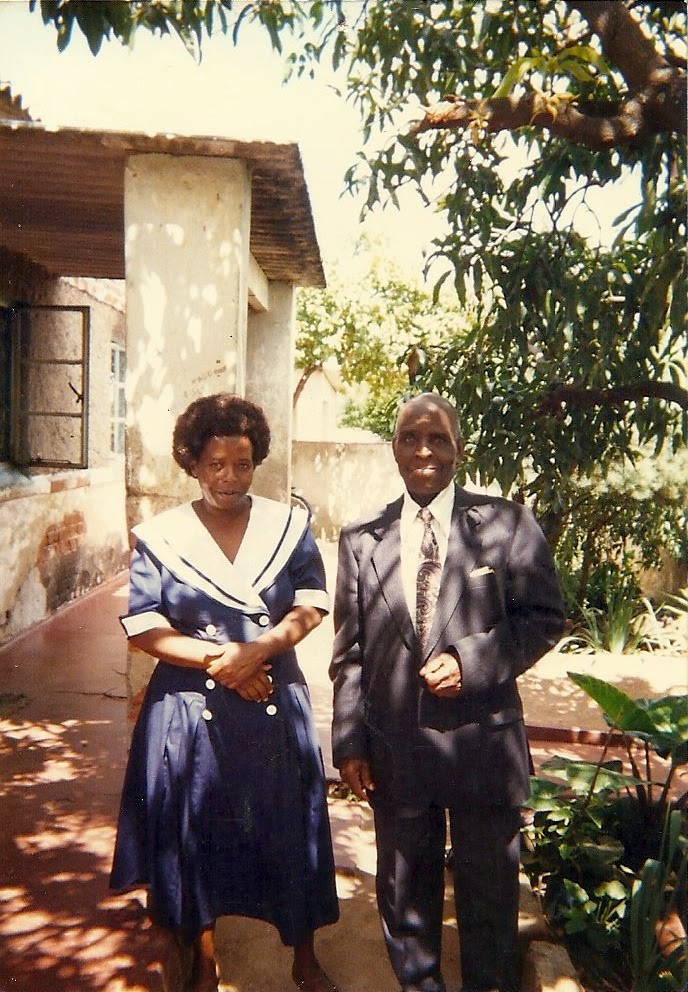
This is Aunt Marjie and Mataka in front of Mataka's house in Luveve. Marjie is the second daughter and hostess of this home. She wears the typical  dress of a Zimbabwe woman  -- a modest 1950s British look. Colorful tribal costumes are not in vogue in Zimbabwe. Mataka, as always, wears a coat and tie, emblematic of his working life as a clerk in the law courts.

Aunt Marjie hosts a shabeen at the Mataka house. This is a private, by-invitation beer drinking establishment, favored by men who wish to avoid the large crowds at the local beer hall. Shabeens are  a widespread African tradition.

Aunt Marjie is also a nyanga or witch doctor, but only in training as she would quickly say. She might show you ,or give you, or sell you, some herbs that she has collected for this profession.

Mataka has five daughter -- you will hear about the others later.

Tuesday, April 28, 2015

Frida Kahlo inspires me

I also wish to thank Frida Kahlo who has become the principle character in this African story.  I do not know how she managed to insert herself into this drama, because there is no known record of her ever going to Africa. Nevertheless, my humble task is merely to write this all down. I cannot be held responsible for the twists and turns of the plot, if there is a plot, if there is a Frida Kahlo, if there is a Fred Owens.

I wish to thank her for this story, and how it keeps me from contemplating the daily madness of the gay marriage earthquake in Baltimore -- all this stuff I read about in the newspaper. So many hairball ideas flood my mind, but I banish them when I go back to Africa in my dreams.

Helen Farias, goddess of the Nookachamps

Helen Farias, goddess of the Nookachamps, founding editor of the Beltane Papers, in a rare photograph. She is no longer with us except in our dreams. She is included in this African story because she inspired it. She did inspire it, but it would take me a long time to explain that. I just want to say thank you, Helen.......

 Shown in this photo with her husband James. On the back of the photo is inscribed "at my birthday party."  I know whose birthday party that was, but the person whose birthday it was would not care to have her name mentioned.

"I want to be a pilot"


Johnny lived at Mataka's house in Luveve, a section of Bulawayo in Zimbabwe. Johnny was a great-grandson of Mataka. Johnny said he wanted to be a pilot when he grew up so we took him out to the airport.

A jet comes in every day from Johannesburg. You can get on that jet and fly to Johannesburg and then get on another jet and fly to see the whole world.

A boy can dream of becoming a pilot when he sees the jets take off.

Sunday, April 26, 2015

Johnny, Prince and Juliano playing


At the home of Mr. Mataka. Johnny, Prince and Juliano are dancing and scampering in the yard, climbing trees and throwing strones. Mr. Mataka, is sitting on the front porch, under the mango tree, drinking his tea and reading the Bulawayo Chronicle. Aunt Marjie is sitting with her friends outside the kitchen door. Aunt Molly is at the beer hall selling boiled cows feet.

This was 1997, another day in Luveve, a high-density suburb of Bulawayo in Zimbabwe. Johnny told me that he wanted to be a pilot when he grew up. I wonder what happened to him.

Saturday, April 25, 2015

Things Fall Apart

Eddie Cross tells the sad tale of Zimbabwe falling apart in the 35-year reign of despot Robert Mugabe.

His weekly newsletters from Zimbabwe are a reliable source of news from that beloved country.

http://www.eddiecross.africanherd.com/

My name is Eddie Cross

My name is Eddie Cross and I am a white African with deep roots on the continent and was born and raised in Zimbabwe where I live and work today.

My great grandfather came out to southern Africa in 1867 as a Baptist missionary to the Eastern Cape. He played a significant role in the country of his adoption and founded several Baptist Churches in South Africa. My grandfather became a Magistrate and rose to become Chief Magistrate of the Republic of South Africa and at one stage played a key role in the Smuts administration that was defeated by the Nationalist Party in 1949, paving the way for the formal adoption of apartheid - an ideology that was to dominate South African politics until 1994.

My father left South Africa in the early 30's at the height of the depression and came to Bulawayo in Rhodesia where he became general manger of an oil company while playing a role in the development of the theatre in Rhodesia. He never left the country and died in his 80's in what became Harare, the capital of Zimbabwe.

I married Jeanette in 1963 and we have two children - Gary who is the Pastor at Northside Community Church in Harare and Susan, who is now married to Charlie Haley and they live and work in Harare. Gary is married to Sarah and they have 4 daughters while Sue has one son, Keith. All the grandchildren are in school in Harare.

We are all committed Christians and attend local Churches - Zimbabwe is a deeply Christian country and this has played an important role in the way we are resolving our problems as a country.

I started work in 1957 and took a Diploma in Agriculture in 1962 and a degree in Economics in 1968. I worked largely in Agriculture - first doing resettlement of people in the Gokwe/Zhombe districts and then as an economist with the Agricultural Marketing Authority, becoming Chief Economist in 1976.

As an economist I played a role in the transition in 1980 by assisting the two leading contenders for power (Zanu and Zapu) prepare for government and then subsequently in the preparation for the first, post Independence donors conference. I wrote the agriculture paper presented to that conference.

In 1979 I was appointed as Chief Executive of the Dairibord followed in 1983 by appointment as the CEO of the Cold Storage Commission, then the largest meat organisation in Africa. In 1987 I was made the Managing Director of the Beira Corridor Group and worked in the BCG until 1990. I then entered the private sector and have run my own group of companies ever since.

In 1999 I joined the Movement for Democratic Change and was made Secretary for Economics in 2000. I am now the Policy Coordinator General for the MDC and sit on the National Executive. In 2008 I stood for the Constituency of Bulawayo South and won the seat against several other candidates with a majority of 58 per cent. In 2013 I ran again for Parliament and doubled my majority, retaining the seat for another 5 year term. In Parliament I sit on both the Budget and Finance Committee and the Public Accounts Committee.

I believe that we as white Africans, with our difficult background and links, must earn the right to be recognised as Africans in every sense of the word and this means sharing in a deep commitment to the continent and its people. I apposed the policies of the former white minority governments in Zimbabwe and when it became apparent that the new regime under Mr. Mugabe was little better, decided to join the opposition to try and get the country onto a sustainable path to prosperity and peace.

Zimbabwe is a rich country made poor by a succession of bad governments and poor policies. Nothing has illustrated this more than the collapse of the economy since 2000. The problems of Africa cannot be resolved from the outside and by choosing to stay in the country of my birth and to try and play a small part in getting the right policies in place that will deliver a better quality of life to all Zimbabweans, I hope we are able to make a small contribution to the well being and future of all Africa.

Eddie Cross
Bulawayo, 1st December 2013
The Rain Queen died in 2005. There is no Rain Queen now, She has not been replaced. this is a disaster of major proportions. Not being superstitious about things like this, but anything that might help it rain is a good idea. We need a new Rain Queen.

http://news.bbc.co.uk/2/hi/africa/4089050.stm

The history of the Rain Queen follows here:

http://en.wikipedia.org/wiki/Rain_Queen

My Name is Precious

My name is Precious. I live in Pennsylvania. I work as a nursing aide. I send money to my African family as I am able. You will not find me on Facebook -- I don't go to Facebook.

This photo shows me in 1997 when I met Mr. Owens. We were having lunch in the courtyard at the Bulawayo Art Museum. In September we were married. We came to America. We divorced seven years later. Now I have my own life, but Mr. Owens was kind to me.

I am older now, I have two grandchildren.

Thursday, April 23, 2015


My name is Zodwa. It means "too many girls" in the Ndebele language. It's what my grandfather, Mr. Mataka, named me. He had ten children, The first-born was Lovemore Peter. And I was the first-born child of Lovemore Peter. But "too many girls" can mean both things in Africa -- for Mr. Mataka it means he wanted a boy instead, but it also means he is happy that I was born because I am his favorite grandchild.

He raised me. Often we are raised by our grandfather and grandmother in Africa. All my brothers and sisters we lived at Mataka's house in Luveve.

Luveve means butterfly in our language. So you think our town was named after a butterfly, but it was not. It was named after a white man who came to administer our area. The white man would sometimes get up and leave quickly, so we called him Butterfly -- see, we always give somebody a name. Butterfly was our white chief long back, so we named our town after him -- Luveve

My grandmother's name was Grace, She was a Kalanga woman from Plumtree. I loved her very much but she died. When she died her relatives came from Plumtree and had the burial in her home village. That was because Mataka, her husband, had never finished paying his "Lobola" after all those years. You have to pay for your wife in our culture, with so many cows or so many dollars. It gets very complicated. Mataka didn't pay all the lobola to Grace's family, so when she died, they came and took her body back to Plumtree.

Wednesday, April 22, 2015

My Sister Amina


My sister Amina is working everyday in the field. She is my half sister. Her mother is Tonga, from the Zambezi Valley. The Tonga people are more traditional. Their villages are far from the city. The elevation is low, where the baobab trees grow. The rainfall is very little. The women go to the fields in October and November, plowing everyday with their hoes, and planting seeds for maize. If the rains come there will be plenty of sadza -- the corn meal porridge we eat every day. If the rains don't come the Tonga people will be hungry.

If there is no rain, they beg from their relatives in town. Most of the men are gone all the time, working in town. They come home at month end when they are paid and bring money and food.

That's my sister on the left with the red scarf on her head. You will see the ladies all wear a wrap skirt. These are a pretty color and only cost a few American dollars. In Zimbabwe women always wear a dress or a skirt. We don't want to look like men. Men are lazy. They don't work in the fields.

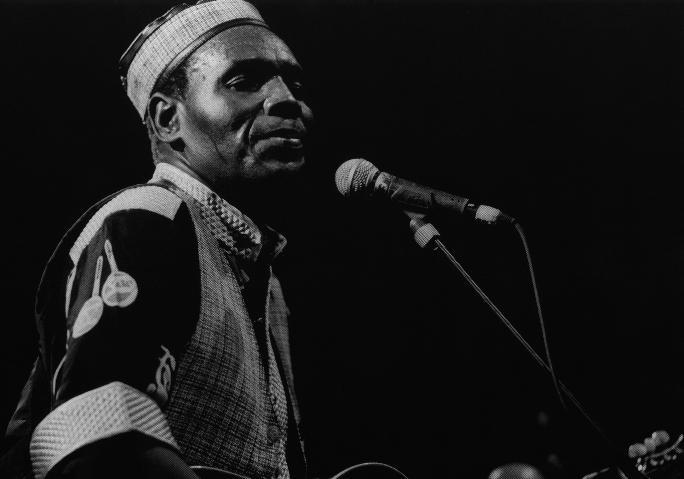
Tuku is the Greatest


We call him Tuku. He is Oliver Mtukudzi. He is famous even in America. Tuku is a Shona man from Harare. So, if you know Zimbabwe, then you will know that I am an Ndebele woman. I don't hate Shona people because I don't hate anybody -- but we are not the same, Shona and Ndebele. Shona are the majority people of 10 million. The rest of us, two million, we are Ndebele, living in our southern portion of Zimbabwe, and our capitol city is Bulawayo.

Even so, with these differences. I love Tuku and his soulful gentle music. Everybody can hear it, the unviversal sound of love. You may know about the troubles in Zimbabwe now, but you won't hear them from my lips, because I only believe in the good things. Tuku is like that. He doesn't have politics

Sitting Where Your Seat Is


We say if you sit on the ground then your seat is everywhere. Men need to have a stool or a chair. We only need a mat for being clean, otherwise the ground is fine. And we sit together. You see that. Ladies together. We can keep our hair this way. We can do our business or talk about our children.

African women get too jealous. One has a man. Then she looks left and right. She knows that her sister will steal her man, just with a look. Then they are both jealous. Angry words. Bitter glances. There is nothing you can do about this. It has always been that way.

But we are sisters too, all sisters. Even if you meet someone from far away -- you ask them who they know. If she is from Zaire, and I am from Zimbabwe, then maybe we both know somebody from Tanzania. I myself have never been to Zaire, but I have been to Tanzania, only one time, but I know it. So if we can find that someone who we both know -- then we are related.

In Africa we are all related. It is one village.

Bulawayo is my Home

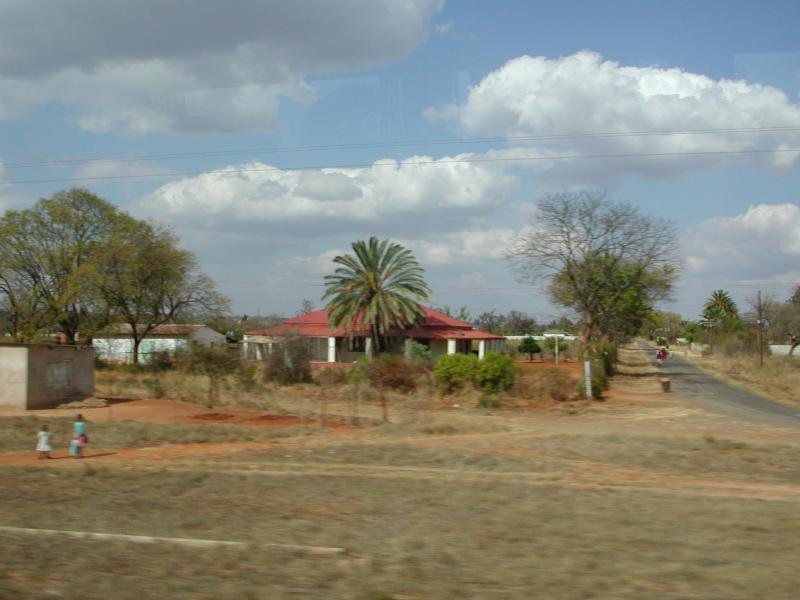
This photo is not the downtown of Bulawayo where you will find tall, modern buildings with elevators, full of people working on computers and cell phones, just like any place else. This photo is from the townships, the old neighborhoods which were reserved for native people under colonial rule. This photo is my grandfather's house in Luveve. Old Mataka, my grandfather, sits on the veranda on the front porch, everyday. He reads the daily newspaper, the Bulawayo Chronicle, and drinks his tea. He sees the neighbors passing by on their way to the market or to the beer hall. He gives his greetings. Or he just watches, so that my grandfather knows everything and everybody in Luveve. He can tell you who is trouble, and who is a good man. He has seen them all. My grandfather is a happy man. Look at this quiet peaceful home, see how blue is the sky. Wouldn't you be happy if this was your home?

Tuesday, April 21, 2015

That is me kneeling next to my grandfather Mataka. He is always smiling, but he is an old-fashioned man, so if you take his picture, he will stand erect and have a dignified, serious expression on his face. You will not get a photo of him laughing, but he is a very kind man. Many grandchildren lived in his house, more than ten. I slept on the kitchen floor with my sisters. My brothers slept in the living room. It's what you call cousins, but we call brother and sister -- we all lived together.

Then if grandfather was mad at us he would start to chase us, but we could climb up into a tree or on to the roof of the house, and then he would shout at us, but after a while he would just smile and walk away. He was never mean.

Then he would sit in the front of the house, under the mango tree, and tell us stories about his village in Malawi, way up in the mountains, where he grew up. He said the missionaries found him one day and because he was a clever boy, they sent him to school in Dedza town. After he finished school he came all the way to Zimbabwe to work, and since then Zimbabwe is his home, but also, like most people in Africa, he has more than one home, because he goes back to Malawi to see his family. And me, I was not born in Malawi, but it is my home too.

Bulawayo

Bulawayo is where we met and Bulawayo is where we were married. It is a city of 650,000 souls. It is the capital of Matebeleland. The climate is hot, but not too hot, because we are in the higher country, 4,400 feet. The rainfall is scarce.

The name of Bulawayo means the Place of Slaughter  -- there is quite a story that goes with that name, but now I will turn this page over to my ex-wife who will tell her story in her own words.


Monday, April 20, 2015

They did not want to go back.

Abraham Lincoln thought the freed slaves, having been so mistreated here, would want to return to Africa. He was mistaken. They did not want to go back.

"Out of Africa" is the nightmare.

"Out of Africa" is the nightmare. The desperate desire to get out of Africa, at risk of drowning, ancient vessels over-crowded with hungry migrants who will pay any amount of money, and take any boat, if only to escape this cursed continent. This is the nightmare.

Out of Africa -- the Dream

"Out of Africa" is the dream -- the beautiful grasslands, the wide skies, the wandering herds, the mystical Masai warriors, and the lovers transported to a higher realm of bliss beyond the reach of time itself. If only it were so! If only Africa was really like that.!

Saturday, April 18, 2015

Sitting together on the couch in Zimbabwe

She was violent, primitive and superstitious. I wondered what she was thinking, and then I realized -- she was not thinking. She did not think.

Here we are sitting on the couch of the house we rented, wearing sweaters -- it can get cold in Africa.

My expression is skeptical and ridiculous.

Her pose is graceful. She leans away from me, yet turns her head toward me. Her hands are crossed, one toward me, one away from me.

I said to her, "We are too different, I am old, you are young, I am American, you are African, I am educated you are not. We are too different."

She said, "If two people love each other, anything is possible."
This was in 1997, in the month of June, which is the winter month in the highlands of Zimbabwe. There would be frosty nights and we started a fire in the fireplace. But the cold time doesn't last long -- maybe six weeks.

To look at this couple on the couch, in the winter in Africa in 1997, do you see any soul connection? Or only the attraction of exotic opposites? 

Did we ever love each other? 

I have not seen her in ten years, but we have spoken on the phone. She said I might tell her story, but she said not to mention one thing, something she wanted kept a secret, so I agreed to that because it adds mystery -- well, no, I agreed to that because she asked me, but otherwise she said I might write a story about her life, and she would be happy.

She herself could tell a good story, being a dishonest woman, She said whatever popped into her head, or whatever sounded right at that time -- that was the truth. But I could not call it the truth, not by everything I was taught. To me, she was a liar, and a talented one.

And her name. Not yet. She told her name on the evening we met, but was that really her name? You see her in this photo on the couch with eyes like a crocodile, moving so slowly, and me about to jump away like a small white bird. What name is that?


Falling and loving are two different things.


Falling and loving are two different things.

Falling down is good. With practice you get better.

What does a woman mean when she says no?

Gabriel Garcia Marquez has inflamed my imagination.

We are making love. I crush your bones until there is nothing left but tulip petals in a pool of urine. Then your belly begins to swell like a fat tomato. A child is born that you can call your own. You can give it a name. I have my own pet names, Lunetta, for a girl, or Bradshaw Gumption for a boy, but I no longer need the power of naming.

Two years pass. Lunetta is a toddler. We are in France. I am very successful. We begin to quarrel. You say I love my work too much. I am distant, but I still think I can control you.

Ten more years pass. You are coming into your power now. You have become a true stallion of a woman, thicker, but still graceful in movement. And then we become equals and then we finally become friends.

Or, we live on a farm in southern Ohio with horses and cows.

Or, I become gravely ill, but even so you tire of me and leave me for Leonard, an artist in stained glass.

Frida Kahlo in Zambia, part two

Frida Kahlo died in 1954. There is no record of her ever making a journey to Africa, except for the mysterious correspondence found in director John Huston's papers. His movie, the African Queen, starring Humphrey Bogart and Katherine Hepburn, was filmed on location in the Congo..... that was in 1951, and in that year, it was rumored, but never proven, that Huston had an affair with Kahlo, and furthermore, there is a gap in her memoirs covering a month or two in 1951 when she may have traveled to Africa to be with him...... So it is fairly possible that she might have passed through Lusaka in the Zambia in 1951.

At which time I was 5 years old and stationed in a northern suburb of Chicago, making it almost preposterously unlikely that she and I had lunch together, as reported yesterday.

However, knowing Kahlo as well as I do, and John Huston too, for that matter, it is likely that something happened, because I am not the kind of person who just makes things up. I do not have an active imagination, but an astonishingly accurate memory -- and something did happen in Lusaka in 1951...

I visited Zambia briefly in 1997. I noticed that nobody had shoes. It is a very poor country.

Fishtown Remembered

The last time I saw Tim McNulty was about ten years ago. He's the poet from Port Townsend...... We had dinner together at the El Jinete in Anacortes and we were both broke -- what I mean by broke is that I wanted to pay for his dinner, and he wanted to pay for my dinner, but neither one of us had enough money, so we split the check -- it was so sad. We just sat there staring at the check, unable to make the manly gesture of picking it up, then slowly removing our wallets and with embarrassment agreeing on a shared total plus tips for the service. So sad, the wages of poetry.

I haven't seen him since, although we are in email contact....

Fishtown --  begun by poets and finished by lawyers, founded in stillness, ending in drama.....

I have insisted all along that the end of Fishtown -- the end of anything worthwhile -- is as important as the beginning.

If there is no ending there is no beginning. The beginning of Fishtown was poetry of great clarity and stillness. The ending of Fishtown was a lawsuit, a civil trial, a raucous demonstration, a dramatic conflict, and a final crushing destruction of old bones and boards, and the eviction and exile of humble folks....The beginning  was the seed of all this. The escape from drama came round and became itself  the drama. It will always be a mystery.

A librarian at Western Washington University is making a collection of Fishtown writings. You can view it here. http://content.wwu.edu/cdm/landingpage/collection/fishtown

Thursday, April 16, 2015

buying beads in Ghana


 (Judy Booth wrote this)

A loud shout, with a French accent, made me jump, “Madam!”

I glanced left just as a half a side of beef, its red meat, white tendons and bones holding it together, bumped into me. The man hefting the carcass, the size of a dresser, disappeared into the crowd.

Helen, native of Ghana, and I had made a tedious and hot journey by bus to the Kumasi market, the largest in West Africa, across red-clay earth highways the previous day to search for trade beads.

From a high hill we looked down on an ocean of corrugated tin rooftops scattered haphazardly all the way to the horizon. The market was the city. Whole villages swooped down from Burkina Faso and Mali, five hundred miles north to sell foot-ball sized yams, tomatoes, onions, cashew nuts, overflowing rattan baskets of red peppers, bolts of tie-dyed fabric and trade beads that had been circling the globe for generations like currency.

I kept losing Helen and would frantically call out her name as we wandered dark labyrinthine passageways. I had been in Ghana for several months, but still the scorching heat, the thick crowds of people jostling me was overwhelming. The smell of diesel, gas, urine, incense, herbs, fish, goat stew and sweaty bodies assailed me. I swished flies out of my face as I looked around at the never-ending swath of humanity. We walked through a mile of stalls filled with just tomatoes and onions, another hundred stalls of Muslim men in kaftans and coiffed jelabas expertly sewing clothes on ancient black sewing machines.

The sound of generators mixed with Fante, Hausa, Twi and Arabic voices. I rounded a corner deep in the bowels of the market, the sun intrepidly sneaking between tin rooftops and saw row upon row of exotic beads: Large and heavy bunches of solid sand-cast beads, cut glass gold, powder-blue, amber and mint-green beads, oven-fired and hand painted, beads made from rock, shell and old phonograph records.

Tired and thirsty I sat down in one of the shops after inquiring of its owner where he got his beads. As was customary with every African Muslim I met, I was treated with the utmost respect. “Bring the madam water,” he ordered a young boy in the stall opposite.

He shook my hand, snapping his fingers to end the shake in typical West African fashion, swept a spot clean on a wooden bench and placed a clean hanky on it for me to sit on. He wore jeans, unusual for a Muslim, and a cowboy shirt. His kinky black hair was shorn very short.

He said his father had traded beads and his father before him and his father before him, and on and on. He had attended a bead show in Europe and in New Mexico. He spoke English well. I gratefully accepted the water brought to me in the ubiquitous clear plastic bag sealed tight. I bit off the end of it, spat it into the gutter and sucked its coolness down my throat.

He asked if he could smoke one of my cigarettes. I handed him two. He put one in his pocket, the other in his mouth. “What can you tell me about trade beads?” I asked. “Where do they come from?

“These are Russian Blues,” his long sinewy fingers expertly flipping through a strand of faceted glass periwinkle blue beads. “They are probably about 150 years old.”
“Were they made in Russia? “ I asked.
“No, probably Venice,”
“How can you tell?”
He shrugged, “I just know, I’ve been doing this all my life. If you want to learn beads, you must do nothing else. Go to Keta. A family there has been making sand-cast beads for generations. You can watch how they are made.”
He unfolded a wrinkled cloth and pulled a strand of antique Chevrons from a box hidden under a bench used to trade for ivory, gold and slaves in eons past. And maybe they still were. “China makes beads that look old and are hurting the market.” He spat. “China makes plastic beads.”

His eyes sparked as he sat across from me. I felt like we were kindred spirits, loving markets, commerce, travel and beads. I wanted to sit with him forever. The sun moved across the sky. I peered down the passageway in the fading light.
“I must find my friend,” I jumped up and dashed down the passageway as coal braziers lit the night. I yelled for Helen. The market was silent, night falls fast near the equator. Where was she?
Frida Kahlo in Zambia

I wish I had never gone to Africa. It was too much trouble. Things did not work out the way I expected. I was in the wrong place at the wrong time. But this was 18 years ago and memory becomes softer, so this might be a good time to talk.

In February of 1997 I had lunch with Frida Kahlo in Lusaka, which is the principle city in Zambia, or it was a woman who appeared to be Frida Kahlo. I cannot say for certain. It was a hot day and I was tired and susceptible to outlandish claims and miraculous appearances.

But I am very certain this was not a dream. We had fried plantains and sadza and each had a glass of sour milk. Months later she sent me this postcard.....someone mailed it to me....after a while you just stop asking questions......it would be like reading the Heart of Darkness and asking if it really happened.

waiting for the bus

In an effort to improve race relations I traveled to Africa in 1997 and married her, the woman sitting next to me on the log. We were waiting for the bus. The sun was hot. 

Ordinarily, being a gentleman, I would offer her the shade, but since she was used to the sun and I was not, she gave me the shade.

We were waiting for the bus. It's a common sight in Africa to see people sitting by the roadside waiting. She is looking down the road, but patiently, or maybe she knows something that I don't know.

I'm looking down the road too, but with a different expression, like, what am I doing here?

But we're in Africa, and she's African, so of course she looks more at ease.
We were not waiting for the bus. We were at this spot by the Zambezi River, just above Victoria Falls. We came to this spot to view the world's largest baobab tree. We came there to look at a tree. We had a rental car parked somewhere nearby.

I was a tree tourist. Some people come to Africa to see lions and elephants, I came to see the trees.

I was not planning to get married, but who plans that kind of thing.
This was in Zimbabwe. I remember this Forest Gump moment I had when I first arrived in Zimbabwe. I stepped off the first-class bus and began looking around. "Everybody is black! Everybody!"

No kidding. It's not like America where some people are black, and there is a black neighborhood in some part of town. 

In Zimbabwe, everybody is black, as far as the eye can see. You can walk and ride for miles -- all black people. I'd be walking down the street in the city, thousands of black people and I'm the only white guy. Nobody ever bothered me. I wonder even if they noticed me. I couldn't tell. I could never tell anything from their faces.

Go back to the photo of me and my wife sitting on a log, waiting for the bus. Can you read her face? I never could.

The African Woman

This is the start of a a story called The African Woman. It is partly true, using photos of real people, and pieces of imagination, woven together. Do not concern yourself or become confused by asking Did This Really Happen?

Yes, once again racial conflict confronts us.

He, the great white hunter, squared off, hands in pockets. She, the African woman, arms folded, holding her ground. This is a real stand off!

The laundry dries gently in the breeze. The good red earth of Africa lies at her feet. But wait! She's wearing his slippers. They must know each other, to say the least.

The harsh sun marks the ground with strong, black shadows. Shadows of the laundry drying on the line. Shadows of the woman and the man. The trees are bare of leaves, and the sky is blue forever.


Sunday, March 22, 2015

It Could Be Worse -- part 2


I do not understand Yemen. Some war is going on. I cannot tell what side we are on, but we send drones and have military advisers. What a screwed up country!  They had a suicide attack at two mosques and killed 137 people – just for belonging to the wrong religion.

This is the kind of madness that makes Benjamin Netanyahu look less bad in Israel. “Less bad” is a category that should be used more often, like “well, it could be worse, it could be Yemen.”

Words cannot express – “words cannot express” being a cliché that negates the craft of writing – but words cannot express the horror of the suicide bomber.

We can illustrate this by comparing Stalin to Hitler. We correctly and morally allied with Stalin during World War II, a terrible murderous man, but he didn’t want to die. You can make a deal with someone who wants to live. You have something in common with someone who wants to live.

Hitler – I don’t care to mention him at any length – but he was the arch suicide bomber and he did not want to live and we could not make a deal with him. We fought Hitler until he destroyed himself. But Stalin died in his sleep.

Among Middle Eastern countries, where cultures seem to welcome suicide, Israel manifests the strongest will to live. That is an excellent quality and we rightly ally with them.

Jacob said to his sons in Genesis, “I have heard there is corn in Egypt: get you down thither, and buy for us from thence; that we may live, and not die.”

That was a tough choice -- famine and starvation in Israel, or exile and slavery in Egypt. But Jacob said it was better to live and not die. So it worked and his people are still with us.

And the best way to live is to not die, so don’t be a suicide. Kill them if it cannot be helped, but don’t throw yourself on the flames.

Although Jews have chosen martyrdom over conversion at times, mainly they have chosen life, which might explain while they are still with us 3,000 years later.

Live! And the way to do that is Don’t Die!

Whereas Yemen….. boy …. What a screwed up place …. or Syria … and you want to weep for Tunisia.

………………..

But I live here in California.

Grounded in Santa Barbara.  I have the luxury of not explaining or defending myself, but I will enlighten you. I work on an organic farm ten miles outside of Santa Barbara, some ten acres of pretty vegetables, going to the farmers market and sold directly off the farm to fresh food lovers.

The men toil in the fields, undocumented and underpaid. I would bet good money that most of them are – first, grateful to be working here for ten times what they could earn in Guatemala or Mexico, and second, hoping and dreaming that they could get some better kind of work than sweating in the dust on the farm. My kids are gonna do better than this, they say in Spanish.

Ninety percent of people who do farm work ardently wish they had some better work. It is the lowest status and lowest paid of all occupations. Imagine being a young farmworker up from Jalisco and trying to impress the girl you want to marry. Do you think she wants to marry a farmworker? No, she wants the guy on the construction gang building houses and strip malls and he’s got a new truck and some plans to start a new business and some money in his pocket.

The guy hoeing weeds on the organic farm takes second place in that drama.  But he’s not a criminal, and he’s not a fool. He works pretty hard. You know, it could be worse.

Farm work is like some kind of Kevin Costner movie -- the life story of Wendell Berry and Thomas Jefferson and Tom Joad.

Frog Hospital Is Recruiting New Readers

You are not a new reader -- you may have been with us for years and years, and it has been fun, and there’s a lot more to come.

But now we want to gain some more readers, 100 more readers being the goal.

That will bring us to 500 in total, and when we reach 500, we will instantly set a new goal of 1,000.

I was reading George Will at the Washington Post  --  it doesn’t make sense that so many people read his column. Frog Hospital is so much better.

You need to nominate friends, relatives and colleagues for presentation to this distinguished company. You, a proud Frog Hospital reader, can let a few good recruits join us in our weekly endeavors.

Send me a name, an email address, and a few words of description – occupation, place of residence and demeanor. Such persons will be added to our list, and we will grow.

We will grow because we are alive. To live is to grow. That is our choice.

And don’t forget paying for a subscription – always voluntary, of course.

Frog Hospital Subscriptions.

Go to the Frog Hospital blog and hit the PayPal button for $25, or
Send a check for $25 to

Fred Owens
1105 Veronica Springs RD
Santa Barbara, CA 93105

Thank you very much,

Fred Owens