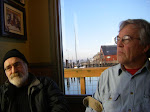
Today, I can see the World. I took a quick look at the newspaper. There is turmoil in France. There is an election in Italy. There is a rape case in North Carolina.
It is 6:40 a.m. I'm up a little early today because I'm driving to St. Hedwig to interview a family that has owned their ranch since 1904. They are being honored for 100 years. I spoke to the Mrs. on the phone last night, and she was glad we were coming and said her husband was so busy, could I come early? I said fine, I will be there at 8 a.m.
She give me the directions. It's just down the road from her brother-in-law's feed store -- the one we wrote about three weeks ago -- but it wasn't me that went out to take the photo, it was Al. I have never been to the St. Hedwig feed store.
In any event, she gave me clear directions, and I'm very good at finding things. I told her, "I never get lost, although sometimes I don't know where I am."
Thursday, April 13, 2006


Wednesday, April 12, 2006
wife
In Zulu wife and woman are the same word -- umfazi. And man and husband are the same word -- indoda. It being inconceivable that a man could become a man, or a woman could become a woman, and not be married.
So, steeped as I am in tradition, I call her my wife, although also being completely current, I refer to her as my virtual SO in that I have never met her. I spoke to her on the phone once. She is not an imaginary woman.
She helps me, tells me little things, encourages me, is tender -- brings me up short now and then but even that comes within a violet-tinged context of great warmth.
I used to try to help her run her life and give her advice, but that never really worked. I think that what I do for her is give her a manageable project, something that doesn't take up too much of her time. It gives her the satisfaction of being a respected voice in my life.
There's a chain of responsibility anyway. I help other people.
It feels like love.
I'm watching TV now.
Stress
I'm having quite a struggle with stress these days, since I am no longer a moving target. Old strategies aren't working anymore. Keeping on the move was a very good strategy -- the bastards could never catch up with me, and since I moved randomly, they could never get ahead of me to set up an ambush --Ah, no, but I was free, "limpio y soplado" as they say in Spanish, "clean and blown."
Now I have settled into this job and determined to -- not stay forever -- but work my way out of it. Consequently I am encountering a mountain of stress -- every day. My job at the newspaper is not super stressful, just average -- but for me, it's an enormous load, having spent most of my life outside the system.
I am like everybody else now. All this was made far worse because seven weeks ago I abandoned my major No. 1 stress alleviating medicine -- cigarettes. The smoke screeen that I blew up around myself was a womb and protection against social battering -- it's gone now. It was too harsh for the lungs.
To complete the picture -- stressful job, old buddy nicotine sent packing, and holed up in a small town with NO FRIENDS, no pals, no sweeties, no partners -- just me and a lot of people who -- well, there's nothing wrong with them, and they all act really nice to me -- but the gap, the chasm, the enormous canyon between my life and theirs leaves me isolated to a higher degree than I have ever experienced in these United States. I felt more at home in Africa than I have in conservative small town Texas.
Anyhow, stress has expressed itself into a great anxiety manifesting in claustrophobia, the chief symptom being that I can't stand being inside any room except my apartment, and it feels kind of lonely here too. Plus when there are people near me, I feel dizzy and my knees begin to buckle, and I have to grab a hold of the wall or something, lest I fall down.
This is really weird. I've never felt like this before in my life. I am downright certifiable. I went to the doctor -- he was not particularly alarmed or surprised at my symptoms. He just wrote me a scrip for Zoloft. That was two weeks ago. I wanted to avoid this medicine, so I tried a lot of stress relieving activities, such as weekend camping and evening garden work, but that only helped a little bit.
It got down to quit the job and make fast tracks to the West Coast or take the pills.Today I decided to take the pills. If I turn into another person, please let me know right away, because I like myself pretty much the way I am.
No newspaper
A startling change in daily habit -- beginnning the day without scanning the newspapers on the Internet.
Instead, I am looking out the window. I see birds. My geranium is beginning to bloom. I can hear the air conditioner humming. I love that cool feeling. I can see the paintings in this room where I sit -- it's the living room, I suppose.
Except I don't have a chair or a sofa. I'm doing this garden work for a neighbor and she owns a furniture upholstery shop and she will trade me a comfortable chair in exchange for the garden work. This is a good arrangement.
I know my life will be better if I have furniture, but I need to get over several objections.
1. Furniture is a burden.
2. Furniture is large and bulky. When you have furniture in a room, it makes it hard to get from one place to another because you have to go around it.
3. Furniture takes up space -- my space. I need to have lots of room for my own ass.
4. Furniture makes moving far more difficult. How many times have I loaded people's stuff into and out of vehicle to move from one place to another. This problem could be alleviated if people moved, but never brought their furniture with them. Think about that -- if you are moving from Texas to North Carolina -- don't you realize that they have as much furniture where you are going as where you are coming from?
I could say more, but I will get the chair, and it will be very good.
Tuesday, April 11, 2006
Moses
Let my people go.
A very serious, devout rabbi that I knew, Marty Feldman, who was the director of Hillel at Northeastern University in Boston, confided to me that no matter how much he prayed or no matter what he imagined or how much he studied, that Moses still looked liked Charlton Heston to him.
A very serious, devout rabbi that I knew, Marty Feldman, who was the director of Hillel at Northeastern University in Boston, confided to me that no matter how much he prayed or no matter what he imagined or how much he studied, that Moses still looked liked Charlton Heston to him.
Childhood -- trees and games in the yard
This is what I remember, not what actually happened. I could have discussed the details with my brother and two sisters as research, but I chose not to. Until my tenth birthday nothing happened and I loved it. Don’t expect this part of the story to move along.
I was born in Evanston, Illinois, the summer of 1946, the fourth child. My parents were renting a house on Prairie Avenue right off Central Street. It was no longer big enough, so they bought the house in Wilmette soon after my birth. The old house on Prairie Avenue stayed in the family because Uncle Ted and Aunt Bea rented it after we moved out and they lived there for many years. We didn’t visit them very often, because Uncle Ted was boring – at least that’s what I thought. He had such a big nose. Aunt Bea had a tiny nose and a sharp mouth, and the food wasn’t any good. My cousins, Dick, Rosemarie and Jerry, were much older than me and they didn’t play.
Uncle Ted was the oldest of Mom’s four brothers. His real name was Ambrose. He had been a stock broker in the 1920s and was making a good living until the Crash. After the Crash he put every last penny back into the market thinking it had reached the bottom. He was wrong of course. Uncle Ted had no more confidence in himself after that. He would not take any leadership role in our family, even though he was the first born. He just got some nondescript job and kept quiet. He might have been sad. I didn’t notice – I had a lot of uncles. Uncle Ted was a spare.
But the old neighborhood always meant something to me. Mom still liked to do her shopping on Central Street. She would take me with her to the butcher shop and they would give me a slice of liver sausage. We bought our shoes at Vose’s every year. The salesman always had a nice smile and said, “Good Morning, Mrs. Owens. How are you?” New shoes were fun, especially sneakers, because I felt extra jumpy when I got them. The salesman would kneel down in front of me, making me feel special and important. He brought out the silver-metal plate with sliding pieces that measured the length and width of my feet. This was a very positive experience, to have growing feet and to be needing new shoes, and to have a nice mother who always got them for me when I needed them.
The best thing about Central Street was the parade every Fourth of July, followed by the fireworks at nearby Dyche Stadium, the home field for Northwestern University. The parade and the fireworks was a very big deal for me, and the rest of the year, when Mom took me there, the street would resonate in anticipation of the big parade.
Not forgetting Prairie Avenue, because the way from our house in Wilmette to Central Street was down Prairie Avenue, and I always looked at the old house when we drove past. It was a stucco bungalow with dark green wood window trim. Stucco was the right and truest way to build a house, because our house in Wilmette was stucco. Everybody else’s house was different and maybe just as good, but stucco was my standard.
We moved to the new house in August, 1946, six weeks after I was born. The address was 1612 Forest Avenue. I didn’t have a stronger connection to the house than my brother or my three sisters, but I always felt that I was the reason we bought it – because we need the room.
Forest Avenue was well-named. The oak trees and elm trees towered over the house and made a canopy of shade all up and down the street. I knew at a very early age that this was better than what other people had, that a good neighborhood had good trees. They were huge at the trunk, even three feet in diameter for the elm tree in our front yard, although it wasn’t exactly in our yard, but between the street and the sidewalk.
Not for climbing, the trunk of the elm tree soared up to the sky in mighty strength, and the high branches spread out in graceful symmetry. I knew it was beautiful. The oak tree was right in the center of the backyard. It was stronger, the bark was rougher, the limbs more twisty than the smooth curves of the elm. The oak tree was not beautiful but it was awesome – so big and so old, and part of a company of giant oaks in the neighborhood. There was an oak next door, and another one across the alley. We were all under their protection.
For wildlife we had grey squirrels, robins and blue jays. There were acorns. There was a horse chestnut tree a block away that was of some interest, because we could gather the smooth dark-brown chestnuts, just to feel them and throw them away after a while.
We had a great climbing tree across the street, a maple with a short trunk and many horizontal branches. You could jump up, grab one of the low branches and swing up your feet. The bark was smooth and worn smoother because all the kids played in it. I was competent and graceful in the tree branches, never reckless. I shinnied up to a certain height, I never tried to test the limit. It was a good tree, nobody ever fell out.
I hardly noticed the weather, except when it was fun. An extremely hot day was not of great interest. Summer was good for thunderstorms and lightning. I loved the boom and the crash and the flashing blue light. We might stay out in the downpour and get all wet and jump in puddles, but usually we were shuffled indoors and just got to watch. The night crawlers came out on the sidewalk after the rain, very big fat worms, sprawled out and lazy in a warm puddle. You could fill a jar or a can with them, although there wasn’t much else to do with night crawlers except cut them in half and squash them in various ways. I had only a mild interest in worm torture.
My parents didn’t make me wear shoes in the summer. Basically from when school let out in the middle of June and until school started again in September, I was barefoot, except on Sunday at church. They were more permissive in this regard than some other parents. I had really great feet. I could walk or run anywhere in bare feet, fearlessly, even on gravel, although that was tough.
The best part of summer in our neighborhood was getting to play outside after dinner. That was never allowed during the school year, not just at our house, it was a neighborhood rule. But in summer, after being excused from the dinner table, we could go out and play until the street lights came on. That was a good standard because there was no arguing. When the lights came on, the game was over. Our street light, and I pretty much thought it was ours, I knew we didn’t own it as such, but it was still proprietary to me, because it stood square in the center of our yard next to the curb. It was our beacon, cast iron in a six-sided column, fluted, with three sides that curved inwards and three sides that lay outward and flat, rising to a pretty tower of light with six panes of mottled glass, and each pane tilted outward slightly, and the light topped by a crown and spike. The street lamp was beautiful to me, and I knew it was better than what other people had. It was the home beacon, Mom and Dad never had to call out in the darkness, we always came home.
The games on summer nights were great. There were a lot of children on our block and we played in the street. Forest Avenue was paved with dark-red bricks, as smooth as porcelain, warm or cool to bare feet, with little bits of green moss or tiny blades of grass growing between the cracks. We played Kick Ball, that was sort of like baseball in that someone pitched the soft red ball to a kicker who booted it and then ran some bases, but girls could play. We also played Kick the Can. I don’t remember the rules or how it was played. The most fun was Hide and Go Seek, and we used the big elm tree for Home Base. Come to think of it, the games always centered in front of our house and not down the block. I think that was because we had the most kids. The Giambalvos lived across the street. Jimmy Giambalvo – that made a rhyme -- was two years older than me, and Paul Giambalvo was one year younger than me. Jimmy was dark like his Italian father. Paul was freckled and red-haired like his mother. They were nice people, but their house was kind of sad and subdued. Mrs Giambalvo was an alcoholic but we didn’t know that at the time.
The Tuttles lived next to the Giambalvos. Their two kids, Sally and Lynn, were much older. Lynn was a strong, masculine type of fellow. He had a canoe. Lynn was not a regular boy’s name, to my mind. There were not too many people who were different than us, so I noticed this.
The Wolfs lived on the other side of the Giambalvos. Mr. Wolf owned the hardware store in the village. This was cool because of all the stuff they had there. They had a girl Christine who my sister’s played with, and a boy named Charlie who was much younger than me, but still a lot of fun, and we used to go over to their house a lot and read comics and watch TV. Plus the climbing tree, the maple, was in their front yard. So really the focus of the games was in the middle between our house and a little bit to the right, where the Wolf’s lived. Mom was even friends with Mrs. Wolf, and sometimes Mrs. Wolf came over to our house for a visit. Mom was friends with the other neighbors, but it was more like cordiality.
The Steinbrechers lived next door on our side of the street. Two kids, Marcia and Richie. Marcia was busom buddies with my sister Carolyn. The Steinbrechers moved away to another part of Wilmette, but we still stayed connected. They were Protestants. The Lynches moved in after the Steinbrechers. The Lynch kids – David, Katy, Molly and several others – were a ton of fun, but they didn’t stay long. Mom really liked Mrs. Lynch. After that the Soderstroms moved. They had only kid and it was boring.
Kick Ball was fun, but it was like weeny baseball and we let the girls in, although the girls didn’t see it that way, because it was understood that street games were never just a boys’ thing. Girls had jump rope and Hop Scotch. Boys threw baseballs and footballs around although we never organized regular games because there wasn’t enough room or enough boys.
Hide and Go Seek was the most important game because it was full-time for boys and girls. We knew that girls could not throw as well as boys, or hit a ball, or do cool things on a bike, but they could run just as good, and hide just as good, so it worked out. If you were It – I loved that word, It. – That was the beginning of philosophy for me, because I used to ponder the status of being It and how it was used in various games. You didn’t want to get caught and become It, of course, but the good part of being It was being the center of attention, and playing the next game well enough so that you would no longer be It.
If you were It in Hide and Go Seek, you covered your eyes and leaned your face against the elm tree – the biggest and most glorious elm tree on the block, which was Home Base and there was never a question about that – and counted to one hundred, while the other kids ran away and hid, usually not too far away, behind a car or a bush, or around the corner of one of the houses.
When you finished counting you called out, “Here I come, ready or not.” You might do this in a sing-song style for effect. And you began to look for the other players, the idea being to tag them before they could run Home and tag the tree, in which case they were safe. As soon as you caught some other kid and tagged him, then they became It for the next game. Of course there still some kids hiding, so you called out “Allee, allee income, freedom free,” also with style.
The back yard was white-fenced in rectangles of two-inch wide strips with a cap rail that you could walk on like a tightrope. The oak tree was smack in the middle of the yard, which was square. The yard just wasn’t big enough for baseball, but we had various pitching games, using the house as a back stop. It was too easy to hit one over the back fence and into the alley, or even further into the Johnson’s yard. Mr. Johnson was a grouch, and if we dug in his flower beds searching for a lost ball, it was just a lot of work. We weren’t scared of him or anything.
The big game was badminton. The back part of the yard was just the right size for a court. This was also boys and girls. We put up the net in early summer and kept it there through the season. We played so much badminton that we wore a six-foot circle in the grass on each side of the net. I loved to slam it and I loved to hit high looping floaters. We played until 21 points, and then we played again.
Mom had peonies and roses against the back fence and roses, but too many children to do much gardening. We respected her garden patch, but she was fairly easy-going about it. If you trampled something you didn’t get a big scolding.
We had a hammock hung between the oak tree and the garage. It had a soft, cotton texture, and mildewed, outdoorsy scent.
The alley was cool. It wasn’t paved. It was the wilderness and the underworld. Day lilies – we called them tiger lilies – grew in a riot between the back fence and the ruts of the cars. They just grew by themselves. We burned the trash in a wire can, so there was debris and ashes around like blackened tin cans. When we were older we went alley-hunting around the neighborhood looking for junk.
A special quiet place for me was the north side of the house, a shady grove where violets and lilies of the valley grew untended. I would sit there on the ground and pick a bouquet and bring them to Mom, purple for violets, and that special tiny white color of the lilies. This may have been why I liked that book so much, the one called Ferdinand the Bull. Ferdinand was the most powerful bull in the pasture of Spain, but they could not get him to fight. He only liked to sit under the cork tree and smell the flowers. As a child I wanted to be strong like a bull, but I didn’t want to fight, I wanted to smell the flowers. Not entirely true. I used to fight and scream with my sisters a fair bit. I never got into punching fights with the other kids, although one time, when Scottie Soderstrom had just moved in next door – he was my age and went to the public school – I punched him really hard in the stomach, I don’t know why. He just ran into the house to get away, and after that his mother wouldn’t let him play with me. Scottie was an only child and he just didn’t know how to act.
That was the yard and the block we lived on. The yard and the block were fundamental markers. The outer boundaries were the through streets with traffic lights and white stripes down the middle. Green Bay Road was two blocks towards the lake and the train tracks went by on the other side of the road. When I was really young the choo-choo trains got me really excited with big towers of white smoke, but the diesel engines came in when I was little older and I was more blasé about that. Shimoneck’s was on Green Bay Road. That was the gas station. I could buy an orange soda for a dime. My allowance was twenty-five cents a week. I was friends with Billy Hoak for a few years when I was about ten. He was pudgy and quiet and he had red hair, but the great thing about Billy was that he could a two dimes from his mother almost anytime and we went to get sodas.
Lake Street was one block from Forest Ave. We didn’t cross that. It was paved with black tar – that was fast for bike riding. Our brick street was cool, but it rumbled under the bike tires. Lake Street was fast in general with cars that clipped along, and it went east to Lake Michigan, one mile away.
Ridge Avenue was three blocks to the west. This was major. The eponymous ridge was only twenty to thirty feet in elevation, but it was the only hill we had and the only hill I knew about. You could ride your bike down the hill and go fast and take your hands off the handlebars and be coasting a long way.
St. Joseph’s church and grade school – St. Joe’s -- was at the intersection of Lake Street and Ridge Avenue, just a short walk from the house, but it was up on that ridge and the church was very tall and imposing. The school building was huge too, facing the church across Lake Street. The drugstore was at the third corner at the intersection. We could buy popsicles and candy bars there.
The last boundary was three blocks to the north. It went Lake Street, Forest Ave, Walnut Avenue, Elmwood Avenue, and then Kenilworth, where the rich people lived and the houses were much bigger.
That was my territory, within that grid. Everything was the way it was supposed to be, and it was always that way. The oak trees and the elm trees covered everything with a summer canopy. Nothing ever happened.
In the fall the leaves came down and there were huge piles and raking teams, us kids, on Saturday morning, raking them all to the curb and burning them in the street. But first we made a big pile and jumped in it. I loved burning the leaves, seeing the first curly whisps of smoke and watching it build and then get dense with rich thick white smoke like whipped cream billowing upwards, and then flames leaping, getting hot, roaring, and then it would die down slowly, or we would dump more leaves on it and start the white smoke again.
In the winter we had snow, snow men, snow forts, snowball fights, and lying down to make angels. Snowmen we outgrew pretty quickly. Snow forts could happen under the right conditions, with plenty of good packing snow and enough kids to build one or two forts and then start a war. It was stupid to get cold fluffy snow that you couldn’t pack. It was contemptible – there was no point in having snow if you couldn’t pack it and make snowballs.
The ideal was good packing snow and enough to get out of school for the day. That was heaven, throwing snowballs. When we were older we used to throw them at the icicles hanging off the eaves of the houses, to knock them down. We would go hunting for big ones and keep throwing until we got it. Even older we got into the riskier games which were to throw snowballs at the street lamps with six panes and knock them out, but usually just one of the panes, because then we had to run away. If we really wanted to be hairy we could go over to Lake Street and throw snowballs at cars driving by. The coolest shot was to land one on the windshield. This could bring the cops around.
And the craziest thing was skitching. I didn’t do it, but the Ridge Boys did. I just wasn’t that wild. You did it on a slow street when it’s packed with snow. You waited until a car came by, then you ran behind it and up to it. You quickly squatted down on your heels and grabbed the rear bumper and went for a wild ride until you fell off and went sprawling.
I didn’t envy those Ridge Boys too much because I was already having a lot of fun and to get into a little trouble was enough for me. Besides that, we lived in a better house. Mom and Dad and the other parents, always Mr. and Mrs. – I had no overall objection to their rule. I knew it was wholesome and it felt good. The world inside that neighborhood was more than enough.
Boston Legal
Boston Legal is my favorite TV show. It has been usurped by a showing of the "Ten Commandments" -- because it's Easter! Now I see Moses on the TV, in the desert, talking to God.
Who is in charge here? Who decided to take my favorite show off the schedule? How many favorite shows do I have? Only one. Boston Legal, starring James Spader, Candace Bergman and Captain Kirk.
Boston Legal, is for me, a kind of spiritual meditation on the deeper questions of existence. The show always culminates in a final scene with Spader and Kirk on the balcony of Kirk's apartment. It's twilight, at the end of a tough day at their law firm. They are enjoying fine scotch and good cigars -- this is my moment of prayer.
But instead they have Moses on TV. And I, who reads Exodus in the original Hebrew, have to watch it.
Under the locust tree
I sat under the locust tree for three weeks last year. It was in February, in the lower Rio Grande Valley, at a place called Falcon Heights. There is a campground there, and I pitched my tent near the locust tree -- or thorn tree, or acacia tree, but here folks call it a mesquite.
Three weeks alone, and yet I was happy the whole time. Not completely alone, because I could go over to the lodge and have little conversations with the somewhat older retired folks who spent the winter there.
Three weeks camping, and the weather was always bad -- It was cold and wet and windy every day -- and yet I was happy.
I had no girl friend, but only the vaguest fantasy of ever being with a woman again, and yet I has happy.
I am not that happy now.
Maybe it's because I had a little money -- about $1,500 -- and I wasn't worried about the future.
Today, I am not so happy. I worry all the time. I wish I had a little more money, and I wish I could go back to the campground.
I could do that next month, if I saved up.
Except -- what was it that made me so happy? -- I know it's that place itself. There has always been something special about Falcon Heights.
There'e no going back. Except I would like to be happy like that again. I fear it will never happen while I work at a newspaper. The work is too abstract, and I miss the earth too much.
Sad
I often feel sad, especialy when I wake up, like this morning. If I think of the past, I feel sad. I don't know why.
When I think of the past, if it was something good that happened, then I miss it, and I wish I could travel back through time and experience that feeling again. But I know I cannot, so I feel sad.
But if I think of something unhappy that happened to me in the past, then I feel unhappy all over again.
So I try to shake it off. Of course, everything has gotten works since I quit smoking cigarettes two months ago.
1612 Forest Evenue
The address of the house where I grew up was 1612 Forest Avenue in Wilmette, Illinois. We bought the house in 1946, shortly after I was born. We sold it in the spring of 1997, after Mom died.
That was nine years ago. I don't think about the house too much. I could take a mental tour and go from room to room, and by doing so, I would remember many details of those 50 years, and most of my life -- but I don't do that. It makes me feel too sad. I don't even have a photo of the old house, except in storage far away.
In fact, I don't have photos of my Mom and Dad either. But with them it's different. I don't miss them at all, because they are present to me. I often speak with them in my mind, and tell them things and ask them what they think -- Mostly Dad. I like talking to Dad. Mom is more this vast maternal presence -- non verbal.
Monday, April 10, 2006
Mushrooms
I finally learned how to write a blog, after trying for six months. I write as if no one were listening, as if it was just myself. This is the only way to write a blog. For six months I fought the self-indulgence in this medium. But I cannot overcome the nature of any medium that I choose to use.
So this blog is only about me, to me, and for me. There is no other way to do it.
After work today, I went over to her house to work on the garden, on the small stone planter in the front driveway. I re-arranged all the stones and pulled up the cord grass. I enjoyed this work very much. Her garden is in the shade in the late afternoon, perfect for me to work on. I could keep busy there all summer -- even though her garden is very small -- I know how to expand the work, so that I have an hour or two for a project several days a week.
She came up and talked to me, with several ideas about what to plant. She's thinking of marigolds -- I told her that would be great -- or petunias, and she had some other ideas..... I think I will just go to the store tomorrow and plant some things for her.
Los descamisados
Los descamisados -- those are the shirtless ones, the ones who supported Juan and Evita Peron in Argentina in the 1950s. Now we have "Los Camisas blancas" -- the white shirts marching in America. I kept checking the Internet all day at work, trying to get live pictures of the marches from CNN.com, but the fucking Internet was too slow, I couldn't get anything.
So I checked the Houston Chronicle and the New York Times for updated reports during the day. There were many marchers today, but nothing like the half million in Dallas, the biggest demonstration in Texas history. I was surprised. I thought that Texas was too conservative for such a turnout. I was wrong.
Something is going on here. The funny thing is that it is not all good for the immigrants. They will only get part of what they ask/demand. Oh, but I do like the way they present themselves.
Marching
Marching in the street. Millions on the move. I am not jealous. It's a march I might like to be in, but I've been in plenty of marches, I don't think I miss this one. My boss thinks that George Soros is paying for all this, so that all the illegals can take the day off -- George Soros sent each one of them a small check.
I certainly have done a great deal of work smashng borders, breaking down boundaries,and blurring identities.
Thirty years of work, and I now I see I may have gone too far -- there actually should be a border between the U.S. and Mexico, and between men and women.
There I go again, mixing up issues. Immigration and gender issues are closely related, because they are about boundaries.
It only makes sense to me.
But maybe I am figuring out what a blog is -- It's talking to myself.
Monday morning
I'm writing the blog rather than reading the New York Times, the Los Angeles Times, The Seattle Times, and other papers that I usually scan in the morning while I'm drinking coffee.
The immigration debate is wonderful. I am strongly in favor of both sides -- my politics is all over the place these days. It's just that I feel that something good will come of this. It's all very hopeful -- we can reach a kind of solid agreement with the new people from Mexico.
And health insurance. I favor national health insurance and everybody the same. In medicine, anything for me is the same as what you get, and everybody else too.
For Americans, health insurance for all Americans. It relates to immigration, to who lives here, and to who is an American.
See? This isn't making sense, except to me. It makes perfect sense to me -- that immigration, which defines our border, which defines who we are and who we are not -- is closely related to national health insurance, which is a mututal promise of care, for everybody who is an American.
I'll just stay out of politics. No one will understand me.
Sunday, April 09, 2006
Pas de deux
Pas de deux
What follows is a ballet story from Aurielle. You are always encouraged to read her blog. I have to thank her for the geraniums on my kitchen window sill.
I have been terribly lonely at times -- especially on Sundays. Why on Sundays? I spoke with Thelma Palmer on the phone. She lives on Guemes Island, back in the Skagit. Thelma loves me like a mermaid, and then she is gone under the waves
I was at the beach this morning, because I camped there, Fri. night and Sat. night, so I woke up Sunday morning, sleeping on the sand. People keep saying I should get a tent, but I like it too much to sleep outdoors under the stars. It was wonderful when I woke up. I didn't start to feel lonely until later in the day.
Now here is Aurielle's dance story.
I studied ballet as a girl. The mistress who taught me though my teen years was named Judith Aane. She had an apricot poodle that matched her own hair, which she gathered into an enormous bun accentuated with a silk gardenia. She wore tea rose perfume, and smelled of ashes and roses. Mave lipstick covered narrow lips, although smileless, she was beautiful. Her eyelashes were thick and coated heavily with black mascara, her eyebrows in half-circles framed aqua irises and expressionless lids. She was no bigger than a whisper and wore tiny chiffon skirts over her leotard. I once saw her en pointe, warming up before a class dancing wildly, she was music.
I walked from school and changed in a little dressing room spending every afternoon in the studio. I loved to dance. It was meditation; learned and controlled I practice a way to move. I was living art. I tortured my body the way that dancers do, with bloody toes and minimal food. I twisted my hair into a chignon and pressed down my curls with a tacky gel called dippity doo, being scolded if a rogue curl was to spring out.
I had a studio in my garage and slept with weights pressing apart my knees to perfect my turn-out. I auditioned for companies in other cities, hoping to one day leave home. I imagined living on my own with a jar of bobby pins, a box of rosin and a moody pianist. But I was just a girl and it was enough for my parents to leave me there after school every day.
My first kiss was from the Nutcracker Prince, a lanky boy named Derek. (I had been kissed previously by the other girls as this was the way of sharing lipstick backstage.) Derek pulled my legs high over my head while I stood en pointe at a barre. Letting go with my hand, I pressed into his strong arms and shoulders wanting at once to impress him with my flexibility and to rely on his strength. He walked towards me extending my leg higher. I pointed my toe and looked into his eyes, wondering if I might be split. I watched for malace, but never found any. It took my full attention not to cringe as my tendons lengthened. I mastered the pleasant smile of one used to suffering. The stretch was slow and warm and I liked him. But I never relied entirely on his balance, there was always a hand, ready to catch myself on the barre or wall nearby. We slept in corners after matinees and before evening performances. I woke to find him watching me.
I was too small to be a dancer. I have shrunken legs and it took a great deal of effort to diminish my developing curves. (The goal was to be thin enough not to menstuate.)
I was never going to dance for a living, I knew that. But I loved it still. I longed to leap and never touch ground. I wanted to spin and fly weightless and silent. Melting into the music I didn't count, I felt each step. I breathed the choreography.
The ballet mistress sent me to another studio as I improved, the one where Derek practiced. I was to learn pas de deux. She told me to buy a special undergarment which would keep the men from crushing my waist. I imagined guts pressing and bones cracking beneath these panties, and only thier tenacious elasticity holding in my organs.
Dancing with men wasn't the same. Suddenly, it wasn't my power, thrusting me in leaps across a stage, it was a concerted stillness that was necessary. I leapt, but was caught and held and then manipulated. Occasionally I was dropped and scrambled mid-air to ready myself for landing. Most often I was suspended like an object. My piroettes were no longer solitary, a man who smelled of eucalyptus rub had wide hands on my waist and spun me while I spotted and steadied myself. These men were older and loved the new little ballerinas. They carried us in the dressing rooms even after being scolded by teachers. They formed my body into arches and lifted me and spun me as if I were a marionette. They stood back during sessions of turns or mock-death scenes and then returned to hold my still body or spot a series of eternal spins.
It wasn't mine anymore. Ballet lost its charm.
I didn't realize that it was my lack of autonomy that pressed me to quit. I blamed it on wanting to go to homecoming one year and not being permitted by the mistress. I also cited a minor (imaginary?) knee injury.
I left ballet, as most girls do. I attended the homecoming and those that followed.
Independence continues to be important to me. But I wonder, if I had trusted, if I had allowed myself to be suspended by someone else's strength for a little while, if I would have found a balance.
Tuesday, April 04, 2006
No Heaven and No Hell
No Heaven and No Hell
Before we get into serious theology, we need to talk about bugs. The two best bug poets in America are Jim Bertolino and Charles Goodrich. I know Bertolino quite well. In fact, he reads this newsletter, and it is Bertolino who told me about Charles Goodrich. These guys both know their insects.
I have a jar of dead beetles on my desk now at work. They were alive on Friday, when Ben brought them in because a woman he knew said these beetles were killing her trees. Ben asked me, “What kind of bugs are these?” I was quite flattered that he thought I would have the answer. I said, pointing to the beetles in the jar, “Well, at least these bugs aren’t going to give you any more trouble.”
By Monday it was tit’s up for the bugs. I tried clattering the jar so they would lie right side up, but if I got one up, then the other two went down. Nevertheless, their bug spirit, which surrendered to the universe over the weekend, filled my office chamber with a kind of holiness.
The Bug Muse guides my theology. I was watching the refugees die in Darfur on television, when I realized that God is an asshole. How could He do that? It is one thing for Him to cause me trouble in the way of angst – really it’s not much at all. But suffering, any kind of pain worse than a mild toothache, serves no educational purpose, and if it so happens that God is all-powerful, then it is all His fault. They say we are the children of God. Then God is a child abuser of the first rank. Terrible things happen all the time, and Who is supposed to be in charge? We are supposed to beg for mercy from a God who lets things like this go on. No fucking way.
Gentle guidance, a firm hand now and then – that I could understand. If, as so many scientists are convinced, the earth is warming because of our industrial madness, and the ice caps are melting, and terrible plagues are about to be unleashed, if God was any kind of friend at all, He would simply not let this happen – may be a couple of really nasty floods and hurricanes to get our attention, but no more than that.
And if, in addition to that, He sends his good people to Heaven, then I am going to go to Hell, because that’s where a lot of my friends will be.
I take this all personally. It is all about me. Some people read last week’s Frog Hospital, which was all about the shabby treatment I have undergone for years back in the Skagit Valley and why I am so mad at them – they said I was immature, childish, that it wasn’t all about me.
Oh yeah, it IS all about me. Global warming is about me. Whenever it rains or doesn’t rain, it’s all about me. And if God let’s all this crap happen that seems about to happen – then it’s over -- and He’s listening right now – that’s it – me and God are parting company. I don’t take that kind of shit.
What about AIDS?
Whose idea was that? God’s little scheme to teach us not to be screwing people outside of holy matrimony, making it literally true, that “the wages of sin are death.” Sleep with somebody you’re not supposed to and God will kill you – slowly. Isn’t that nice?
I lived with the specter of AIDS for many years. Precious, my African wife, was HIV positive. We met in Zimbabwe, we fell in love, we began to live together – me, her, and no more than 50 0f her closest relatives, all at my expense, of course. Then we got married and every thing was fine. We had a big wedding. I paid for it – this is what African husbands do.
After a while I got homesick for America, and I missed my children, and I realized that if I kept feeding her enormous family, sooner or later the well would run dry. So we decided to move to the U.S. She needed a visa, a slam dunk being married to an American citizen, except an HIV test was required. And it came up positive. I suppose, given the high rate of infection in Zimbabwe, I could have expected the result. Still I was shocked and numbed – God was fucking with my life again, why couldn’t He just let me be happy?
For a few days, I thought I could just quietly slip away to the airport, and fly back to America without her – just go. But I didn’t. I said okay, I’m going to live with an HIV woman, and I did for the next seven years. It wasn’t really that bad. We had to pay a lawyer and jump through extra hoops to get her visa, but we got to America.
We came to Washington state and that was lucky. Washington provides 100 percent first rate treatment for HIV positive people, and it did not cost one dollar. Precious got the best medical attention in the world. It got to be that I hardly thought about it at all – she took one or two pills a day, and had her blood tested every three months. Some months her blood scores were so good that she would go off the medication for a while. She was, and is, in perfect health.
But more than a dozen, more than 20, of her relatives back in Zimbabwe – and it was always the ones in their 20s and 30s and 40s – they all died. Nobody would ever talk about it. Nobody would ever say it. I would never say it. I agreed completely. Precious and I never once talked about it. Why talk about it? Talking is some creepy, American, therapeutic, Oprah-voodoo thing that is supposed to make things better.
African don’t talk about AIDS because they do not fear death. We are afraid to die. They are not afraid to die. So there is no reason to talk about it. Even now, I would go back to Africa in a minute, if I could get over my fear of death. African people are with God, they are not angry at God like me, but they are with God, and their beautiful African bodies, which are the most beautiful of all human bodies – they lay them aside like water and become the spirit.
I was able to be there and see it, and a be part of it for a little bit, and it was wonderful, most wonderful, just the glimpse that I saw of people who lived so close to heaven, but I’m still afraid to die and I still have to stay on the shore here.
All for you, my beautiful Africana,
Fred
Saturday, April 01, 2006
The Gulf Coast
I am camping on the beach, on the Gulf Coast, just to the north of Corpus Christi,in a hot and humid wind. It is always, always windy here, blowing off the water. If the wind ever stopped the mosquitoes would come out of the bushes and kill us all. As it is, they have mosquitoes here that can fly upwind in a strong breeze and still get you.
The good part is the space. This is the good part all over Texas, there is just so much fucking room.
I came into town, to this Internet cafe, to get out of the wind, and to check my email. I didn't get any good email. I hardly ever do. It's rarely as good as the stuff I send out, but I still like to hear from people.
Barbara Cram called from Seattle. We talked for almost an hour. She told me that a long time ago, in the 1950s, she lived in Odessa, in far west Texas, in the middle of nowhere.
I told her a lot about my current circumstances, living in this small town, down here, deep in the heart of Texas, all the good parts and bad parts, and she appreciated my situation -- what I was saying.
I have come up with a plan to visit the Skagit Valley in late May, in conjunction with the poetry festival -- back to where people know me. This will provide some nice relief. Puget Sound Yin to Texas Yang.
But Texas --- the great thing about Texas is the writing. There is so much character in the land and in the people. This is the best thing.
All pride and prejudice aside, I am the best writer ever to work at this newspaper. I am the best writer ever to work or live in Wilson County, and I am one of the ten best writers currently working Texas. That's is God's truth and no brag.
Thursday, March 23, 2006
Wilson County
I am getting to like Wilson County. --- First, a little business. If you read this blog and wish to receive the Frog Hospital newsletter, then send me an email at froghospital911@gmail.com
Back to Wilson County. I drove out Schneider's Store, ten miles south and east from Floresville, going further out into the country. It's just a wide spot in the road.
Helen Schneider ran it for 60 years. She sold it to Alene Pawelek in 1996, but Alene kept the name.
I went there after work and had a Bud Lite. I gotta say something. Bud Lite is really popular in Texas -- why? because I don't think it's very good beer. But anyway, when in Rome ... I picked the right place to go for a beer after work, because Leo, whom I just met bought it for me. I only had one, and some fritos, and then I drove back to Floresville, to my apartment.
And -- not trying to be eclectic, but just being my natural self -- while I drove I listened to a Shostakovitch String Quartet.
Now I'm listening to Tom Waits sing, "I hope I don't fall in love again."
Tuesday, March 21, 2006
We sometimes wonder
I still have her letters. She lived in Minneapolis and I was in Chicago -- 400 miles apart -- in the summer of 1965. I drove up there one night, all night, a two lane highway. I remember the blinding lights of the trucks coming the other way. I remember coming into Eau Claire, Wisconsin, staggering tired at 3:30 a.m., to get some coffee. I was driving a 1960 Ford -- My Dad's. I just took it. I had to see her.
I got to their house shortly after sunrise. They laughed -- her parents -- and they let me in and I slept on the couch. I got to stay for a few days and we made love when her parents weren't looking and they were nice about it.
We broke up the next year. She couldn't come back to college anyway, she had to go someplace else. Then she married John Cronin, some kind of insurance guy. He was good, normal, tall, good-looking.
Years later they moved out to Seattle and I saw her again. I still loved her. She had two teenage children. Her older son committed suicide when he was 18. That was in 1989. He went out to the garage, closed the doors, turned on the car, and asphyxiated himself.
I went to the funeral. They buried the boy in the cemetary on Capitol Hill -- the same cemetary that Bruce Lee, the karate star, is buried in. It was most awful funeral I ever expect to attend. It hurt so bad.
She died seven years later -- of grief and anger. She was an incredibly passionate woman. Many times I thought that she should have run wild with me -- because she would still be alive. Instead it was all locked up in her violent, flashing eyes.
Sometimes I think I will look up John Cronin and see how he is doing. He always knew that I loved her and he didn't mind.
Monday, March 20, 2006
Always
Always will always be always. I dreamed about her again last night. I woke up wondering -- could I ever love anyone again?
Even to hold her hand, it was electric. When we made love, it was the world. When we talked -- no matter how fast I skipped from one thing to another, so that there was no micro-second of difference between what I thought and what I said, but I was just talking like a jazz singer. No matter how fast, but she was always there, right there, even before I got there, like silver lightning, just to hear me. She always understood everything I said.
Even to hold her hand, it was electric. When we made love, it was the world. When we talked -- no matter how fast I skipped from one thing to another, so that there was no micro-second of difference between what I thought and what I said, but I was just talking like a jazz singer. No matter how fast, but she was always there, right there, even before I got there, like silver lightning, just to hear me. She always understood everything I said.
Sunday, March 19, 2006
something different
Once again we turn to Aurielle's blog for an interesting sotry about her batty next door neighbor. Read on:
At the new house the plot of land is small. I'm close enough to my neighbor to see in her window. I imagine she can see in mine as well. I live next door to a little red house with an arched driveway which has never been paved. There's an outdoor shower with a caddy and plastic shower curtain rings but the curtain has long disappeared. (I am praying that she will not employ this shower when the weather warms.)
When I first moved in, I noticed her from time to time peering out her kitchen window at me. I believed that she must be very short, but it turns out her spine is rather curled and if she could straighten out she would be taller than I am.
I would have liked a sweet old lady to bring a loaf of bread to once in a while. Maybe she has quaint old stories, I imagined as I waved cheerily.
I introduced myself after a few days.
"I know your name," she said, "I called." She then warned me about the rest of the residents of our little street, "this one is cold," and, "the one on the corner says the girl who lives with him is an au pair, but I'm not one to judge. They seem pretty close if you know what I mean." "The person on the corner doesn't plow," and "the man at the end claims to be a lawyer, but I think he's shady shady." She proceeded to tell me that one neighbor's baby looks nothing like the father and another one has been recently left left left by her husband. I wondered what she would say about me, and I hoped it was juicy.
"I noticed you don't have a man sleeping over."
"I am just divorced"
"I'm not one to judge."
The next day she yelled at me from her stoop. I walked over, being unable to tell what she was saying. "When I flash my light at you, it means I need something. I've been flashing it two nights in a row, haven't you noticed?"
"No."
"You should be more attentive."
"Come over tomorrow after you take the children to school."
"I have an appointment." (It should be noted that I had to say everything three times before she heard me.)
"After the appointment. Eleven. Be here at eleven."
Eleven O clock the next day I had forgotten and was home. My phone rang. The agent who rented me the house had given her my number. (Thanks.) I hid. But my car was in the driveway. I gathered myself and walked over, knocking quietly hoping that her aging ears would fail her.
"Come in." I stepped over the threshold. "Hurry, it's cold!"
She gave me her children's phone numbers in case she dies or becomes ill. She gave me her doctor's number. She had a bag of bags under her chair which she tried to hand me, she hoped I would get her mail and tie it to her door, but not knock lest I disturb her nap.
She wanted groceries fetched and prescriptions claims and I shouldn't get any ideas because she will not sell her house to me. It's been in her family for years and she is leaving it for her children even though it has two bathrooms and mine has only one.
It's filthy. She wanted the number of my cleaning lady. (I clean my own house, but had dear Nubia before. I could never do that to poor Nubia. I made feeble excuses for her.) It's so dirty, I can't imagine it is safe to eat there, or to walk.
She asked why I am not married anymore. She wanted my ex husband's number, "just in case". She asked what doctor I see in town and wanted his number as well. "You never know," she said, "there are a lot of deer around." I looked puzzled thinking if I developed lyme I could phone my own doctor. But then she added, "they bite, you know. If they are hungry enough, they will chase you and the children and bite you." Deer?
"I saw your new husband on Saturday."
"I don't have a new husband, just the old one."
"So who was here?"
"Um, the old one came for the children."
"I see."
She then told me which type of lettuce she prefers (Bibb or Boston) and not field greens, never iceberg, in case I go to the store for her. She reminded me again of the flashing light.
"When is your boyfriend coming?"
"sorry?"
"I won't tell anyone."
I'm sorry, there's nothing to tell."
"I'm not one to judge." (Clearly.)
I changed the topic again looking at my cell phone and telling her I had to pick up Conrad from school (in an hour). She tried to offer me a drink of water from a glass that might have once been transparent. I reminded her of my son's preschool and tried to think where I might spend the next hour as I would no longer be able to stay home. I made it as far as the door.
"I hope that I didn't embarrass you by suggesting that you have a new lover. It's just that men don't leave wives unless they have other men. They just can't take it. Ego. He must have found you."
I raised my eyes. "No."
"Well, then there must be something else wrong. But I doubt it. Well not to worry. You'll find a new husband soon. You're still pretty. You should hurry though. Don't be sitting around thinking too much."
I wouldn't do that, would I?
I've since been sure not to look at the direction of her house.
She called last night. Her daughter is in town for the weekend from Boston. (Hopefully to pack her up and take her to an assisted living facility.) She wanted me to come over on Saturday night. "I have plans," I said.
"I thought you said you didn't have a lover."
Thursday, March 09, 2006
terror
The world is coming to an end. Giant black frogs swarm the land. The apocalypse of yellow festering pools. Death. All death.
I started seeing this yesterday. Pestilence. Mass psychosis. No remembrance, no grace, no tradition.
I saw this years ago, when I was young. 1969. Everday I saw the brown cloud consuming the city, and I knew we were all lost.
Since then, I have tried to overcome this vision of horror -- saying "It doesn't have to be true."
But the hot wind was blowing today, blowing red sand and dust, sucking the moisture out of the land. Wild grass fires filled the air with smoke. This is the end.
Wednesday, March 08, 2006
Going to hell
I'm going to hell -- but first a message from a great poet.
Sube a nacer conmigo, hermano.
Rise up and be born with me, brother -- That is the first line of Pablo Neruda's poem, called Macchu Picchu. I find his poems in English and in Spanish at redpoppy.net
Okay, back to my life. I talked with Willie Sekula out on the sidewalk in front of my apartment. He works a chemist in San Antonio. He lives in the country near Falls City, which only has 600 people. Willie is one of the best birdwatchers in Texas. He told me scary things about the changing climate. Like the green jay, a pretty bird, commonly found in the Rio Grande Valley, but now nesting up here in Wilson Count, 250 miles farther north. Then he listed numerous species that have been migrating farther north because of climate change.
This may be true, but it's so gloomy. One alternative is Christianity, which around here, might mean the wrath of God striking us wicked souls and come judgment day it all ends with some going to heaven and some going to hell.
Oh, I didn't like that at all -- even worse than the scientists gloomy climate change scenario. I decided, then and there, that if God is so vengeful as to destroy the earth and to send the wicked to hell, then I want to go to hell too, because I don't want to be in heaven with God, if God is like that.
Tuesday, March 07, 2006
Too tired to sleep
Another Day!
This afternoon I wrote a story about feral hogs -- these are pigs that have gone weild and just live out in the woods. It has become a real problem in Texas -- more than 2 million feral hogs inhabit and pestiferate.
I interviewed two old ranchers about the wild pigs on their places. They dig up big holes when they come out to feed at night.The ranchers shoot them as they are able.
At 6 p.m. I went to the baseball game between Falls City High School and Stockdale High School. These are two very small schools. Stockdale has a good team and they were whuppin' Falls City pretty good. It got to 8 to 0 in the fourth inning -- that's when I left. But I did get some good photos.
I drove the 18 miles from Stockdale back to Floresville listening to the highlights of Mozart's opera, The Marriage of Figaro.
At 8 p.m., I stopped at the Coffee & Creamery where the Republicans were hanging out waiting election results from our primary.
I saw with LaJuana and Norman and enjoyed myself.
After one hour, I drove over to the Courthouse, where they are still counting votes. I sat with Marvin Quinney, the County Judge. Marvin is my main man.
By ten p.m., I got very tired. I ate some banana cream pie, and then went home.
They are still counting votes. I expect Marvin will be there until midnight, along with many of the others.
Not me, I'm having a glass of red wine and then I'm hitting the sack.
Monday, March 06, 2006
Burning Children
I covered a fire with three fatalities on Saturday. A mother, age 32, and two of her boys. Jonathan was 8, and Nicholas was 2. They were all found together after the fire was put out.
It happened late at night, around 4 a.m. in their single wide trailer, a way out of town in a rural slum, in a multi-family compound with lots of junk everywhere. They were all related. They all had the same last name.
The flames engulfed the trailer. The fire chief told me later how a trailer can explode like that -- how that hot fire can begin from an electric short, and creep around through the walls and up through the ceiling, spreading and spreading, until it breaks through into the air, and a sudden rush of oxygen feeds the fire into a torrent of flame -- the people inside were sound asleep and they didn't have a chance.
Alex, the 10 year-old boy, awoke to flames. He got to his father. His father sent him down the road to his auntie to call the fire department. The father tried to get into the room where the mother and the two kids were trapped -- but he collapsed from smoke inhalation.
The firemen came. They said they could do nothing -- it was all over.
I got there at noon -- eight hours later. It was very calm. I talked to the sheriff for a while. Then I talked to the relatives -- sisters and brothers and uncles, all with the same last name, all living in this compound out in the brush. They hadn't begun to cry.
It wasn't until Monday that emotions began to break. I called the uncle. I said I needed a photo of the family for the newspaper, so he brought one in -- a picture of the three boys, the two younger ones who died, and the older one who suffered some burns, but not seriously.
Then I began to feel tears, looking at the photo. I showed it around the office. We agreed that we could not use the photo in the newspaper. It was just too strong. It was hard enough to make the headline, "Mother, two children die in home fire" over a black and white photo of the ruins of their trailer home.
The photo of the children might be used next week in the formal obituary.
It was the firemen who suffered the most, outside of the family. The ones who came at 4 a.m. and watched helplessly, knowing that the woman and children had died inside. The firemen were volunteers -- they were friends with the family.
The toughest hardest thing was for Ed, the fire chief. It was he and the funeral director who removed the bodies -- not old bodies, naturally dead. I have done that, cleaned up granma in the hospital when she died, washed her, combed her hair, straightened her out, tucked in the blankets nicely, and put the sheet over her head. That is a simple act of respect.
No, this was different.This was very hard for Ed. He is the chief, and he has to do the hardest job -- even for the funeral director it was hard -- to find these burned children and their mother and to carry them out.
Thursday, March 02, 2006
I may be tired
I may be tired of women who create drama in their lives to get attention, unless they are tired of it too.
If you are good at creating drama -- I am -- then it can go on for years, all by itself, some little masterpiece of theater that you cooked up -- it just runs on and on. A good five years or more.
The drama in my life has been running down, and almost stopped. Now I'm doing what people do after that.
Wednesday, March 01, 2006
Ya no quiero nada
Estoy en un rinconcillo de cielo y ya no quiero nada.
I'm in my little corner of heaven and I don't want anything -- or it could be that I don't love anybody -- it depends on how you translate it, but it don't mean the same in English anyway.
I make these words in Spanish. I get this word from here, and another word from there, and I put them together -- from songs I hear on the Tejano radio station when I'm driving my car.
The trouble with speaking Spanish in south Texas is that it is highly political -- when people hear me say something in Spanish they think I am supporting some agenda, they think I am coming down on one side of an issue, they think I'm trying to be somebody's friend.
That's the trouble with speaking Spanish in south Texas. What about me? I don't care anything about these issues. I do not support la cultura. I don't want to be part of la raza. I just like the language. I like the sound of the words. That's all.
Tuesday, February 28, 2006
Late, Late, Late at night
If it was late at night, would I still see it this way? Would I still want to call her up, wake her from sleep, and plead with her, or scream at her?
I don't know. I don't know anything. I hardly know..... I was going to say, "I hardly know who I am," but I do know who I am.
I know myself. There has never been a small moment of doubt, ever since I was a small boy.
But it's true, that when I was a small boy, when I first realized who I was, at that time I became very angry. I was angry because other people could not see me for what I truly was. They kept asking me, so stupidly, "What do you want to be when you grow up?"
"Want to be?" I felt inside so much contempt for this stupid question. "Why would I want to be anything, when I was already a golden magnificence?" And I knew this when I was seven. But I was very angry, because all the grownup were so stupid.
I remained angry about this until three weeks ago when I sat in prayer in the lobby of the Church of Christ in Stockdale, and I felt, miraculously, that all the anger was leaving me forever. It just popped out of my skin, like little balls of fire, while I was in that church. Although I wasn't really inside with the congregation, but beyond the glass doors, where I could see inside, at the preacher, but also see outside to the blue sky and fresh air. That's where I sat, when the anger left, that
I had held inside of me since I was seven-years-old.
It was the power of the spirit that took the anger from me, but there was a reason as well -- because now people around me finally realize that I am something, and they no longer look at me with their stupid questions. And I have forgiven them.
Monday, February 27, 2006
The Future
I am facing the FUTURE and listening to the music of Leonard Cohen. Some of his words are in French.
I heard the voice of Chinua Achebe, the Nigerian novelist. He said that things fall apart.
Ellen Bynum sends me emails every day, about her friends in the Skagit Valley. It's easy for me to read her mind.
I heard the voice of Chinua Achebe, the Nigerian novelist. He said that things fall apart.
Ellen Bynum sends me emails every day, about her friends in the Skagit Valley. It's easy for me to read her mind.
Sunday, February 26, 2006
Lunch with Marvin and Alene
Sunday. I got up. I drank coffee. I read news on the Internet. I forgot to eat breakfast -- this was not good. I left the apartment for church at 9:35. When I got to the Highway, I saw two cops speeding by with sirens, so I turned around to follow -- maybe I could get a photo.
But I couldn't keep up. Then I saw the giant truck hauling the huge tank down the highway with front and back flag trucks. Curious indeed. This was the same tank they were hauling several weeks ago. I got pictures. I asked one of the fellows what it was.
Surprisingly, the tank was on a long trip, from Odessa to Houston, more than 500 miles, but all on side roads to avoid overpasses and busy intersections.
The man said that four of these tanks, manufactured in Odessa, were being delivered to Houston.
I got the photos, but I would be late for church. That didn't concern me at all, but the fact is, I was getting jittery and distracted. That was the part I didn't like.
I got to the church, over in Stockdale. I sat in the back. My mind was very jumpy. I was thinking about the newspaper too much. Usually I don't think about it all on Sundays.
The preacher talked about Ishmael and Abraham. I love that story. Ishmael got such a raw deal, and he did nothing wrong. This was 3,000 years ago, but we still need to make this right. That's not what the preacher said, but that's what I think.
But I was reading the Book of Ruth during the sermon, it's very short. Ruth leaves her home and people to go with her mother-in-law Naomi and become an Israelite. Then she married Boaz. It's a very touching story.
Still, the problem was food -- I just didn't realize it at the time.
After the service, Marvin and Alene invited me to lunch at the OK Corral outside of Stockdale a few miles down the road. I enjoyed eating with them very much, although I didn't think the food was very good.
They are a sweet couple. Sometimes I think Alene is the brains of the outfit, but it just might be that she talks a lot more than Marvin. Well, she is pretty, and vivacious and charming, and Marvin is just a classic gentleman and easygoing country fellow -- with plenty of backbone, if the situation calls for it. He said, speaking of his 20 years as a state trooper, "I always tried to treat people as nice as they would let me."
Saturday, February 25, 2006
Rebecca -- a story I wrote in 1989
Rebecca -- Sunday, November 27, 1989
A day at the Farm and an evening at Barkley’s Pub, rather ordinary -- as the world turns, and things happening in Eastern Europe are changing our lives in more ways than anything that has happened here lately.
I worked all morning on the farm, cutting and splitting wood, pulling weeds, raking up debris and re-planting daffodil bulbs. Martin had the hardest work, he was crawling underneath the house to put insulation on the plumbing and did not come up for hours. Paul slept until 11:30, by permission. When he got up he stacked all the new wood on the front porch.
I was going to cut the wood with the handsaw when I got up that morning because we do not yet have a chainsaw. But caution and past experience was guiding me and telling me to approach this arduous task very slowly.
As I approached the pile of 6-foot limbs which we had snaked out of the woods, a man drove into the yard with a pickup truck. His name was Kelly; he lives in Avon. He asked me about the old boat in the barn, and he said that a friend of his wanted to buy it, to plant in his front yard, filled with flowers.
The boat had been in the front yard for two years. It was 17-feet long, built of wood, with a stout keel and mounting for an inboard engine. It had been recovered at with fiberglass and was painted red. The boat had been stored in a shed at Fishtown for many years. Bo Miller was the nominal owner. During the Fishtown Woods Massacre, we decided to have a fundraising auction, so Bo and Jack Hubbard somehow manhandled the old boat on to a truck and brought it over to the farm.
The auction fizzled out due to a lack of planning and interest and there the boat sat. Six months later I moved off the farm into an office-cum-lodging facility in LaConner -- but I was rudely evicted from that spot when the landlord sold the building to a new owner who simple didn’t want me around. After a three-moth odyssey of temporary quarters, I moved back to the farm, which is at 3325 Martin Road in Mount Vernon, under the auspices of Friendship House. The boat was still there.
And Kelly wanted to buy, but I didn’t really want to sell it -- I like old boats. I was planning to drag it out of the barn someday and turn it upside down on blocks and just let it set there for decades, so I could admire its beautiful lines.
So I said “$50”, hoping to discourage him. Then he said he really didn’t want it, that it was for a friend, it wasn’t really worth much...
Obviously he preferred to pay nothing, and I began to think that he was lying, that he wanted the boat for himself, because he told me he was a fisherman and had three other boats. His little lie did not disturb me because I felt that if he really wanted the boat, he might give it a good home.
I was thinking this as I stood by the woodpile with my handsaw trying to avoid brute labor. Then I got a flash, I asked “Do you have a chainsaw?” Kelly said yes, he was cutting cords of wood for spare money at the time. “How about if you cut up this wood, and help us cut up some more wood in the forest by the road, and we’ll give you theboat?” Deal.
And I thought, thanks, Dad, for sending me to college -- so I can use my brain because my back is not that brawny.
The wood was cut, the boat was hauled out of the barn and on to Kelly’s truck, and we have not seen him since.
Later in the day, about 3 o’clock, Paul and I took a walk around the farm. The farm is 40 acres -- about 15 acres of overgrown unfenced pasture, and 25 acres of woods. It lies on top of a hill just to the north of Skagit Valley College. On the south and east sides of the farm, it is abutted by new housing developments, but the north side joins other farmland, and the eastside is just up the hill from Barney Lake, where the trumpeter swans line in the winter. Rainwater from the farm drains into the Nookachamps River. And although our farm is located with the city limits of Mount Vernon, we consider ourselves to be Nookachampions just lie the folks in Big Lake and Clear Lake.
The farm forest is primarily alder interspersed with towering cottonwood trees, vine maple, wild cherry, and here and there a heavenly-scented grove of young cedar trees. A small herd of deer inhabit the woods and have left well-marked trails.
Paul and I call our walks “surveying the property.” We found a lovely fern garden, and I discovered red berries growing on a small tree, of a kind which I have never seen before. We picked small branches of the red berries plus some ferns to put in the cookie jar (we use it as a vase) on the dining room table. Martin got the cookie jar at the Salvation Army thrift store where he works. It looks like a pig sitting up on his hind legs and wearing overalls and a straw hat -- we call him Farmer Pig.
The Friendship House Farm is probably the last low-rent old farmhouse in the valley. The property is owned by a logging company which owns extensive acreage throughout the area. The owners plan to log off the woods and then sell the property to a developer who will build more housing. In the meantime it has been offered for our use free of charge. The house needs a lot of work, especially the plumbing and insulation. So we make improvements in lieu of rent. The farm is ideally suited for additional housing because of its flat hill top location. We don’t object to the plan, but only hope that some of the trees are spared, especially the cedar groves. We also hope that the farmhouse and barn plus a few acres around it could be sold to Friendship House at a reasonable price -- we have plans to do some serious gardening and chicken-raising.
Oh, we also have a cat with two tails.
Oh, we also have a cat with two tails. Her name is Twig, she’s a calico, about five months old. It’s really a split tail, about four inches long; one part has the bone and it doesn’t move, the other part has the muscle and it wiggles around.
At four o’clock I took a bath; I was very tired. I put on nice clothes and went to visit Susan and the kids. The kids were playing upstairs. Susan had laryngitis and was talking in a whisper. She had made a beautiful quilted wall-hanging with warm, rich winter colors. She invited me to dinner and heated up some turkey, gravy and dressing.
At Barkley’s Pub
I left Susan’s house, got into the car and didn’t want to go back to the farm. I tried to think of anyplace to go besides Barkley’s Pub in LaConner. I had not been to Barkley’s for a week because I had drunk too many brandies on the Saturday night previous and felt stupid about that.
But I went there and had only one. I sat with Rebecca and artist Richard Gilkey of Fir Island. I sat with them in the booth and listened mostly because I was too tired to talk. Steve was sitting on a barstool with his back to us. He turned and asked Rebecca if Amy had come back for Thanksgiving. Amy is Rebecca’s daughter. She is a freshman at Smith College in Massachusetts.
“No, she’s not,” Rebecca answered, and she said that Amy had been a bit homesick, but she has a boyfriend now. The boyfriend drove Amy down to Baltimore to stay with friends for the holiday and then continued on to South Carolina.
Steve remarked that it had been snowing back East. Steve is from Massachusetts and travels frequently on business, going from one big city to the next, although he rarely has time or energy to look around these distant places -- just the airport and the hotel. He lives with Sue Dental in Bonnie McDade’s old house on Snee Oosh Road.
Steve has a round head and face. A rim of black hair surrounds his evenly bald head and is balanced by a neatly trimmed beard of the same proportions. He is both cheerful and quiet.
He mentioned that he had a frequent flier discount coupon good for a roundtrip to the east coast for only $175 and offered it to Rebecca, who said she was interested.
Then Rebecca began talking about what she calls “mama drama” and she as able to embarrass her 18-year-old daughter at a distance of 3,000 miles. Amy had been calling home more frequently in the past week because she was homesick. So Rebecca wrote a note to the senior student in Amy’s dormitory, telling her that it would soon be Amy’s birthday and asking her to give Amy a birthday hug from Rebecca. Apparently the senior student made a big production of this at dinnertime in front of all the other students.
Rebecca and Amy are a two-person family. They moved here to LaConner from Mukilteo about seven years ago. Rebecca works as a waitress at the Lighthouse Inn and has rented several house and apartments in LaConner since then. She does not like waitress work although she has no complaints about her employers at the Lighthouse, who provide Scandinavian security and stability to their employees, who, in return, do not leave to work elsewhere. Both mother and daughter are gifted with a fine intelligence and a yearning to do and be more than what they are.
Richard Gilkey, the artist, sat across the both from Becky and me. He is over sixty. He has short, grey hair, rugged wrinkles and dark, sparkling eyes. He was wearing a logger’s hickory shirt and drinking Cutty Sark and water. He had a car accident about five year’s ago which messed up his shoulder. It has pained him ever since. Two months ago he had an operation which repaired the rotator cuff and “cleaned up the debris”, as he put it. The operation had been successful and Richard praised the doctors. But he talked about how awful it was for him to be running down to Seattle for treatment. Truck drivers splashed mud on his car as they passed him.
Rebecca agreed that truck drivers drove much too fast, were string out on amphetamines -- how they tail-gated at 65 mph, etc. This was said without any animosity, but more to continue the conversation which seemed to want another topic altogether. I supplied one. I mentioned that Lloyd Trafton commuted down that same freeway everyday to his job in downtown Seattle.
That reminded Richard that he and Lloyd had been high school classmates years ago at Ballard High School. Lloyd is in middle management at IBM and has a 25-year pin. “I don’t know how he does it,” Richard said. Lloyd frequents Barkley’s and provides an interface between the corporate world and the rest of us.
Rebecca sat next to me in the booth with her knees up, relaxed as if she had her shoes off. She told me two times, first when I entered, and second when I left, how much she liked my red shirt. I replied, “Yes, I took a bath”, and she laughed.
What I meant was that I looked good because I felt good, and I felt good because I had done some good outdoor work and got cleaned and got dressed afterwards. But I was tired and I could only manage that short phrase. I would also have said that I bought the shirt one day when I was feeling low. I had driven over to Clear Lake to visit Helen Farias. She was wearing a red dress which I found very cheerful. She and talked about how different colors create different moods. I left Helen’s house and drove directly to J.C. Penney’s where I bought the reddest flannel shirt I could find for $30. It does tend to cheer people up.
No one else was in the bar except Ben, the cook, who fills in as bartender on Sunday night. Ben was wearing his special paisley vest which everyone admires. He has a long and rather interesting story about how he acquired it in exchange for a painting. I have offered to rent the vest from him by the week, but he declines. He lives in Burlington and is devoted to his work at Barkley’s and to his employer, Michael Hood.
Michael came in just then, stood behind me and talked to Richard. Michael and I do not get along well. We ought to get along well, but we don’t.
He talked to Richard about the opening of the Kaleidos Gallery on December 1. Susan, the owner of the gallery, had mailed out over 2,000 invitations to God-knows-who. Michael was wondering how many people would actually show up, since he was catering the event. Richard said, “Put out a lot of peanuts”.
Richard talked about Janet Huston’s gallery. She is Richard’s dear friend and show his paintings. She has been collecting names for her mailing list for 15 years, he said. She is very sharp and professional about this. The artists approve of Janet because she shows many of them and brings in buyers with big bucks.
Michael has been a bit short lately, not his usual gracious, humorous self -- most likely because he lost the election for town council to Jerry Hedbom by only three votes. Ben had turned the radio to KPLU in order to hear the jazz and blues program which starts at 7 p.m. and which everyone likes. The problem is that it was only 6:45, so we were listening to “Car Talk” with Click and Clack from Massachusetts -- two guys bantering about mechanical problems and fielding call from the listeners. Michael wanted the station changed. Ben registered a mildly strained expression on his face and then switched to classical music for the remaining 15 minutes.
During a lull in the conversation between Rebecca and Richard, I decided to talk about recent events in Czechoslovakia. I said that I enjoyed watching the huge crowds on television -- so full of life and hope. They both nodded with approval and looked like they were ready for me to continue on that subject and all the big changes in eastern Europe, but I was too tired to elaborate.
The conversation drifted on, but slowly my mind came into focus, and I said, “Can you imagine the conversations and the people talking about things they never could talk about before, and people talking to complete strangers, pouring their hearts out -- endless exciting talk?”
Again they nodded with genuine sympathy. And I wanted to say more, even loudly something like this, Look, I read the newspapers every day and often watch the TV news. Every little story they cover, they smother, they frame it up tight and interpret it; they make it clear that this little bit of news has been “brought to you by CBS” and Dan Rather is spoonfeeding this little slice of life to you from the network government.
But what is happening in Eastern Europe is so alive and incredible that the media cannot interpret or filter or “present” this torrent of life and awakening. The wall has been torn down, the East Germans are flooding across, real life is cascading through the airwaves and into our newspapers and living rooms -- real life, direct, live, unedited. It’s wonderful.
But I didn’t say it, I was happy just to sit and listen. I left after one brandy and drove back to the farm. I stopped at Safeway to buy cornflakes, milk and sugar, which Paul had earnestly requested. I also bought ten Medjool dates at $2.98 per pound and three golden delicious apples.
Thursday, February 23, 2006
Maybe
Maybe I should keep a journal again. My old journal is about 4-feet thick, counting multiple volumes over many years. No one has ever seen it. It is a vast sea of self-pity and great dreariness. I think if someone were to read it, they might find a few passages of some value, but they would have to wade through a lot of repetitive nonsense.
Well, it was private. I just now attempted three blogs postings, which I quickly discarded -- because it's none of your business, and you might discover what a creep I am, and what a sordid mess I have made of my life.
Why should I tell you? And furthermore, in this ultra-confessional Oprah world, why would you want to know?
Go read Aurielle's blog. Hers is better.
Spring
It feels like spring out there. Last evening, I saw a woman working in her garden. She had just planted two rose bushes. She showed me some teeny, tiny leaves that were going to be flowers. This little garden patch is just down the street from my apartment, on the corner, behind a wrought-iron fence. I can watch this garden grow.
I live above the store and I look out over a roof -- nowhere near any dirt. I'm thinking I might root some rosemary and grow that in a pot.
Lots of people around here grow rosemary, but I never see any lavender.
Lavender is just as easy to grow as rosemary. Both of these plants thrive on abuse -- perfect for the Texas climate. I had several dozen lavender plants where I used to live. I had some of it trimmed into a hedge.
Lavender smells great. I would just pick a few leaves, crush them, and smell them. Sometimes I would rub leaves on my forehead and arms in lieu of cologne. Or make lavender tea -- it's very mild in taste, good with honey, and naturally relaxing. But mainly it was just to easy to grow, and I was simply glad to have it around.
If I get a small lavender and small rosemary, I can grow them in pots on my kitchen window sill -- that might be enough garden for me.
Winter Olypmpics
I caught the fever late into the games. Those weird new sports put me off. Half-pipe, short-track, ice-dancing, freestyle -- whoever heard of that? No gimmicks, please. I don't care for curling either.
What I like -- downhill skiing, and the slaloms, x-country skiing, the ski jumps of 90 meters and 120 meters, the biathlon, hockey -- all the classic stuff.
I saw Sasha Cohen Tuesday night in her short program. She was very good.
What I like -- downhill skiing, and the slaloms, x-country skiing, the ski jumps of 90 meters and 120 meters, the biathlon, hockey -- all the classic stuff.
I saw Sasha Cohen Tuesday night in her short program. She was very good.
Wednesday, February 22, 2006
Bible class
After dinner, I drove to Stockdale to attend Bible study at the Church of Christ. I was their last week and sat with Marvin and Alene, but they didn't come this week. I didn't mind. I sat with some other folks.
The lesson was about Romans, Chapter 14. I started to read that, and then I checked a footnote which referred to the second Book of Samuel Chapter 22, so I looked that up, and it was about King David, and the book of Samuel is soooo much more interesting than the Epistles.
Okay, the Epistles are just a lot of boring advice, and St. Paul is a pill -- there I've said it.
I sure didn't say that in Bible class, but this is why we have blogs.
I read the book of Samuel, where David is old and dying and about to formally select Solomon, his son by Bathsheba, to be his successor. Meanwhile Wayne, the preacher and leader of the Bible class, is explaining what Paul meant in Chapter 14 of Romans, and I'm kind of half-listening, when we got to the part about how I shouldn't do something and be a stumbling block to my brother.
I shot up my hand, and Wayne recognized me. I said, "That's kind of complicated."
He said that I asked a good question, and he went on to explain it all over again, but he did agree that a lot of preachers never preach Romans, because, in fact, it is a bit complicated.
Afterwards, when the class ended, I spoke with the woman who sat next to me. She said she was a nurse at the nursing home in Stockdale, that she was the director of nursing service -- the DNS, the boss, I knew that term -- but she was a very sweet lady and said she had been a nurse there for 40 years -- what a good life!
I drove home, stopping to buy a pint of Blue Bell ice cream.
Lentils
Thousands of people across the globe are wondering what I had for dinner tonight. I will tell you. I combinied and re-heated some leftovers.
For vegetables, I had some carrots and cauliflower that I had steamed with a sprig of rosemary. For a main course, I had some spaghetti with meat sauce -- a very simple dish, Newman's own sauce percolated along with some ground chuck, chopped onions and garlic, mixed with cooked pasta, and left in oven to get better acquainted -- but that was yesterday. Today I just took a scoop of the pasta, along with the steamed vegetables, and put them in a saute pan with a scoop of lentils -- also already cooked.
Now, these are those cute little French lentils. They are smaller, darker, and creamier. They cook quicker, and they only cost a little bit more, and lentils don't cost much anyways, but you have to go to Whole Foods in San Antonio to get them, because they don't have them at the H-E-B.
That was the hot part. The salad part was a half avocado slice, and a kiwi sliced, not mixed together, but each in their own little pile, of which I put salt on the avocado and some hot sauce, but plunked the kiwi down straight and sweet into my mouth. In fact I ate the kiwi first, because everything else was hot.
Now, this may surprise you, but I believe this is the very first time that I had bought and eaten a kiwi.
Oh, I eat them all the time at other people houses, but I never did them myself until tonight.
Tuesday, February 21, 2006
Too much on TV
I watch TV. Tonight there is too much on. NBC has the Olympics -- the bobsled and women's figure skating. CBS has the San Antonio Spurs versus the Seattle Supersonics -- like my favorite teams. ABC has Commander in Chief, followed by Boston Legal.
Boston Legal is now my favorite show. Too much. Plus Trish sent me an email. She said she was not chickening out or losing interest in me, but that life had caught up with her and she was too busy. She said to call after 7:30 p.m. I did. No answer. I left a message. I know all about what's keeping her busy. I approve. I understand. But still, taking care of Fred needs to be on the schedule.
Boston Legal is now my favorite show. Too much. Plus Trish sent me an email. She said she was not chickening out or losing interest in me, but that life had caught up with her and she was too busy. She said to call after 7:30 p.m. I did. No answer. I left a message. I know all about what's keeping her busy. I approve. I understand. But still, taking care of Fred needs to be on the schedule.
The blog wakes up
My coffee maker broke, my Mr. Coffee, Joe DiMaggio is dead. I had to make coffee on the stove. I used to make hobo cowboy coffee all the time, until I moved here, and Elaine got me a coffee maker. Then it broke -- it was my fault. I left it on all day, and it burned out.
Now I am scraping until the next pay day, so I don't know if I can buy another one.
I need a more comfortable chair, a classical guitar, some running shoes.
I might need a new muffler for my car.
I'm not actually worried about money right now. I refuse to complain, as some do, about the low pay of journalism. It's clear to me that the pay is commensurate --- it is simply too damn much fun being a reporter. If I walked off this job, I would be quickly replaced.
Plus the dignity -- My job has TONS of dignity.
I just wish I had some friends. I will never have friends in this little town. I've been here three months now -- three months is long enough to know that there will be no friends. Yet, there is so much about this place that I love, and especially I like my job. Okay, I can't figure that out today -- off to work.
Monday, February 20, 2006
It's been a long time
I haven't written here in some time. I've been sending the newsletter out again instead of doing this blog. You can get the newsletter if you email me at froghospital911@gmail.com
It's always good to read Aurielle's blog when I'm not writing. Just go to the link to her blog on the lower left side of the page.
She and her husband are divorcing. It has been awful. They have two small children. They sold the house and Aurielle will be moving out in a few days, to a little cottage nearby.
Her soon-to-be ex-husband comes from a very wealthy and powerful family -- she has been cruelly treated by them. Her husband's family has heaped lawyers against her, and she seems to be penniless now.
I'll tell you about myself the next time.
Monday, February 06, 2006
Seahawks lose

The Seahawks lost yesterday against the Stealers. Such a good team, but they lost. They screwed up and they had bad luck. I think the referees were guided by the gods of football, because all their calls went against the Seahawks.
No point here -- except that I remember times in my life when I was close to winning and I threw it away. I know that feeling, looking at the ashes of my life and envying the winners. I'm so glad those demons have left me. I don't think I really did anything to get rid of the loser demons, but they surely went away, and now they dwell in the Seattle Seahawks. I am most sympathetic.
Saturday, February 04, 2006
Girl Power, Boy Loser
 I saw the girls basketball game last night at the gym. I took photos for the newspapers and made notes for story I'll write Monday morning.
What I really noticed was the pep, enthusiasm, style, grace, power, confidence, grit, beauty, and strength of these two girl teams, with sound athletic skills -- shooting, dribbling, passing, rebounding, working together, reading the court -- they had everything. Girl Power.
Boy Loser. Did you see the cover of Newsweek about how badly boys are doing in school these days, and they form a solid minority in colleges and graduate schools too. Boys are bums. You look at them and you know they're prison-bound, pathetic, guaranteed to be homeless, under-employed, ignorant, unhealthy dullards.
This wasn't supposed to happen. Girls were supposed to get more confidence and self-esteem, which they did and we can see it. But some of us, not me, predicted that the boys would fall. They have fallen. Boys are losers.

So, we can congratulate the people who were right about this and said it would happen. And we can blame the people who trashed the boys and built up the girls. I recommend neither choice. I recommend, at least for today, accepting the reality of what has happened. The girls are up and the boys are down. And that is the plain truth.
Friday, February 03, 2006
laparoscopic surgery

I was invited to observe laparoscopic surgery today at the local hospital. It was for a colon resection, where they snip out a piece of the lower intestine and staple the good parts back together. They do this by making several small incisions -- one for the light and camera, the other openings for the tools of the trade.
This is a lot easier on the patient than opening up a big cut and going in by hand -- minimally invasive. I interviewed the surgeons afterwards -- the big shot from San Antonio who teaches the other doctors how to do this procedure, plus the local docs who were learning the technique. They were pumped. Patient doing nicely and going home tomorrow.
Monday, January 30, 2006
Will Hamas govern?

PROBLEMS BETWEEN ISRAEL AND PALESTINE ARE NEVER-ENDING
Hamas won the election in Palestine this week, surprising everybody except the Palestinians. Amid widespread commentary in the media, nobody said that Hamas stole votes and nobody claimed any election fraud. It was a clear-cut, straight-up win for this militant faction, which is formally pledged to the destruction of Israel.
Aside from the danger of this pledge, consider its lunacy: Israel actually does exist, and yet Hamas says it does not. The Jews have lived in the Middle East since the beginning of history and long before the time of Mohamed. It must be their current independence that is so galling to the Arabs, and the Jews haven't been nice about it either, like they were in the past when they said "Excuse me for living," and their Arab masters sometimes found them to be useful, as long as they paid heavy taxes.
Now Israel exists independently – as plainly as Ariel Sharon's boots on the ground in the Negev Desert. Consider Sharon himself -- he lied to many people, but he never to lied to himself. He played the game of illusion throughout his political career, but he never believed those illusions. Sharon knew who he was, and he knew that his own life was no illusion. His was a life of sheer, exuberant, determined existence. Sharon’s life was quintessentially a fact – not a dream, or theory, or fantasy.
And then comes Hamas, spawning suicide bombers, those evil viruses walking into restaurants and bus stations, those poor fools who were willing to deny their own existence in order to deny the existence of other people.
But the Hamas strategy of suicide bombing did not succeed. In response to it, Sharon did not put up a smoke screen or a mirror, or call for a conference in order to discuss the issue. “What issue? What is there to debate?” Sharon might have exclaimed. He was not a religious man, but he surely knew the verse in the 43rd chapter of Genesis, when Jacob said to his sons that it is better “to live and not die.” Not to live well, or to live righteously, or to live in freedom, but first of all to live. Thus Sharon in no way improved the culture of Israel, but instead insured its continued existence.
In order to do that, he erected a concrete wall between Israel and Palestine. You can call this concrete wall a symbol, yes, but a symbol of what? Of the division between two peoples? Perhaps, but I would say this concrete wall is not a symbol at all. It was not erected to be a symbol or to send a message, but only to keep suicide bombers out of Israel, and it worked.
So Hamas redirected itself and won the election in Palestine. This was a significant step closer to reality for Hamas, to go from suicide bombing to winning votes. Palestine cannot be different than America in this respect -- that all politics are local. Hamas cannot have won the vote based on their insane platform; they won because Palestinian voters could -- I hope this so much -- be making a pragmatic choice. I am hopeful -- this is subjective, I admit -- but I actually think that Hamas might actually choose to govern, that is, to mend sewers, build schools, and do those other mundane chores. Lord knows, Yassir Arafat never governed. Palestine. He never had time for it, he spent his life chasing twisted rainbows, and sold those dreams to his own people. Arafat built illusions, but he did not build a nation.
Hamas might be different. Is Hamas beginning to realize that denying the existence of other people is not a recipe for nation building? If Hamas chooses to govern rather than to pursue disastrous fantasies, then someday Palestine will exist as an independent state. Palestine will come down from its lunatic state and begin to take out the garbage and wash the windows and complain and suffer like the rest of it.
And the Palestinians will still be mad at the Jews who, after all, can be quite difficult to live with. Yet Israel exists.
Ariel Sharon lies on his death bed. He said, of the Palestinians, that he never trusted them. He said, of peace, that he had no hope for it. But he is leaving the possibility of trust and hope and peace for the people who come after him.
Subscribe to:
Posts (Atom)